Part 3
Ryan sent the resignation at 6:41 on Monday morning.
The office was still half-empty. The lights over the operations floor hummed softly. Someone had left old coffee in the break room pot. Outside the windows, San Diego was waking beneath a pale marine layer.
Ryan sat down, opened the overnight reports, and began his day.
He did not feel brave.
He did not feel dramatic.
He felt like a man who had finally stopped trying to win a rigged argument.
At 8:12, Dale Whitmore appeared beside his desk looking miserable.
“You sent it,” Dale said.
Ryan kept his eyes on the screen. “I did.”
“I wish you’d talked to me first.”
“I like you, Dale. But you couldn’t fix this.”
Dale looked down. “Maybe not.”
That was the problem. Everyone decent was always sorry after the damage had become structural.
What Ryan did not know was that Evelyn Brooks had already been moving.
Not because Dale warned her about the resignation, though he did.
Not because Chloe had pleaded, though she had not.
Evelyn moved because she had reviewed the records.
All of them.
Submission timestamps. Authorship data. Meeting decks. Revision histories. Email chains. The Western Distribution warnings Ryan had filed twice and leadership had buried twice. The process improvement Marcus had claimed. The logistics analysis Trevor had reframed.
Once she knew where to look, the pattern was embarrassingly clear.
It was theft dressed as collaboration.
Punishment dressed as politics.
And she had no patience for either.
The quarterly operations review happened Wednesday at 10:00.
Everyone was there: managers, team leads, senior leadership, HR, finance, and Evelyn at the front with a folder so plain it made Ryan uneasy.
He had decided to present cleanly. No emotion. No farewell speech. No final accusation. He would finish his responsibilities professionally and leave with his record intact, even if people whispered over it.
Marcus presented first.
His slides were beautiful.
That alone made Ryan suspicious.
Halfway through, Marcus paused beside a chart showing an eleven percent reduction in cross-regional routing errors.
“This improvement,” Marcus said smoothly, “came out of a framework my team developed after identifying inefficiencies in driver assignment logic.”
Ryan looked at the chart.
It was his framework.
His wording had been changed, but the bones were his. The sequence, the thresholds, the escalation triggers. He had built it at his kitchen table while Emma slept and submitted it eight months earlier.
He wrote one word on his notepad.
Mine.
Trevor presented next.
His numbers were solid. His tone was confident. Near the end, he glanced around the room and said, “As we move into this next phase, I think it’s important that leadership distinguishes between verified performance and visibility created through unusual circumstances.”
He did not say Ryan’s name.
He did not need to.
The room understood.
Ryan kept his face still.
Inside, something tired and old settled into place.
Then it was his turn.
He stood. He presented the numbers. He flagged Western Distribution staffing again. He gave the forward projection. He did not mention Marcus. He did not mention Trevor. He did not mention the resignation sitting in HR’s queue like a door already closing.
When he sat down, Evelyn set her pen on the table.
The sound was small.
The room went quiet anyway.
“Before we continue,” she said, “there are several documentation issues I’m going to address.”
Marcus smiled politely.
Trevor leaned back.
Ryan looked at the table.
Evelyn opened the folder.
“First, the cross-regional routing framework presented earlier as a team-developed initiative was formally authored and submitted by Ryan Carter eight months ago. The system record includes his original document, distribution list, and timestamp.”
Marcus’s smile disappeared.
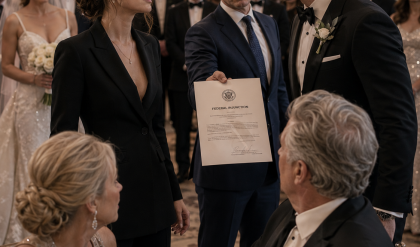
Evelyn placed a printed record on the table.
“Second, a logistics analysis included in last month’s senior leadership summary without attribution was authored by Ryan Carter three weeks before that summary was created. Again, the record is timestamped.”
Trevor shifted in his chair.
Evelyn did not look angry.
That made it worse.
“The pattern here is not ambiguous,” she continued. “It is documented, traceable, and unacceptable. When work is rerouted away from the person who produced it, the company doesn’t only mistreat an employee. It damages its ability to identify competence. That is a business failure, not a personality conflict.”
Marcus opened his mouth. “Evelyn, I think there may be some context—”
“I’m sure there is,” she said. “You can provide it to HR.”
The room froze.
Evelyn turned one page.
“I’ll also be reviewing how repeated warnings regarding Western Distribution staffing were acknowledged and then buried without action. Mr. Carter escalated that issue twice. The failure was not his.”
Ryan did not move.
He could not.
For two years, he had trained himself not to expect rescue. For six years, he had trained himself to let the work speak even when nobody listened. Now someone had pulled the record into the light and read it aloud in a room full of people who had mistaken his silence for weakness.
He did not feel triumphant.
He felt unsteady.
Like a man who had been carrying a heavy box for miles and only realized its weight when someone finally took it from him.
Evelyn closed the folder.
“This meeting will continue,” she said. “But the follow-up on these matters will be formal.”
No one spoke for several seconds.
Afterward, people left the conference room too quietly. Dale stopped Ryan near the hallway.
“I should’ve said something sooner,” Dale admitted.
Ryan looked at him.
Dale’s face was red with shame.
“Yes,” Ryan said. Not cruelly. Just truthfully.
Then he walked back to his desk.
At 12:18, an email from Evelyn’s office appeared.
Your resignation has been received. Before it is processed, I’d like to meet at your earliest availability. This is not a request for you to justify your decision. I’d simply like to speak with you before it becomes final.
Ryan stared at it.
He almost ignored it.
Then he thought of Emma asking why grown-ups never just said what they meant.
He replied: 3:00 works.
At exactly 3:00, he stood in Evelyn Brooks’s office.
The view behind her desk showed the city stretching toward the water. Her office was elegant without being warm. Glass, pale wood, books arranged by use rather than decoration. On one corner of the desk sat a framed photograph of Chloe at about twelve years old, missing a front tooth, laughing at someone outside the frame.
Evelyn gestured to the chair.
Ryan sat.
She did not waste time.
“I read your resignation,” she said. “I understand why you wrote it. I’m not going to ask you to withdraw it. That decision belongs to you.”
Ryan nodded. “I appreciate that.”
“I’m not finished.”
He almost smiled. “I noticed.”
Something like amusement touched her face and disappeared.
“My attention to your work was professional and justified,” she said. “But I’m aware that my attention created consequences for you that you did not invite. That is my responsibility.”
“I don’t blame you.”
“I know,” Evelyn said. “That’s part of the problem.”
Ryan looked at her.
She leaned back slightly. “You don’t complain. You don’t leverage hardship. You don’t perform injury in order to be rewarded for surviving it. Those are admirable traits. They are also traits companies exploit when no one interrupts the pattern.”
The words landed harder than Ryan expected.
He looked away first.
“I have a daughter,” he said after a moment. “I can’t gamble with stability.”
“I know.”
His eyes returned to hers.
Evelyn’s voice softened, though only slightly. “Chloe told me. Not details. Enough.”
Ryan’s jaw tightened.
“She shouldn’t have.”
“No,” Evelyn agreed. “Probably not. But I’m glad I know. Not because your personal life entitles you to special treatment. Because your performance entitles you to appropriate treatment, and your compensation does not reflect what the company has been asking from you.”
Ryan said nothing.
“The project lead role is being restructured,” Evelyn continued. “Realistic hours. Defined authority. Support staff. Compensation that matches responsibility.”
“That sounds like a correction made after a scandal.”
“It’s a correction made after review.”
“And the fact that I resigned?”
“Accelerated the conversation,” she admitted. “It did not create the need.”
Ryan stared at the city beyond the glass.
For two years, every choice had been math.
If he dropped the courier route, Frank’s payment slipped.
If he stopped rideshare, Emma’s after-school care became impossible.
If he accepted a promotion with longer hours, he lost the fragile system keeping his home alive.
If he stayed small, he survived.
That was the trap.
Not failure.
Survival.
Evelyn let the silence sit.
Then she said, “The new salary would allow you to stop the outside work.”
Ryan closed his eyes briefly.
The sentence was simple.
It should not have felt like a hand reaching into deep water.
“What would you want from me?” he asked.
“Good work. Honest reports. The same judgment you’ve already been giving this company at a discount.”
“And the rumors?”
“I can’t erase what people said,” Evelyn replied. “But I can make the truth documented, visible, and more useful than the lie.”
He looked at her for a long moment.
Then he said, “You didn’t have to do what you did in that meeting.”
“Yes,” Evelyn said. “I did.”
That was the first answer that made him believe her.
Ryan did not accept immediately.
He went home.
Emma was at the kitchen table coloring a science worksheet when he came in. Mrs. Alvarez was watching a soap opera too loudly in the living room. The apartment smelled like tomato soup.
Emma looked up. “Daddy, why do you look weird?”
Ryan dropped his keys into the bowl. “I might have had a big day.”
“Good big or bad big?”
He thought about it.
“I don’t know yet.”
She considered this with the seriousness of a judge. “Can we have pancakes for dinner while you figure it out?”
So they did.
Later, after Emma fell asleep, Ryan sat at the kitchen table and opened the budget spreadsheet he hated more than any document in his life. He entered the salary number Evelyn’s office had sent. He removed the courier route. Then the rideshare estimate. Then the weekend inventory shifts.
For the first time in two years, the numbers still worked.
Not extravagantly.
Not magically.
But they worked.
Ryan put his hand over his mouth.
He sat like that for a long time.
The next morning, he withdrew his resignation.
The weeks that followed were not easy, but they were honest.
Marcus Hale and Trevor Sands entered formal HR proceedings. The company did not announce details, but everyone saw the reorganization. Marcus lost oversight authority. Trevor was moved off strategic planning pending review. People who had been quiet around Ryan began acting normal again, though normal carried its own apology.
Ryan did not make them grovel.
He had no energy for revenge.
He took the project lead role.
He built the Western Distribution repair plan in three phases. He hired two additional coordinators. He created a driver escalation system that reduced stranded delays by nearly twenty percent in the first quarter. He left the office at 5:20 most days and did not apologize for it.
The first evening he did not turn on the rideshare app, he sat in his parked car outside Emma’s school for eleven minutes, unsure what to do with time that belonged to no creditor.
When Emma climbed in, she looked suspicious.
“Why are you here so early?”
Ryan smiled. “Thought I’d try something new.”
“Are we rich?”
“Not even close.”
“Can we get ice cream?”
“We can get one scoop.”
She narrowed her eyes. “Each?”
“Yes, each.”
She threw both hands in the air like he had announced a trip to Paris.
Frank Carter cried when Ryan told him he was quitting the overnight courier route.
Not loudly.
Just one hand over his eyes in the recliner, the other gripping the armrest.
“I never wanted you carrying all this,” Frank said.
Ryan sat across from him. “I know.”
“I was supposed to be helping you.”
“You raised me,” Ryan said. “That counts.”
Frank shook his head, but he was smiling through tears. “Your mother would’ve liked that answer.”
Ryan looked down.
His mother had been gone nine years. Some absences became quieter, but they never became small.
Chloe changed too.
She apologized to Ryan once more, properly, soberly, without making herself the center of the apology. Then she started therapy. She stopped treating pain like something that had to become spectacle before anyone believed it existed. She and Evelyn began having dinner every Sunday night, even when they argued through half of it.
One Sunday, Chloe said, “Ryan saved me and you saved him.”
Evelyn corrected her. “Ryan saved himself. I corrected a company failure.”
Chloe rolled her eyes. “You’re allergic to sounding human.”
“I’ve been diagnosed.”
But she smiled when she said it.
Months later, Ryan was leaving late after a project launch when he passed Evelyn’s office and saw her still at her desk, cold coffee beside her, jacket folded over the chair, the city dark behind her.
He knocked on the open door.
“You eaten?” he asked.
She looked up. “That depends whether almonds from a desk drawer count.”
“They don’t.”
“I suspected.”
“There’s a diner two blocks over. It’s not fancy, but the grilled chicken sandwich won’t betray you.”
Evelyn studied him with the same evaluating look she had given him on her doorstep months earlier.
Then she stood and reached for her coat.
They walked to the diner under streetlights, two people who had met at the worst edge of a morning and somehow found their way into a different kind of understanding.
They did not talk about rumors.
They did not talk about rescue.
They talked about Emma’s science fair volcano, Chloe’s therapy dog idea, Frank’s stubborn refusal to use the good cane, and why Harborline’s Phoenix warehouse still had the worst coffee in America.
At one point, Evelyn looked across the table and said, “You know, that morning, when you brought Chloe home, I thought you wanted nothing from us.”
Ryan took a sip of water. “I didn’t.”
“I know that now.”
He smiled faintly. “You didn’t know it then?”
“No,” she said. “But I hoped it.”
Outside, cars moved along the wet street, headlights stretching over the pavement.
Ryan thought about the life he had been living before that morning. The alarms before dawn. The debt math. The fear that one wrong move could collapse the whole fragile structure. He thought about Chloe barefoot outside a bar, Evelyn in the doorway, Marcus smirking in a conference room, Emma asking if they were rich because her father had arrived early for once.
He had not fixed everything.
Life did not work that way.
His father still had appointments. Emma still needed braces someday. The company still had politics. Trust still took time. Some wounds closed slowly because they had been open too long.
But Ryan no longer felt like he was running behind a train he could never catch.
He was inside his own life again.
That was enough.
On the drive home, he did not turn on the rideshare app.
He did not calculate fares.
He did not wonder how many hours of sleep he could trade for survival.
He stopped at a red light near the coast and rolled down the window. The air smelled faintly of salt, just as Chloe had said that morning when she could not remember anything else.
Ryan looked toward the dark line of the ocean and laughed softly to himself.
One ordinary decision.
One stranger helped home before sunrise.
One door opening.
Sometimes life did not change because someone made a grand heroic choice.
Sometimes it changed because, at the exact moment when walking away would have been easier, a tired man still chose to be decent.
THE END