The Woman Who Knitted the Night
My mother crochets circles.
Not blankets.
Not scarves.
Not sweaters with sleeves or patterns or names stitched into the collar.
Circles.
Perfect navy-blue circles, each one exactly five inches wide, made with the same yarn, the same hook, and the same silent concentration she’s carried for eleven years.
She started the first one the night I left for Afghanistan.
The military bus disappeared past the gates at Fort Campbell, and she stood in the parking lot long after every other family had gone home. The Tennessee wind pushed her gray hair across her face while she stared at the empty road like she could still stop me if she watched hard enough.
She drove home alone.
That was the part she told me hurt most.
Not the goodbye.
Not the uniform.
Not the fear.
The drive home.
Because every mile away from the base felt like a mile farther from her son, and when she unlocked the front door, the silence inside the house sounded wrong. Like the walls themselves noticed I was missing.
She sat in the kitchen under the yellow light above the stove.
And she picked up a crochet hook.
Not because she planned to start something.
Because her hands needed somewhere to put the fear.
The first circle took thirty minutes.
Navy blue yarn looped into itself over and over again, forming something small and neat and controlled while her thoughts spun in directions she couldn’t control at all.
When she finished, she placed it beside her coffee cup.
Then she started another.
And another.
And another.
The circles became a system before she realized she had created one.
Every fear became yarn.
If she worried about roadside bombs, she made a circle.
If she worried I wasn’t eating enough, she made another.
If the news mentioned casualties overseas, the hook moved faster.
Some nights she stayed awake until sunrise crocheting fear into shape.
Loop after loop after loop.
By the end of my first deployment, she had made almost seven hundred circles.
She stacked them in plastic bins in the hallway closet.
When I came home, I thought the crocheting would stop.
It didn’t.
The fears just changed uniforms.
Instead of worrying about explosions, she worried about silence.
Instead of worrying about enemy fire, she worried about nightmares.
Instead of wondering if I’d survive overseas, she wondered if I’d survive being home.
Because war followed me back.
It lived in stupid things.
Car doors slamming.
Fireworks.
Crowded grocery stores.
Helicopters overhead.
I slept with the lights on for nearly a year.
My mother noticed everything.
The way I sat facing exits in restaurants.
The way I scanned parking lots before getting out of the truck.
The way my jaw tightened every Fourth of July.
Every observation became another circle.
One for the nightmares.
One for the panic attacks.
One for the nights I drove aimlessly because being still felt dangerous.
By the time I turned thirty-eight, she had over four thousand circles.
Four thousand pieces of navy-blue worry stored in bins around her house.
My sister once opened the guest-room closet and just stared.
Plastic containers from floor to ceiling.
Fear with lids on it.
“Mom,” she said carefully, “what are you planning to do with all these?”
My mother didn’t even look up from her crochet hook.
“Keep making them.”
“You already have thousands.”
“I know.”
“At some point you have to stop.”
That finally made her pause.
She lifted her eyes slowly, like my sister had misunderstood something fundamental about motherhood.
“I stop,” she said quietly, “when I stop being his mother.”
And then the hook started moving again.
Loop. Pull. Twist. Repeat.
The rhythm of a woman trying to protect her child from a distance too large for human hands.
Last winter, my daughter Emma found the circles.
She was eight years old and curious about everything.
I heard her upstairs opening closet doors while my mother baked cornbread downstairs, humming softly to herself.
Then Emma yelled:
“Dad! Grandma has blue pancakes in the closet!”
I went upstairs and found her sitting cross-legged on the floor surrounded by stacks of navy-blue circles.
Hundreds of them.
Maybe thousands.
My mother appeared in the doorway behind us, still holding the wooden spoon from the kitchen.
For a second, nobody spoke.
Emma picked one up.
“They’re pretty,” she said. “What are they for?”
My mother opened her mouth, then closed it again.
How do you explain eleven years of fear to a child?
How do you explain that every stitch is a prayer nobody heard?
I answered for her.
“They help Grandma worry.”
Emma frowned.
“That doesn’t make sense.”
“It doesn’t have to.”
My daughter studied one of the circles carefully.
Then she asked the question none of us expected.
“If they help her worry,” she said, “why don’t we help her stop?”
Silence.
My mother looked down at the spoon in her hand.
I looked at the bins.
And suddenly I realized something that should have been obvious years ago.
Those circles were never supposed to stay unfinished.
They were waiting for something.
The next morning, I drove to the craft store and bought backing fabric, thread, batting, and enough supplies to fill the truck bed.
My mother looked genuinely alarmed when I carried everything into her living room.
“What is all this?”
“We’re making a quilt.”
“A quilt?”
“With your circles.”
She shook her head immediately.
“No no no, they aren’t for that.”
“Then what are they for?”
She didn’t answer.
Because she didn’t know.
The circles had become the point.
The making had replaced the meaning.
So we started anyway.
My wife stitched circles into rows while Emma handed out pieces like playing cards. My mother resisted for exactly twenty minutes before instinct took over and she started helping.
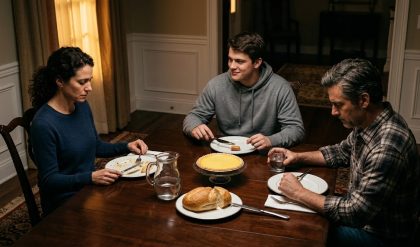
Three generations around one table.
Hands moving together.
Every circle carried a memory.
“This one was from the week you stopped answering your phone overseas.”
“This one was after your first panic attack.”
“This one was when Emma had pneumonia.”
“This one,” she whispered once, holding a faded circle carefully, “was from the night you told me you didn’t think you’d make it through the winter.”
I remembered that phone call.
I remembered sitting alone in my apartment with a bottle of whiskey on the counter and darkness in every corner of the room.
I remembered my mother talking to me until sunrise.
And afterward, apparently, she made three circles.
We worked on the quilt for six days.
By the end, it covered almost the entire dining room floor.
A massive field of navy blue stitched together from eleven years of love disguised as fear.
My mother stood over it speechless.
Her fingers touched the fabric carefully, almost reverently.
Then she started crying.
Not loud crying.
The exhausted kind.
The kind that comes from carrying something heavy for too long.
“I thought,” she whispered, “I thought if I stopped making them, something bad would happen.”
I walked over and wrapped my arms around her.
“Nothing bad happens, Mom.”
Her voice cracked against my shoulder.
“How do you know?”
I looked at the quilt.
At thousands of circles made one by one by a woman who refused to stop loving her son even when love terrified her.
Then I looked at my daughter sitting cross-legged in the middle of it, smiling.
“Because I’m still here.”
That night, before I left, my mother handed me one final circle.
Freshly made. Still warm from her hands.
“For your pocket,” she said.
I smiled. “You’re still worrying?”
She gave me the same look she’s given me my entire life.
“Always.”
I carried the circle home anyway.
And for the first time in eleven years, my mother didn’t crochet another one before bed.