The Note Hidden in My Coat Pocket
The Appointment
The first time my daughter complained about her tooth, I barely looked up from the dishes.
“Mom, it hurts when I chew,” Emma said, pressing a tiny hand against the side of her mouth.
She was ten. Dramatic about vegetables. Dramatic about math homework. Dramatic about anything that interrupted cartoons or sleepovers. I assumed this was just another small childhood problem.
But three days later, she said it again.
That’s when I called the dentist.
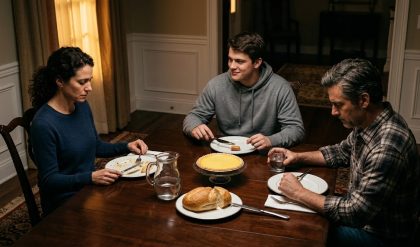
The moment I mentioned the appointment to my husband, Mark, something changed in his face.
“I’m coming with you,” he said immediately.
I blinked. “You hate dentists.”
“I know. I still want to come.”
It should have sounded caring.
Instead, it sounded rehearsed.
Mark had been in our lives for two years. He wasn’t Emma’s biological father — my first husband, Daniel, had died in a car accident when Emma was six. Losing him shattered both of us, and for a long time I believed nobody could ever step into our broken little world again.
Then Mark appeared.
Reliable. Calm. Charming.
The kind of man who fixed leaking sinks without being asked. The kind of man who remembered birthdays and brought flowers to school recitals. Everyone loved him.
Especially at first.
But over the last year, tiny things had started bothering me.
Emma stopped sitting beside him on the couch.
She flinched when he entered rooms unexpectedly.
Sometimes she locked her bedroom door at night.
Whenever I asked her why, she always shrugged.
“I don’t know. I just like privacy.”
And every single time, I convinced myself not to overthink it.
Because mothers who imagine terrible things destroy families.
At least that’s what I told myself.
Saturday morning arrived gray and rainy. The dental office smelled like mint gum and disinfectant. Emma sat beside me in the waiting room flipping through a puzzle magazine while Mark paced near the aquarium, checking his phone every few seconds.
When the dental assistant called Emma’s name, she immediately reached for my hand.
Mark noticed.
His jaw tightened.
Inside the exam room, Dr. Miller greeted us warmly.
“Well, Miss Emma, let’s see what’s bothering that tooth.”
Emma climbed into the chair slowly.
Dr. Miller had treated her since kindergarten. Usually she joked with him. Usually she smiled.
Today she barely spoke.
Mark stood near the counter with his arms crossed, watching every movement Dr. Miller made.
Too closely.
Dr. Miller examined Emma quietly, then paused.
His eyes flicked toward Mark.
Then back to Emma.
Then back to Mark again.
Something invisible passed across his face.
Concern.
Real concern.
“You mentioned pain in the back molar?” he asked gently.
Emma nodded.
Dr. Miller adjusted the overhead light and leaned closer.
Then his expression changed completely.
Not confusion.
Recognition.
His eyes sharpened.
He stepped back slowly.
“Mr. Thompson,” he said carefully, “could you hand me the smaller mirror from the tray?”
Mark hesitated for half a second too long.
Then he grabbed the instrument.
But when Dr. Miller took it from him, their eyes locked.
And suddenly the room felt freezing cold.
The rest of the appointment moved strangely fast.
Dr. Miller said Emma would need X-rays and possibly minor dental work later that month. His voice remained calm, but I noticed his hands weren’t steady anymore.
Before we left, he squeezed Emma’s shoulder gently.
“You’re very brave,” he told her softly.
Then he looked directly at me.
“Mrs. Thompson, make sure you check your coat pocket when you get home.”
I frowned slightly.
But before I could ask what he meant, Mark interrupted.
“Thanks, doctor. We appreciate it.”
His voice sounded tight.
On the drive home, Emma stayed silent in the back seat.
Mark kept glancing at her through the mirror.
Twice I caught him doing it.
Twice he looked away too quickly.
By the time we got home, my stomach hurt so badly I could barely breathe.
I hung my coat near the kitchen door.
Then I remembered Dr. Miller’s words.
Check your pocket.
At first I found nothing.
Then my fingers touched folded paper hidden deep inside the lining.
A note.
Tiny.
Rushed handwriting.
I unfolded it slowly.
And the moment I read the first sentence, every drop of blood drained from my body.
Do NOT confront your husband.
Take your daughter and go directly to the police.
Emma is showing clear signs of abuse.
She told me she’s terrified of being alone with him.
My hands started shaking so violently the paper slipped onto the floor.
“No…” I whispered.
From the living room, I heard Mark laughing softly at something on television.
Normal.
Relaxed.
Like nothing was wrong.
Then Emma appeared silently in the hallway.
She looked at me.
Then at the note in my trembling hands.
And in a voice so small it barely sounded human, she whispered:
“I didn’t know how to tell you.”
I don’t remember grabbing my car keys.
I don’t remember making excuses to leave the house.
But somehow, ten minutes later, Emma and I were driving through pouring rain while my entire body shook against the steering wheel.
Mark stood in the doorway when we left.
“You okay?” he called.
I forced myself to smile.
“Just running to the pharmacy.”
For one horrifying second, I thought he knew.
Then he waved casually and stepped back inside.
The moment we turned the corner, Emma burst into tears.
Not loud tears.
Silent ones.
The kind children cry when they’ve been scared for too long.
“I’m sorry,” she whispered over and over again.
I pulled into an empty grocery store parking lot and turned around to face her.
“You never apologize to me for this,” I said, my voice breaking. “Never.”
She covered her face.
And then everything came out.
The nightmares.
The fear.
The reason she locked every door.
The reason she avoided being alone in rooms with him.
The reason she stopped smiling at home.
She told me how Mark always acted kind when I was around.
How he waited until I worked late shifts.
How he whispered threats afterward.
“No one will believe you.”
“You’ll ruin your mother’s life.”
“She’ll hate you.”
Every sentence felt like someone driving glass into my chest.
I wanted to scream.
Wanted to throw up.
Wanted to go back in time and protect her the way I should have from the beginning.
Instead, I drove straight to the police station.
The officers listened carefully. A female detective sat beside Emma for nearly an hour while another officer took my statement. Dr. Miller had already contacted authorities himself before we even left the clinic.
He had recognized behavioral signs immediately.
Fearful body language.
Extreme anxiety around a specific adult.
Physical indicators during examination.
The detective later told me something that still haunts me.
“Children usually try to protect the adults they love,” she said quietly. “Even when they’re suffering.”
That night, police escorted us back to the house.
Mark looked annoyed when he opened the door.
Then he saw the officers behind me.
Everything in his face collapsed instantly.
“What is this?” he asked sharply.
Emma grabbed my hand so tightly it hurt.
The detective stepped forward.
“Mark Thompson, we need you to come with us.”
He looked at me desperately.
Then angrily.
Then coldly.
And in that exact moment, I finally saw the man I had invited into our lives.
Not charming.
Not caring.
Not safe.
Just dangerous.
The investigation lasted months.
There were interviews, evidence collection, therapy appointments, court hearings, sleepless nights, panic attacks, and more guilt than I knew a human being could survive.
But Emma survived.
That became the only thing that mattered.
Dr. Miller testified during the case. So did the child psychologist assigned to Emma afterward. Piece by piece, the truth came out.
And eventually, Mark was convicted.
The day sentencing ended, Emma squeezed my hand outside the courthouse and asked quietly:
“Do you still think I’m brave?”
I dropped to my knees and held her as tightly as I could.
“No,” I whispered through tears.
“I think you saved both of us.”