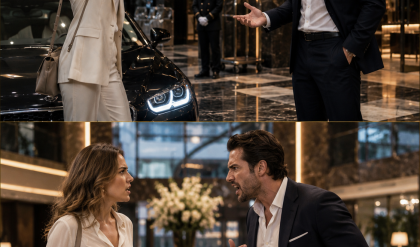
“I heard your people discussing brake lines and Albanians.” I set my untouched champagne on a side table. “So let’s stop pretending. Who killed my sister?”
Gabriel turned. “Victor Kastrioti. Albanian organization. He has been trying to move into Chicago for two years.”
“And Natalie was killed because she loved you.”
His jaw flexed. “Because I loved her.”
“That sounds like a convenient distinction.”
“It is the truth.”
“No,” I said, stepping closer. “The truth is that Natalie walked into your world and your world swallowed her.”
A flash of pain crossed his face, but he did not deny it. “She knew the risks.”
“That sounds like something guilty men say when the woman is too dead to argue.”
Franco shifted slightly at the door, but Gabriel lifted a hand. His eyes stayed locked on mine.
“You are nothing like her,” he said.
“Finally, something useful.”
“Natalie burned through rooms. You measure them. You stand near exits. You listen before speaking. You insult a man with enough power to make people disappear and calculate how he reacts before deciding whether to step closer.” His gaze narrowed. “Who taught you that?”
“Our parents.”
“What were they?”
“Careful.”
The corner of his mouth moved, almost a smile. “That is not an answer.”
“It’s the only one you get today.”
For a moment, we measured each other in silence. Then Gabriel crossed to a cabinet, opened a drawer, and removed a small leather journal. He held it out to me.
“I found this hidden among Natalie’s things at the gallery. I did not give it to the police.”
“Because you own them?”
“Because I did not know who I could trust.”
I took the journal, and Natalie’s handwriting hit me like a voice from another room. Looped letters, hurried notes, little stars beside important dates. I opened to the first marked page and read quickly.
Men following her. License plates. A restaurant downtown. A name repeated three times: Sylvio.
“Who is Sylvio?” I asked.
Gabriel’s expression hardened. “Sylvio Moretti. My adviser. He has been with my family fifteen years.”
I turned the journal toward him. “Natalie saw him meet an Albanian man three weeks before she died. They exchanged an envelope. She followed him because she thought he was hiding something from you.”
The air in the room changed.
Gabriel took the journal from me and read the entry twice. His face became frighteningly still.
“If Sylvio gave them information,” he said, “then he did not just betray me. He signed her death warrant.”
“You need proof.”
“I need five minutes alone with him.”
“That’s not proof.”
“In my world, it is often enough.”
“Then your world is exactly as rotten as I thought.”
His eyes flashed. “And yet you came here.”
“For Natalie.”
“So did I.”
The words struck harder because they were true. Beneath everything—his power, his criminal name, the danger that clung to him—was a man who had loved my sister and failed to save her. I hated him for that. I understood him for it, too.
Franco’s phone buzzed. He checked it, and his posture sharpened.
“Boss,” he said. “We have a problem.”
Gabriel did not look away from me. “What kind?”
“The kind that followed Miss Cooper here.”
Franco showed us security footage from outside my hotel. A black sedan sat across the street, two men inside, faces obscured. The timestamp showed they had arrived ten minutes after I checked in that morning.
I studied the image. “They followed me from the airport.”
“Or watched the funeral and realized Natalie had a twin,” Gabriel said. “Either way, you are not going back there.”
“I can take care of myself.”
“With what? Sharp observations and a purse?”
“And a healthy suspicion of men who confuse protection with control.”
He stepped closer, anger cutting through the grief. “Listen carefully, Lauren. You walked into a war wearing the face of a woman Victor Kastrioti wanted dead. Maybe those men think you know something. Maybe they want to use you against me. Maybe they simply want to correct a loose end. But if you return to that hotel alone, I will be identifying your body before sunrise.”
The brutal honesty should have frightened me.
Instead, it clarified the situation.
“I help investigate,” I said. “I’m not a prisoner, and I’m not helpless. You want my cooperation, I get access to what Natalie found.”
Gabriel stared at me. “You negotiate like a woman who expected to be threatened.”
“I was raised by people who knew threats were just conversations with weapons.”
Franco coughed softly, hiding amusement.
For the first time since I had met him, Gabriel smiled. It was small, sharp, and dangerous.
“Natalie would have cried, pleaded, or kissed me into agreement,” he said. “You hold a blade to my throat and ask whether I bleed easily.”
“Is that a yes?”
“It is a ‘we discuss terms at a secure location.’”
The secure location was a lakefront estate north of the city, hidden behind iron gates, cameras, and men who looked at me as if ghosts made them nervous. The house rose from the dark like money had learned architecture: stone, glass, warm windows, private dock, trees bending in the lake wind.
Inside, Natalie was everywhere.
Photographs lined the mantel and side tables. Natalie laughing with a camera around her neck. Natalie in a red dress, looking over her shoulder. Natalie barefoot on the dock at sunrise. Natalie beside Gabriel, her face bright, his gaze fixed on her with the stunned seriousness of a man who had not expected joy and did not know how to hold it safely.
I stopped before one photo of the two of them at a gallery opening. Gabriel looked severe in a black suit. Natalie, in emerald silk, had one hand pressed to his chest as if physically keeping him from leaving the frame.
“She changed him,” Franco said quietly.
“Did she?”
“She made him want a future that was not just territory and revenge.”
“And then his enemies killed her.”
Franco did not flinch. “Yes.”
He led me upstairs to a guest room larger than my entire Seattle apartment. Cream walls, silver accents, balcony overlooking the lake. The closet held women’s clothes in jewel tones. Natalie’s clothes.
I touched the sleeve of an emerald blouse and felt something inside me loosen.
“She kept a room here,” Franco said. “Mr. Donatelli thought you might prefer privacy. This room has the best security.”
“Also the most ghosts.”
“Unfortunately, those are harder to keep out.”
When he left, I did what I always did in unfamiliar rooms. I checked the exits, locks, windows, balcony drop, blind spots, cameras. Third floor. Too high to jump safely, possible to climb if necessary. Door reinforced but could be blocked from inside with the writing desk. Window locks modern, not alarmed.
Our parents had taught Natalie and me games other children did not play. Find three exits. Identify the heaviest object in the room. Listen for footsteps. Notice who lies with their mouth and who lies with their hands. They had called it preparation. Natalie had called it a cage. I had called it useful.
A car arrived below. Gabriel stepped out, followed by two men. He looked up directly at my window as if he had known I would be watching. Our eyes met across the cold distance.
Minutes later, he knocked.
“You settled?” he asked after entering.
“As much as one can after being relocated by armed men.”
“Protected.”
“Kidnappers often prefer generous vocabulary.”
His mouth moved, but the smile faded quickly. He crossed to the dresser and placed Natalie’s journal on top. “I had my people pull more footage from the week before her death. She was right about Sylvio. He met with Albanian contacts at least twice.”
“Then bring him in.”
“He has disappeared.”
The words landed like a verdict.
Gabriel loosened his tie, exhaustion showing beneath the control. “His phone went dark an hour after your arrival at the funeral. His apartment is empty. Accounts partially drained.”
“So he knew I existed?”
“Or someone told him you were asking questions.”
I opened the journal again and turned pages until I found something I had missed before: a series of numbers written along the margin, not quite dates, not quite phone numbers.
“This is not random,” I said.
Gabriel came to stand beside me. “What is it?”
“A cipher Natalie and I used as kids.” My throat tightened. “We made it up after our mother got sick. It was stupid. A way to pass notes when adults were fighting.”
“Can you read it?”
“I think so.”
I pulled a pen from the desk and worked through the numbers. The message emerged slowly, each word a small resurrection.
Lo, if you ever read this, I’m sorry. Sylvio isn’t the only one. The man who ordered it sits higher. Gabriel can’t see the traitor because grief makes him loyal. Trust the scarred man, not the polished one. Don’t let them bury me as an accident.
For a long moment, neither of us spoke.
“Scarred man?” Gabriel asked.
“Franco has a scar through his eyebrow,” I said. “Sylvio was polished.”
Gabriel’s face tightened at the implication that Natalie had trusted Franco more than his own adviser. “She knew she was in danger.”
“She knew enough to leave me a message in a code from when we were eight.” My voice shook despite my best effort. “She thought I might come.”
“She wanted you to.”
The guilt came so fast I had to grip the edge of the dresser. Natalie had left breadcrumbs for a sister who had refused her calls. She had been scared, investigating betrayal, and still she had believed I might show up when it mattered.
I hadn’t.
Glass shattered downstairs.
Gabriel had a gun in his hand before the sound finished echoing.
“Stay behind me,” he said.
The door burst open and Franco appeared, blood running from a cut at his temple. “Perimeter breach. Three vehicles. Albanians.”
Gunfire cracked through the house.
Whatever grief had made hazy became brutally clear. Gabriel grabbed my hand and pulled me into the hall. Smoke curled from below. Alarms shrieked. Men shouted in Italian and English. Franco led us down a back staircase I had not noticed earlier, moving with surprising speed for his age.
“Panic room,” he said. “Basement.”
“I thought this house was secure,” I said as we ran.
“It was,” Franco snapped. “Which means somebody gave them the layout.”
Sylvio.
The panic room hid behind a false wall in the wine cellar. Inside were surveillance monitors, weapons, emergency supplies, reinforced steel. A fortress inside a fortress. Gabriel went straight to the monitors while Franco sealed the door.
The screens showed chaos outside: black-clad men at the gates, Gabriel’s security returning fire, headlights cutting through smoke. The attackers knew where the guards had been posted. They knew which camera angles were weak. They knew the service entrance from the lower drive.
“They had inside information,” I said.
Gabriel’s voice went flat. “Sylvio gave them everything.”
“Maybe not everything.” I pointed to one feed. “They’re avoiding the west terrace like it’s covered, but it isn’t. Why?”
Franco leaned over the monitor. “Because it used to be. We moved that guard post last month.”
“So their information is old. Use that.”
Gabriel looked at me for half a second, then started issuing orders into his radio. His men adjusted, funneling the attackers toward a blind corner they believed was dangerous and was, in fact, waiting to become a trap. Within ten minutes, the assault collapsed. Some attackers fled. Others did not get the chance.
When the all-clear came, the house looked as if a storm had moved through carrying bullets instead of rain. Glass glittered across marble. Blood stained the foyer. Men worked with practiced efficiency to tend the wounded, erase evidence, and convert a small war into “an attempted robbery” before police arrived.
Gabriel stood in the wreckage, jaw clenched, fury barely contained.
“You should have sent me back to Seattle,” I said.
He looked at me then, and the grief in his eyes was different. Not Natalie’s grief. Mine, somehow. Fear for a person still breathing.
“Yes,” he said quietly. “I should have.”
“But you won’t.”
“No.”
“Because I’m useful?”
“Because when the gunfire started, the first thing I thought was not about Sylvio, or Victor, or revenge.” His gaze held mine. “It was that I could not watch your face disappear from this world a second time.”
The honesty made the room feel too small.
“I’m not Natalie.”
“I know.”
“Do you?”
He stepped closer but did not touch me. “Natalie was light. She made me believe there might be a door out of the dark. You are not that door, Lauren. You are the woman standing beside me in the dark, pointing out where the enemies are hiding.”
I should have moved away.
Instead, I kissed him.
It was not gentle at first. It was grief, adrenaline, anger, the terrible need to feel alive after nearly dying. Then it changed. His hand slid into my hair, careful despite the hunger in him, and the kiss became slower, deeper, more dangerous because it was no longer only about survival.
When we broke apart, my hands were still fisted in his shirt.
“That was a mistake,” I whispered.
“Probably.”
“I’m her sister.”
“I know.”
“You loved her.”
“I still do.” He did not look away. “Love does not vanish because a coffin closes. But what I feel when I look at you is not confusion, Lauren. It frightens me because it is clear.”
I stepped back. “We barely know each other.”
“I know you walked into a cathedral full of killers because your sister deserved goodbye. I know you heard the truth where everyone else heard whispers. I know you are brave enough to call me rotten in my own house.” His mouth tightened. “And I know I should stay away from you.”
“Then do it.”
“I am not famous for doing what I should.”
By afternoon, Sylvio asked for a meeting.
He sent word through a mistress Gabriel’s people had found in a hotel outside Evanston. He claimed he could give us Victor Kastrioti: location, schedule, security weaknesses, the entire structure of the Albanian operation in Chicago. The price was freedom.
Gabriel wanted to refuse.
I could see it in the way he stood by the window of his office, hands braced on the sill, the lake gray behind him. He wanted Sylvio bleeding on the floor, begging forgiveness Natalie could not give.
“You kill him now, Victor disappears,” I said.
“He deserves to die.”
“Yes.”
Gabriel turned. “That agreement sounded too easy.”
“I’m not arguing mercy. I’m arguing order. First the man who gave the command. Then the man who sold the door key.”
His eyes darkened with something like approval. “You think like a strategist.”
“I think like a sister.”
That night, we met Sylvio in an abandoned warehouse near the river. Gabriel brought twelve men. Sylvio brought four and the terrified confidence of a traitor who believed he still had leverage.
He stood under a hanging work light, silver hair perfect, suit immaculate, hands trembling.
“Gabriel,” he said. “Thank you for coming.”
“Do not thank me for delaying your death.”
Sylvio swallowed. “I never wanted Natalie dead.”
The sound Gabriel made was almost a laugh. It contained no humor.
“She was leverage,” Sylvio rushed on. “Victor said he only wanted leverage. I gave him schedules, routes, nothing more. I swear to God, I didn’t know he’d cut her brakes.”
My hand tightened around the gun hidden beneath my coat. I imagined Natalie driving along the lake, music on, maybe thinking of calling me again. I imagined the brake pedal sinking uselessly beneath her foot.
Gabriel took one step forward. “Say her name.”
Sylvio blinked. “What?”
“Not ‘she.’ Not ‘leverage.’ Say her name.”
“Natalie,” Sylvio whispered.
Gabriel’s voice dropped. “Again.”
“Natalie.”
“And what did you do to Natalie?”
Sylvio’s face crumpled. “I betrayed her.”
The warehouse seemed to hold its breath.
Then Sylvio’s fear hardened into calculation. “I have a dead man’s switch. If I do not check in every fifteen minutes, everything I know about your operation goes to federal authorities. Accounts, contacts, shipments from years ago, names of judges and aldermen. Take Victor and let me walk, or we all burn.”
Gabriel went still in the way predators go still.
I stepped forward before he could speak. “Show proof.”
Sylvio looked at me, really looked, and something like shame flickered through his eyes. “Natalie said you were the smart one.”
“She said that to you?”
“She said it once. When she was drunk and angry at Gabriel for trying to protect her. She said, ‘My sister would have figured this whole room out in ten minutes.’” His smile was bitter. “She was probably right.”
“Proof,” I repeated.
He handed over a phone. It held photographs of Victor entering a penthouse building downtown, schedules, guard rotations, banking records, private elevator access codes. Enough to end a war if it was real. Enough to kill us if it was bait.
Gabriel looked at me. The question in his eyes was not whether Sylvio deserved death. We both knew he did. The question was whether justice could wait long enough to become complete.
“Take the deal,” I said.
Gabriel’s jaw clenched. “He walks?”
“He crawls. Watched. Hunted if he lies. But alive long enough to give us Victor.”
Sylvio exhaled like a man reprieved by a judge he had underestimated.
Gabriel leaned close to him. “You will leave this building breathing because she allowed it. Not because I forgave you. If one detail is false, if Victor slips away because you held something back, I will find you. I will find everyone you paid to hide you. You will spend your final hour wishing Victor had killed you first.”
Sylvio nodded, pale and sweating.
The next night, Victor ran exactly where Sylvio said he would.
His penthouse occupied the top three floors of a luxury building downtown, all tinted glass and private elevators. Gabriel’s team moved with quiet precision: security disabled, guards neutralized, stairwells controlled. I was supposed to remain in the command vehicle with Franco, watching feeds and coordinating extraction.
I lasted twenty-three minutes.
Victor’s private security had been waiting on the top floor, which meant the information had been good enough to lure Gabriel in but not clean enough to keep him safe. Gunfire erupted through the comms. On a secondary feed, I saw a black SUV roll into the underground garage, engine running.
Victor’s escape route.
“Franco,” I said. “Garage level. East side.”
He cursed into his radio. “Boss, Victor has a vehicle waiting below.”
Gabriel’s voice crackled through static. “Pinned down. Moving when clear.”
“He won’t make it,” I said.
Franco looked at me. “No.”
“I didn’t ask.”
I grabbed a spare earpiece and moved before he could stop me. The service entrance opened into a concrete corridor that smelled of exhaust and old oil. Voices echoed ahead, Albanian, fast and angry. I moved low, counting steps, remembering our father’s lessons.
When outnumbered, do not win.
Create confusion and survive long enough for the room to change.
The garage opened wide around the corner. Victor Kastrioti stood beside the SUV in an expensive coat, three guards around him. He was younger than I expected, handsome in a cold, empty way.
I fired twice into the ceiling.
The gunshots exploded through the garage. Everyone turned.
“Federal agents!” I shouted, betting my life on panic. “Building’s locked down!”
For half a second, the lie worked. Victor hesitated. His guards looked toward the exit instead of shooting.
Then one recovered and opened fire.
I dove behind a concrete pillar as bullets chewed the edge of it. The sound was deafening, the air sharp with dust. One guard advanced. I waited until his shadow crossed my line of sight, then fired once. He went down clutching his shoulder, screaming.
I felt nothing.
That frightened me later. In the moment, it simply meant I could continue.
New gunfire erupted from the far entrance. Gabriel and his men stormed into the garage, catching Victor’s guards between two threats. The remaining men fell or surrendered. Victor ran, but Gabriel hit him like a force of nature, driving him to the concrete.
When I reached them, Gabriel had one hand fisted in Victor’s collar and the other raised to strike again. Victor’s face was bloodied, but his smile still tried to be cruel.
“The Cooper woman?” Victor spat. “She was nothing. Collateral.”
Gabriel pressed a gun to his temple. “Her name was Natalie.”
“Gabriel,” I said.
He did not look at me.
“If you kill him here,” I continued, keeping my voice calm, “he becomes another body in a garage. Make him answer where everyone can see. Make him rot in a cage. Make every man who trusted him wonder whether he will trade their names for sunlight.”
His finger tightened.
For one terrible second, I thought grief would win.
Then Gabriel lowered the gun.
“Franco,” he said into the radio, voice shaking with restraint. “Take him. Make the calls. I want him buried so deep he forgets the lake has a sky.”
Only when Victor was dragged away did Gabriel turn to me.
The fury in his face broke into fear.
“You could have died.”
“Victor was leaving.”
“Not you!” The words tore out of him. He crossed the space and gripped my shoulders, not hurting me, but holding on as if checking I was real. “Not you, Lauren. I cannot lose someone else to this life. I cannot look at your face and watch it go still because I needed revenge.”
“I made a choice.”
“So did Natalie.”
That silenced us both.
Back at the lake house, after the police had been given their acceptable story and Victor had disappeared into federal custody through channels I did not want explained, I cleaned the graze along Gabriel’s ribs. He sat shirtless on the edge of the bed, bruised and quiet, while dawn paled the windows.
“You are good at this,” he said as I taped gauze over the wound.
“Our parents believed children should know how to stop bleeding before they knew how to drive.”
“Your parents sound terrifying.”
“They were loving. Also terrifying.” I closed the first aid kit. “Natalie hated the training. She wanted ordinary.”
“And you?”
“I wanted to survive.”
Gabriel caught my wrist gently. “Can you live with what happened tonight?”
I thought of the guard I had shot. His scream. The cold absence of hesitation in me. Natalie’s casket. Victor’s smile.
“I don’t know,” I said. “Ask me tomorrow.”
Two weeks later, tomorrow had become impossible to avoid.
I stood in my hotel room staring at a plane ticket to Seattle. My suitcase waited by the door. My life waited somewhere beyond security gates and blood debts and a man who had loved my sister first. Gabriel had called three times that morning. I had ignored him three times.
When the knock came, I knew before opening the door.
He stood in the hallway wearing dark jeans and a leather jacket, looking more tired than dangerous.
“You were going to leave without saying goodbye,” he said.
“I was trying to.”
“At least you’re honest.”
I let him in. He walked to the window and looked out at the city as if it belonged to someone else now.
“Victor is gone,” I said. “Natalie has justice.”
“Does she?”
“She has more than most murdered women get.”
His shoulders tightened. “And us?”
“There may not be an us.”
He turned then. The expression on his face was not anger. It would have been easier if it were.
“Because I loved her first,” he said.
“Because you still do. Because I look like her. Because this entire thing started in grief and gunfire. Because your world killed my sister, and I don’t know what it says about me that part of me understands why she stayed.”
Gabriel crossed the room slowly. “It says you are honest enough to know darkness is not always something outside us.”
“My parents spent their lives trying to give us a normal future. How do I honor that by choosing a man who built his power in the shadows?”
“I am leaving that life.”
“Men like you don’t leave. They rebrand.”
That hurt him. I saw it, and I did not apologize because I needed the truth more than comfort.
“Franco is taking control of the remaining operations,” Gabriel said. “The legal businesses are already being separated. It will take time, but I am done building an empire my children would have to fear.”
Children.
The word entered the room quietly and changed its temperature.
“Because of Natalie?” I asked.
“Because of her. Because of you. Because I am tired.” He looked down at his hands. “Natalie wanted me to become better, but I treated better like a gift I could give her after the war was won. With you, I understand there is no after. There is only what we choose now.”
I wanted to believe him. That was the danger.
“If I stay, I keep my work,” I said. “My name. My independence. I am not becoming a decoration in your lake house.”
“I would never ask that.”
“You follow through with Franco. Six months. Real transition, not theater.”
“Yes.”
“And we visit Natalie’s grave together.”
His expression softened. “Today.”
The cemetery was quiet beneath copper autumn leaves. Natalie’s headstone was simple: Natalie Anne Cooper. Beloved daughter, sister, fiancée. White lilies rested against the stone.
For a long time, I could not speak.
Finally, I knelt and touched the engraved letters of her name.
“Hi, Nat,” I whispered. “I’m sorry I let pride take three years from us. I’m sorry you called and I made silence feel like an answer. I came too late, but I came.”
Gabriel stood a few feet behind me, giving space without leaving.
“I met him,” I continued, tears slipping down my face. “The terrifying man you loved. You were right. He’s impossible. Stubborn. Controlling. Dramatic in the way only rich dangerous men can be.”
Gabriel made a quiet sound that might have been a laugh or a sob.
“But he loved you,” I said. “He really did. And I think you loved him because you saw the man he could become, not just the man everyone feared.”
Gabriel stepped beside me then. His voice was rough when he spoke to the stone.
“I failed you, Natalie. I thought keeping you close was the same as keeping you safe. I thought love could be protection if I held tightly enough. I was wrong.”
The wind moved through the trees.
“I’m going to try with him,” I said. “That feels wrong and true at the same time. I need to believe you would understand.”
Gabriel took my hand. “She would want you happy.”
“You think so?”
“I know so. Natalie was many things, but she was never small with love.”
We left lilies and walked back to the car. At the cemetery gates, Gabriel asked, “Where to?”
I looked once more at Natalie’s grave, then at the man beside me.
“Home,” I said.
Nine months later, Gabriel Donatelli stood in a ballroom at the Four Seasons and let the city watch him bury the last living piece of his old crown.
The charity gala benefited victims of organized crime. The irony was so obvious that no one dared mention it aloud. Politicians smiled for photographs beside him. Businessmen shook his hand. Women who had once whispered his name like a threat now praised his generosity. Money did not erase memory, but it taught people when to pretend.
I stood near the stage in an emerald dress, one hand resting on my six-months-pregnant stomach, watching Franco accept documents that made official what had already become true. Gabriel had transferred the remaining operations, the dangerous ones and the complicated ones, to the only man he trusted to dismantle what could be dismantled and contain what could not. The legal businesses were clean, audited, boring in a way that made me almost emotional.
Gabriel came to my side and placed his hand over mine when the baby kicked.
“Our daughter has opinions,” he said.
“She gets that from you.”
“She gets her ability to interrupt powerful men from you.”
Franco approached in a tuxedo he clearly hated. “Everything is signed,” he said. “As of midnight, it’s mine.”
“Not mine,” Gabriel corrected. “Yours to end properly.”
Franco looked at him for a long moment. “You sure?”
Gabriel’s eyes dropped to my belly. “More than I have ever been.”
I excused myself soon after, needing air and a moment away from speeches. In the hallway, quieter and cooler, old instincts saved us one last time.
A man in catering black stood near the service entrance. Mid-thirties. Too still. Too alert. His hand drifted toward his jacket while his gaze tracked Gabriel through the ballroom doors.
I heard him speak into a phone, low and fast, the accent Albanian.
Victor had a cousin, Sylvio had warned months earlier. A man with a long memory and nothing left to lose.
I moved without panic. Franco first.
“Service entrance,” I said. “Armed Albanian. Watching Gabriel.”
Franco’s expression hardened. “Get to him.”
The lights dimmed for the presentation as I pushed through the crowd. Perfect cover. Perfect timing. Gabriel stood near the stage, smiling politely at a councilman. I grabbed his arm.
“We need to move.”
His face changed instantly. “Where?”
“Service entrance.”
Too late.
The man stepped into the ballroom, weapon rising.
Franco hit him from the side before he could fire. They crashed into a table, glass exploding, guests screaming. Gabriel turned and shielded me with his body, backing us behind the stage as his security flooded the room. The attacker was subdued within seconds, but the illusion shattered.
There would always be echoes.
On the hotel balcony afterward, with police lights flashing below and the lake dark beyond the city, Gabriel stood beside me in silence.
“Maybe I was arrogant,” he said. “Thinking I could build something clean from blood.”
“You are building it,” I said. “Not perfectly. Not easily. But one foundation, one scholarship, one legal business, one person given a way out at a time.”
His hand covered mine on my stomach. “Our legacy.”
“Her legacy, too.”
We had chosen the name weeks earlier, and he had cried when I suggested it.
Natalie Cooper Donatelli.
Three weeks after the gala, our daughter arrived during a sunrise that painted Chicago gold.
Gabriel held my hand through every contraction, every curse, every moment of pain that led to the smallest, loudest miracle I had ever seen. When the nurse placed her in my arms, pink and furious and perfect, Gabriel broke completely.
“She has your eyes,” he whispered.
“She has your dramatic entrance.”
He laughed through tears and kissed my forehead. “Natalie, meet your mother. The woman who walked into a funeral and brought the truth with her.”
I looked down at my daughter, at the tiny face carrying our future, and thought of my sister. Not as a ghost in a white casket, not as a photograph in Gabriel’s house, not as a warning. As a bridge.
Later, when the room was quiet, Gabriel showed me a photo on his phone. Natalie’s grave covered in fresh lilies, with a small plaque placed beside the stone.
Aunt Natalie. Forever loved. Never forgotten.
“I went this morning,” he said. “Told her about the baby. Told her we’re trying.”
“What did she say?”
He looked toward the window, where the sun was lifting over the city. “Nothing. Everything.”
I held our daughter closer and breathed in the impossible sweetness of new life.
Outside, Chicago woke beneath a sky of rose and gold. The city that had taken my sister had given me answers, danger, love, and a future I never would have chosen if grief had not dragged me through the cathedral doors. I had arrived as Natalie’s ghost and stayed as myself.
Some wounds never close entirely. Some darkness never leaves. But love, I learned, does not need untouched soil to grow. Sometimes it blooms in the places everyone else has written off as ruined.
And somewhere, I like to believe, my sister smiled.
THE END