Then at her.
He left it.
He climbed after her and shoved open the hatch into the freezing morning.
They reached the SUV with Celeste bleeding through her jeans and Ronan’s men firing warning shots into the fog behind them. The vehicle tore away from Blackstone Yard as the sun rose over the harbor, pale and indifferent.
Celeste stared out the window, one hand pressed to her injured leg.
“You dropped the evidence,” she said.
“I noticed.”
“You dropped all of it.”
Ronan looked at her then.
“It was evidence or you.”
She had no answer for that.
The lodge sat beside a mountain lake in New Hampshire, hidden beyond forty minutes of forest road and a gate that looked abandoned until it opened. Ronan said the owner was an old ally named Carver, the kind of man who asked no questions because he already knew too many answers.
For two days, Celeste and Ronan barely spoke.
He worked at the kitchen table, rebuilding the lost investigation from memory, phone calls, and the few photographs his men had managed to send before the ambush. Celeste cooked because doing nothing made her feel trapped inside her own skin.
On the third morning, she found him at the end of the dock before sunrise, holding a fishing rod over perfectly still water.
She stopped and stared.
“Are you fishing?”
“No.”
“You’re holding a fishing rod.”
“I’m failing to fish.”
She sat beside him despite herself.
The sky was deep blue, almost bruised, and mist hovered over the lake. For a while, they listened to water tapping softly against the dock.
“My father used to take me fishing,” Ronan said.
Celeste glanced at him. “You had a normal childhood?”
“No.”
A pause.
“But it had normal pieces.”
He told her his father had tried to stay neutral between violent families and died for it. His mother followed two years later, worn down by grief and fear. Ronan had taken over at nineteen, angry enough to burn the city down and smart enough to burn only the pieces that deserved it.
“I did things I would not do now,” he said. “But I made one promise. No family under my protection would be abandoned because powerful men decided they were disposable.”
Celeste thought about the calls she had overheard at the estate. Hospital bills paid. Temporary housing arranged. Families helped without any announcement.
“That’s why you paid for the dock workers,” she said.
Ronan looked surprised.
“They were hurt because of my war. Their families didn’t choose that.”
Celeste watched the water.
“My mother worked doubles my whole childhood,” she said. “Diner in the morning. Nursing home laundry at night. She depended on people who kept failing her. Landlord never fixed the heat. Boss never gave the raise. Men promised to stay and didn’t.”
Her voice became quieter.
“So I decided early I would depend on nobody.”
“Is that why you work so much?”
“You checked?”
“When a woman saves my life, I learn who she is.”
She should have been offended.
Somehow, she wasn’t.
“I like standing on my own feet,” she said. “It’s the only ground I trust.”
Ronan nodded slowly, as if he understood that better than he understood most things.
They caught no fish.
But when they walked back toward the lodge, Celeste realized she had felt safe for almost an hour.
That scared her more than the explosion.
The call came three nights later.
Ronan answered in the living room, and Celeste watched his face change. Not dramatically. That was not his way. His expression simply emptied, as if someone had turned off every light behind his eyes.
When he lowered the phone, his voice was quiet.
“Marcus is dead.”
Marcus Lowell had been Ronan’s adviser for fifteen years. More than that, Celeste understood by the way Ronan stood motionless afterward. Marcus had been the man who found Ronan at twenty-two, furious and half-wild, and taught him that anger was fuel, not direction.
That night, Celeste found Ronan at the kitchen table, staring at an old photograph of Marcus laughing at some company dinner.
She placed coffee in front of him and sat down.
“Tell me about him,” she said.
Ronan looked up.
He did not tell her to leave.
So he talked.
For nearly an hour, he told her about Marcus. How Marcus hated roses but grew them because his wife loved them. How he kept terrible candy in his desk drawer. How he called Ronan “kid” long after Ronan had become a man nobody dared insult. How he had stopped Ronan from becoming the worst version of himself more times than Ronan could count.
Celeste listened.
She did not say, “I’m sorry” every five seconds. She did not tell him everything happened for a reason. She did not try to turn his grief into something pretty.
She just stayed.
When he finally stopped speaking, Ronan looked at her with a kind of naked exhaustion she had never seen on him.
“We need to end this,” he said.
“Then we end it.”
The lead came from partial records Ronan’s analysts reconstructed from memory and a Port Authority contact who still owed Marcus a favor.
A name appeared three times.
Adrien Vale.
To the public, Vale was Boston royalty. Billionaire investor. Hospital donor. Founder of a children’s literacy nonprofit. Owner of Vale Global, a company that seemed to have money in every clean, respectable corner of the city.
Ronan looked at his name for a long time.
Celeste noticed.
“You know him.”
“I know enough.”
“But not enough.”
His eyes lifted to hers. “The most dangerous men are always at the center of things that look like they have no center.”
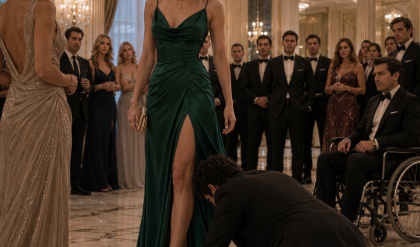
Three nights later, Celeste walked into the Grand Regent Hotel in a dark green gown she could never afford and heels that made her want to confess crimes she had not committed.
The charity gala glittered with chandeliers, champagne, and rich people pretending generosity was the same as goodness.
Ronan moved through the room like he had been born in a tuxedo. Celeste moved separately, pretending to belong while listening to everything.
That was how she found Vale.
He stood near an east corridor, silver-haired and elegant, holding champagne like a man who had never been thirsty in his life.
Another man leaned close to him.
“Vescari survived the harbor.”
Vale smiled.
“Inconvenient,” he said. “Temporary.”
Celeste’s pulse slammed in her throat.
“The issue is no longer eliminating him,” Vale continued smoothly. “It’s making sure everything he built dies with him.”
Celeste kept walking.
Her face showed nothing.
Across the room, she found Ronan at the bar and stood beside him.
“It’s Vale,” she whispered. “He’s the one.”
Ronan did not move.
Then Adrien Vale looked across the ballroom directly at Celeste.
And smiled.
Not cruelly.
Not angrily.
With interest.
As if he had just noticed a small object on the floor and decided whether it was worth stepping on.
“Don’t move toward the exit yet,” Ronan murmured.
“He saw me.”
“Yes.”
“That seems bad.”
“It is.”
“How long?”
“Thirty seconds.”
“Thirty seconds is a long time when a billionaire psychopath is smiling at you.”
“Twenty-nine.”
Vale said something to the man beside him. The man drifted toward the staff corridor.
“He’s cutting off the side exit,” Celeste said.
Ronan picked up his glass. “Then we use the front.”
The strangest four minutes of Celeste’s life followed.
They walked slowly.
Ronan stopped twice to greet donors. He shook hands. He complimented a senator’s speech. He laughed softly at a joke that could not possibly have been funny.
Celeste wanted to scream.
Fifteen feet from the main entrance, Ronan turned.
“Adrien,” he called warmly, loud enough for nearby guests to hear. “Beautiful evening, as always.”
Heads turned.
Vale had no choice.
He raised his glass and smiled back.
Forty witnesses saw Ronan and Celeste leave normally.
Only when the car pulled away did Celeste exhale.
“You made it public.”
“If we vanished quietly, his men could follow us into the street. Now any move against us tonight points back to him.”
“You bought us time.”
Ronan looked out at the city.
“I bought us tonight.”
The next morning, Vale took Dara.
Part 3
Dara Bennett was Celeste’s best friend, emergency contact, unpaid therapist, and the only person alive who could tell when Celeste was lying from a single text message.
When Ronan said Vale had her, Celeste’s chair scraped backward so hard it nearly fell.
“No,” Ronan said immediately.
Celeste looked at him. “You don’t even know what I’m about to say.”
“You are about to say you’re coming.”
“I am.”
“No.”
“You don’t get to no me when my best friend is missing.”
Ronan’s voice stayed calm, which somehow made it worse. “Vale took her because of you. That means he expects you to react emotionally. You will stay here with four guards while my team locates her.”
Celeste stared at him for a long moment.
Then she nodded.
That should have worried him.
Three hours later, she left through the east entrance during a seven-minute gap in the guard rotation she had spent two days memorizing.
She took cash from an unlocked drawer, a borrowed phone from the kitchen counter, and one piece of information Dara had mentioned before all this began.
A new man she had been seeing.
Worked in shipping.
Picked her up from work every night.
At the time, Celeste had barely listened. Now the detail returned like a flare in darkness.
Vale’s network ran through shipping.
The man had not been romance. He had been placement.
It took Celeste two hours and three cash-paid rides to reach South Harbor. She kept her face away from cameras, walked under awnings, changed direction twice, and cursed Ronan for teaching her how to disappear without realizing he had done it.
Marin Freight Solutions sat at the southern edge of the port, a dull two-story office attached to a warehouse. Lights burned in two upper windows after midnight.
Celeste watched from behind stacked containers.
Two guards at the front.
Movement upstairs.
One shadow near the window that did not move for twenty minutes.
She called Ronan.
He answered before the second ring.
“South Harbor. Marin Freight Solutions,” he said.
Celeste closed her eyes. “You knew.”
“We tracked the same lead. I’ve been trying to reach you.” His voice dropped. “Where are you?”
“Across the road.”
The silence was sharp.
“Do not go inside.”
“There’s someone upstairs who hasn’t moved.”
“My team is eleven minutes away.”
“I’ll wait eleven.”
She counted to four hundred.
Then a side door opened and a guard stepped out, sweeping a flashlight toward the containers.
Celeste moved.
The building smelled like dust, paper, and cold coffee. She stayed low, quiet, and furious. She found the staircase. She found the upper hallway. She found a locked room with a cheap knob that surrendered to a bent paperclip she had picked up from the floor without knowing why.
Dara sat inside, wrists zip-tied, eyes red, very alive.
“What the hell is happening?” Dara whispered.
“Long story.”
“Is this a mafia thing?”
“Unfortunately.”
“I told you that restaurant needed better security.”
“Walk now.”
But as Celeste pulled Dara up, she saw the crates.
Three large gray storage crates stacked against the far wall.
Inside were paper files. Shipping manifests. Transaction records. Internal memos. Names. Dates. Account numbers.
Celeste stared.
Dara groaned. “We’re not leaving yet, are we?”
“Two minutes.”
“You always say two minutes before ruining my life.”
Celeste photographed everything she could reach.
By the time Ronan’s men stormed the hallway four minutes later, Celeste was standing outside the room with Dara behind her, a phone full of evidence in her hand, and three of Vale’s men zip-tied on the floor.
Ronan stopped in the doorway.
His gaze moved from the unconscious guard, to the crates, to Celeste.
“You waited eleven minutes.”
“I counted to four hundred.”
“That is not eleven minutes.”
“It felt emotionally similar.”
For the first time since Marcus died, Ronan smiled.
A real smile.
Brief, unwilling, and devastating.
“Show me the crates,” he said.
The evidence from Marin Freight did what the warehouse files could not.
It connected Vale’s respectable empire to everything.
Shell companies. Bribed officials. Construction fraud. Laundered money. Port routes. Political donations. And buried beneath eleven years of financial camouflage, the reason Vale hated Ronan Vescari.
A trafficking network.
Eleven years earlier, Vale had been the money behind it. Not the man moving people across borders. Not the face in the dirty rooms. Men like Vale never touched the horror directly. They built the bank accounts, bought the warehouses, paid the lawyers, and called themselves investors.
Then Ronan found out one of the routes ran through his port.
He destroyed it in a week.
Anonymously, violently, completely.
Survivors were sent to federal agencies and safe organizations. Records were delivered to prosecutors. Vale lost millions, but more importantly, he lost the trust of men who had believed he was untouchable.
“He waited eleven years,” Celeste said, reading the file.
Ronan nodded. “And blamed me every day.”
The legal pieces took forty-eight hours to prepare.
Two federal investigators Marcus had trusted joined Ronan’s team in secret. Journalists were notified but not yet sent the full file. Port authorities waited for confirmation. Vale Global’s largest institutional shareholder had a sealed evidence packet prepared in case Ronan failed to walk out alive.
They needed one more day.
Vale did not give them one.
The attacks began across Boston at 8:11 p.m.
A warehouse fire.
A vehicle ambush.
A bomb threat that turned out to be real.
Vale’s people hit three of Ronan’s legitimate operations in eleven minutes, scattering his men across the city. Then Vale locked down the top floors of Vale Global headquarters and began destroying internal records.
Ronan made two calls.
Then he looked at Celeste.
“You should stay here.”
Celeste picked up the phone with the evidence files loaded and ready.
“You should stop saying that.”
Vale Global headquarters rose over the financial district like a glass monument to arrogance.
Ronan’s team entered through the parking structure. Celeste stayed close enough to feel the heat of him beside her. She was afraid. She did not pretend otherwise. Courage, she had learned, was not a clean absence of fear. It was fear with its jaw clenched.
The upper floors were guarded by private security and contractors from Blackstone Yard.
The fight was loud, ugly, and terrifying.
Smoke alarms screamed. Glass cracked. Men shouted commands. Somewhere below, federal vehicles began surrounding the block, waiting for the final signal that the evidence had gone public and could not be buried.
Vale’s office occupied the top floor.
When Ronan opened the door, Adrien Vale stood behind his desk in a perfect navy suit, two guards at his sides, the Boston skyline glittering behind him.
His eyes flicked to Ronan.
Then to Celeste.
“A waitress,” he said.
Not angry.
Amused.
Dismissive.
“He brought a waitress.”
“She brought herself,” Ronan said.
Vale smiled thinly. “You have no idea what you’re walking into. Every lawyer I have is already mobilized. You have photographs and shipping documents. My legal team has buried stronger cases before breakfast.”
Celeste stepped forward.
“I already sent it.”
Vale’s smile faded by one inch.
“What?”
“The complete file,” she said, holding up the phone. “Federal investigators. Three journalists. Port oversight. Your largest shareholder. And the families of the people trafficked through your network eleven years ago.”
The room went silent.
Celeste’s voice did not shake.
“They deserved to know before the world did.”
Vale looked at her as if seeing her for the first time.
His phone lit up on the desk.
Then again.
Then again.
A financial alert. A board resignation. A message from legal. A news notification. His largest shareholder had issued a public statement. The first article had gone live.
Celeste watched the billionaire’s empire begin collapsing in the reflection of his office windows.
Not with fire.
Not with bullets.
With truth.
Outside, federal agents moved through the stairwell.
Vale slowly sat down, as if his legs had accepted defeat before his pride could object.
His guards looked at one another and lowered their weapons.
Ronan said nothing.
He only placed one hand lightly at Celeste’s back and guided her toward the door.
Behind them, agents entered the room.
Vale looked at Celeste one final time.
“A waitress,” he said again.
But this time, it sounded different.
It sounded like a man finally understanding exactly how he had lost.
Three months later, Portofino’s reopened with new windows, fresh paint, and the same handmade pasta drying over wooden rods in the kitchen.
The harbor had been repaired. The cobblestones reset. The street cleaned so thoroughly that a tourist could walk past and never know a car had burned there.
Cities were like that.
They swallowed violence and called it recovery.
Celeste returned to work on a Tuesday.
No announcement. No speech. She tied on her apron, clipped back her hair, and carried two plates of tagliatelle to table four like she had not helped dismantle a billionaire’s criminal empire.
Dara sat at the bar, watching her with a coffee she had not touched.
“You look annoyingly normal,” Dara said.
“I feel annoyingly normal.”
“You zip-tied three men and exposed a monster.”
“I took pictures and pressed send.”
“Celeste.”
They looked at each other.
Then Dara laughed.
Celeste laughed too, and for one brief moment, the weight of the last three months became something they could carry.
But underneath the ordinary things, Celeste knew she had changed.
The woman who had burst through Portofino’s doors and grabbed Ronan Vescari’s arm was still her. The stubbornness remained. The independence remained. She still believed in standing on her own feet.
But now she understood something she had spent her life refusing to learn.
Sometimes the ground could hold two people.
Ronan came on a Thursday evening.
Dinner service was almost over. The harbor outside the windows was gold with sunset. Celeste was wiping down the bar when the door opened.
She knew before she looked up.
Some people had a presence that reached a room before their footsteps did.
Ronan stood inside wearing a dark coat.
No bodyguards.
No black sedan at the curb.
Just a man holding a small wooden box, looking more nervous than he had looked facing bombs, guns, and federal raids.
Celeste set down her towel.
“You didn’t call.”
“I wanted to ask in person.”
He placed the box on the bar.
Celeste looked at it. “If that’s jewelry, I’m throwing it at you.”
“It’s not jewelry.”
“Good.”
He inhaled once, slowly.
“I’ve been thinking about what you told me on the dock. About standing on your own feet. About not depending on anyone.”
“I remember.”
“I’m not asking you to stop.”
His eyes held hers.
“I’m asking you to consider that standing on your own feet and letting someone stand beside you are not the same thing.”
Celeste’s throat tightened despite her best efforts.
“Open it,” he said.
Inside was a brass key attached to a plain white tag.
An address was written on it.
Two buildings down from Portofino’s.
Celeste stared.
“The old waterfront space?” she asked.
Ronan nodded. “It’s been empty for two years. I had it inspected. Good kitchen. Better view. Terrible plumbing, but I’m told that can be fixed.”
She looked up slowly.
“What is this?”
“A restaurant,” he said. “If you want it. Yours first. Ours only if you decide that word does not offend you.”
Celeste picked up the key.
It was warm in her palm.
That made no sense.
But there it was.
She thought about her mother working doubles. About cold apartments and broken promises. About a burning car, a hidden room, a mountain lake, a billionaire’s face when truth reached him faster than money could stop it.
She thought about the man standing in front of her.
The dangerous man.
The complicated man.
The man who had dropped a bag of evidence in a tunnel because her life mattered more.
“I have conditions,” she said.
Ronan’s expression softened.
“I expected nothing less.”
“I choose the menu.”
“Of course.”
“No silent ownership games. No men in suits coming in here telling me what I can and can’t do.”
“Agreed.”
“And if you ever buy me something this big again without warning me, I will make you work a Saturday dinner rush.”
For the first time that night, Ronan smiled.
“I would be terrible at it.”
“You would.”
“I’d still show up.”
Celeste closed her fingers around the key.
Outside, the harbor lights came on one by one, slow and certain across the water.
Ronan Vescari had survived a car bomb, a betrayal, a billionaire with eleven years of revenge, and a city that had tried to swallow him whole.
But none of it had changed him as much as the woman who once grabbed his arm and told him not to talk.
He had listened.
And for the first time in his adult life, he was glad he had.
THE END