“Harrison found out later. He was furious. He planned to fix it.”
“He died before he could.”
“Yes.” Walt’s mouth hardened. “And Grant Ellison made sure the file disappeared.”
Grant Ellison was Hartwell Automotive’s chief operating officer. Smooth smile. Expensive suits. The kind of man who could steal your wallet while offering you a handshake.
Mason looked toward the closed office door where Ellie was still asleep on a cot before school.
“Vivian doesn’t know any of this,” Walt said. “She came in a year after Harrison died. Grieving, overwhelmed, surrounded by men who wanted her signature more than her leadership. Grant has been steering her ever since.”
“I’m not going to tell her.”
Walt stared. “After how she treated you?”
“I’m going to rebuild six engines because they deserve to run.” Mason placed his hand on block number three. “The rest is hers to discover.”
Walt studied him for a long moment.
Then he sighed.
“What do you need?”
“A crankshaft for number five. Sleeves for number one. Your hands for eight weeks.”
Walt rolled up his sleeves.
“You’ve got them.”
By Thursday of the first week, Cole’s Garage no longer sounded like a repair shop. It sounded like a resurrection.
Walt sorted valve springs into trays marked keep and replace. Mason cleaned oil passages with the patience of a surgeon. Ellie brought them hot chocolate every evening and taped a handwritten sign to the office door that read: Engine hospital. Do not disturb unless bleeding or hungry.
Mason worked fourteen-hour days, then made Ellie dinner, checked homework, and returned to the shop after she slept.
He never complained.
But at night, when the mountain air turned cold and the old fluorescent lights hummed overhead, he sometimes paused beside the engines and remembered the lab at Hartwell. Harrison laughing over impossible dyno numbers. Laura visiting with takeout. A younger version of himself believing talent and honesty would be enough.
On Friday morning, Vivian’s assistant called.
“Ms. Hartwell would prefer to meet in a neutral location for one final signature,” the assistant said. “The Corner Cup downtown. Ten a.m.”
Mason washed his hands twice.
He did not change his shirt.
The flannel had a black streak on the cuff that would never come out, and he had no intention of pretending it would.
The Corner Cup was crowded at ten. Vivian had chosen the center table on purpose. Her corporate attorney sat to her left. Two junior associates sat to her right. Four cappuccinos steamed on their side of the table.
Across from them waited one empty chair and a glass of water.
Mason walked in five minutes late.
The bell above the door rang once.
Conversation dipped when he crossed the café. The oil stain on his cuff was visible. So was the grease under one fingernail that refused to wash away.
Vivian looked him up and down and spoke loudly enough for the next table to hear.
“Mr. Cole, next time perhaps you could wash your shirt before meeting my legal team. Or is that not customary out here?”
One associate laughed.
It was a small, sharp sound.
The kind of laugh people make when they are trying to stay employed.
A woman in a denim jacket at the window lowered her coffee cup. A man near the counter lifted his phone discreetly.
Mason pulled out the chair and sat.
“May I read the document?”
Vivian smiled. “Take all the time you need. We don’t bill by the hour for patience.”
The associate laughed again.
Mason read every line.
He reached section 4.2 and read it twice.
Then he signed.
He slid the folder back across the table and stood.
“Ms. Hartwell,” he said, calm as still water, “are you sure you don’t want block number three?”
Vivian’s fingers froze around her cup.
There it was again.
Block number three.
She had not told him the order. She had not given him the manifest. She herself had never seen the serial numbers.
Grant had handled the disposal list.
Grant had arranged the transport.
Grant had chosen the receiving garage.
Mason gave one small nod to the table and walked out.
The café bell rang behind him.
Vivian sat very still.
Her coffee went cold in her hand.
Part 2
Vivian drove back to Charlotte with the radio off.
She told herself it was nothing.
A rural mechanic had read a contract carefully. A man in a stained shirt had refused to be embarrassed. A phrase about an engine block had unsettled her because grief made strange things feel meaningful.
Nothing more.
But by the time she reached the glass tower that carried her family name, the phrase had become a stone in her shoe.
Block number three.
That evening, she called her personal attorney, not Hartwell’s corporate counsel.
“I want every document tied to the VP7 disposal pulled quietly,” she said. “Not through Grant. Not through operations. Quietly.”
By midnight, three contracts sat on her desk.
All contained the same unusual language.
Section 4.2 granted “full and final discretion” to the receiver of disposed assets. All had been initiated by Grant Ellison using delegated authority Vivian had signed over during her first month as CEO, when she was still numb from burying her father and too exhausted to question every document placed before her.
At 1:17 a.m., Vivian opened her father’s will.
She had read it after the funeral through a blur of shock and legal voices. Now she read it with a pencil in her hand.
Halfway through, one clause stopped her cold.
The Heritage VP7 engines shall not be destroyed, transferred, liquidated, or materially altered without written consent from the original chief engine engineer.
Vivian underlined original.
Then chief engine engineer.
She did not know who that was.
Worse, she had never thought to ask.
The next afternoon, Vivian drove back to Hendersonville without telling anyone.
When she entered Cole’s Garage, the first person she saw was Walt Briggs standing at the parts bench, sorting valve springs.
She knew Walt.
Everyone at Hartwell did.
He had been with the company for thirty-three years before retiring. He had stood near the back at Harrison’s funeral, hands folded, eyes red, never approaching her.
“Mr. Briggs,” Vivian said.
Walt looked up. “Ms. Hartwell.”
“What are you doing here?”
“Helping a friend.”
Her gaze moved to Mason.
He stood near the machining table with his sleeves rolled to the elbow, a micrometer in one hand. Block number three rested beside him, cleaned, oiled, lifted on a cradle.
It no longer looked dead.
It looked patient.
“Who are you?” Vivian asked.
Mason set down the micrometer.
“Mechanic,” he said.
“Mechanics don’t get Walter Briggs to drive two hours and sort valve springs for free.”
“No,” Walt said quietly. “Most don’t.”
Mason gave Walt a look.
Walt closed his mouth.
Vivian held Mason’s gaze longer than she had held anyone’s in a year. She expected anger. She found none. She expected accusation. None came.
That almost made it worse.
She left without asking again.
That night, she took down a framed photograph from her office credenza. It showed her father in 2014, standing in the Hartwell engineering lab beside a man wearing a white coat, safety glasses, and a helmet that half hid his face.
She had passed that photograph a thousand times.
She had never asked who the man was.
Now she studied it under her desk lamp.
The man’s face was obscured, but his hands were visible on the workbench beside Harrison’s.
Long fingers.
A wedding ring.
A small scar across the right knuckle.
Vivian had seen that scar in the café, wrapped around a pen.
During the third week, Vivian visited the garage three times.
The first time, she sat in the office chair and drank burnt coffee from a chipped mug without complaining.
The second time, she brought a paperback and pretended to read while watching Mason work through the office window.
The third time, she stood three yards from the bench while he adjusted the valves on engine number one.
She watched his hands.
There was no wasted movement in them. No performance. No need to prove intelligence. Every touch seemed to remember something the metal itself had forgotten.
At 4:15, Ellie came home from school.
She dropped her backpack in the office, saw Vivian, and stopped.
For a moment, Vivian braced herself for shyness or suspicion.
Instead, Ellie walked to the shelf, pulled down a children’s book about engines, and held it out.
“Do you want to read with me?” she asked. “It explains four-stroke cycles.”
Vivian opened her mouth to say she had calls to return.
“Yes,” she heard herself say.
They sat together at the low table in the office while Ellie explained intake, compression, combustion, and exhaust with the solemn authority of a tiny professor.
Vivian laughed once.
It startled her.
She had not laughed since before her father died.
At the workbench, Mason’s hands paused for half a second. He did not turn around, but he polished the same rocker arm three times.
The next morning, Vivian drove to Walt’s house in the foothills and knocked on his door.
He answered in an old Hartwell Racing T-shirt with oil on his fingertips.
“Who was the original chief engineer of the VP7 program?” she asked.
Walt looked at her for a long time.
“Ms. Hartwell—”
“Please.”
The old man’s expression softened, but he did not betray Mason outright.
“You already know him.”
Vivian’s throat tightened.
“Where?”
Walt stepped back and began to close the door.
“You know where.”
On Friday morning, Grant Ellison entered Vivian’s office carrying a thin folder and the satisfied smile of a man who believed he was about to win.
Two attorneys followed him.
“I think we’re ready to act,” Grant said. “Cole completed the first engine yesterday. If he starts it, we can claim he violated the old non-compete from 2018. We sue, recover all six units, and seek damages.”
He placed the folder on her desk.
The top page was a photograph from 2014.
Mason Cole stood in a Hartwell lab beside Harrison, one hand on a VP7 engine, Harrison’s hand proudly on his shoulder.
Vivian stared at the photograph for ten seconds without breathing.
Grant watched her carefully.
“Once the first engine runs,” he said, “we have him.”
Vivian closed the folder.
“Let him finish.”
Grant blinked. “Excuse me?”
“Let him finish.”
“Vivian, with respect—”
“Thank you, Grant.” She slid the folder into her drawer and turned the key. “You can leave it with me.”
When he walked out, Vivian sat alone in the office.
Her father’s city stretched beyond the glass walls. Her father’s company moved beneath her. Her father’s name shone in steel letters behind her desk.
And Vivian realized she had been running all of it with someone else’s hands around the wheel.
Grant had known who Mason was.
Grant had known the clause.
Grant had sent the engines to Mason on purpose.
Not as a mistake.
As a trap.
But why?
On Monday of the fourth week, Vivian arrived at Cole’s Garage with a small wooden box on the passenger seat.
She had found it in her father’s private safe two weeks after his funeral. She had not opened it then because grief had made even his handwriting unbearable. The key had been taped to the underside of a leather blotter in his desk.
Now she placed the box on Mason’s workbench.
“My father kept this in his private safe,” she said. “I never opened it.”
Mason wiped his hands with a clean rag.
Vivian’s voice was quieter when she added, “I want to open it with you.”
He unlatched the brass clasp.
Inside were three items.
A folded letter on Harrison Hartwell’s personal stationery.
A black USB drive attached to a steel key ring.
A sealed manila envelope marked Custodial Trust.
Mason opened the letter first.
It was dated June 2017 and addressed to Harrison’s personal attorney, but it had never been sent.
Mason read silently at first.
Then his face changed.
Vivian gripped the edge of the bench.
“What does it say?”
Mason’s voice was steady through the first paragraph and rougher through the next.
Harrison had discovered, through a private audit, that Grant Ellison had been embezzling money through false disposal contracts since 2015. Engines and prototype castings marked as destroyed had instead been sold privately to collectors in the United Arab Emirates, Japan, and Europe through shell companies registered in Delaware and the Cayman Islands.
The letter listed account numbers, dates, transfers, brokers.
It also stated Harrison’s intention to fire Grant the following month.
And to reinstate Mason Cole as chief engine engineer of the VP7 program with full repayment of the severance wrongfully withheld from him in 2018, plus interest.
Harrison had died of a stroke three weeks after writing the letter.
Vivian sat down because her knees had gone weak.
Mason opened the manila envelope.
Inside was a notarized document naming him Heritage Engineering Trustee in perpetuity, with a twelve percent equity stake in Hartwell Holdings conditional upon formal reinstatement of the VP7 program.
The USB drive contained the audit trail.
Names. Buyers. Dates. Wire transfers. Internal manifests.
Grant had not merely stolen money.
He had sold pieces of Hartwell’s history and erased the people who could expose him.
Vivian did not cry.
Her hands rested slowly on the bench on either side of the open box.
“I signed a paper paying you four thousand dollars to take six engines worth millions,” she said. “I called your garage rustic. I humiliated you in public. I was such a fool.”
Mason closed the letter gently.
“You weren’t a fool.”
She looked at him.
“You were lied to,” he said. “There’s a difference.”
“Why didn’t you tell me who you were?”
“Because you didn’t know me.”
“That’s not an answer.”
“It is.” Mason leaned back against the bench. “If I told you on day one, I’d be a mechanic in a small garage claiming your dead father owed me something. Grant would have buried me before lunch. I needed to save the engines first.”
“Whether I believed you or not.”
“Yes.”
Vivian looked at him for a long time.
The shop lights caught the gray in his hair near his temple, the scar on his knuckle, the exhaustion he wore without self-pity.
“My father chose you,” she said.
“Your father was a good man.”
“He left you twelve percent of the company.”
“I would’ve refused it if I’d known.”
“I’m not my father,” Vivian said.
“No,” Mason replied. “But you can decide who you are.”
Before she could answer, Ellie entered with two mugs of hot chocolate.
She handed one to Vivian. A small marshmallow floated in the center, tilted to one side.
“Dad says people should drink hot chocolate when they’re sad,” Ellie said. “I made you one.”
Vivian took the mug with both hands.
For a long time, she did not drink.
She just held it like warmth was something she had forgotten how to accept.
By the end of the fifth week, engine number one was ready for the test stand.
Mason had built the dyno room himself behind the garage in 2020. Concrete walls. Steel shielding. Reinforced glass. A control booth small enough for three people and a child with hearing protection.
He checked the fuel line.
Then the ignition.
Then the cooling system.
Twice.
Then a third time.
Walt sat at the data console. Ellie stood beside him with oversized headphones and a notebook. Vivian stood three yards from the engine, her blazer removed, sleeves rolled to her elbows.
Mason had never seen her sleeves rolled up before.
He looked at her.
“You start it.”
Vivian’s eyes widened. “Me?”
“Your father always made someone outside engineering start the first engine. Said it proved whether the machine accepted new hands.”
She placed her palm over the ignition switch.
Her breathing shook once.
Mason nodded.
Vivian pressed the button.
The starter turned.
The engine coughed.
Then the VP7 came alive.
The sound filled the room, deep and clean and astonishingly steady. It was not the scream of a modern race engine. It was lower, richer, a pulse you felt in your ribs before you heard it in your ears.
The gauges climbed.
Torque rose.
Horsepower rose.
Temperature stayed green.
Walt leaned toward the monitor.
“Six hundred twelve horsepower at sixty-three hundred RPM,” he shouted over the sound. “Four percent over original spec.”
Mason watched the numbers, but Vivian watched the engine.
She remembered being eight years old on her father’s shoulders at a test session, both hands over her ears while Harrison laughed like thunder.
For the first time since his death, the memory did not cut her.
It opened something.
Vivian walked to the corner and made a call.
“Mr. Bellamy,” she said. “This is Vivian Hartwell. I have six restored VP7 heritage engines. Better than original specification. Verified on a test stand.”
The voice on the other end went silent.
“Who certified them?”
Vivian looked at Mason.
“Mason Cole.”
Another silence.
“Mason Cole, the original VP7 chief engineer?”
“Yes.”
“I’ll take all six,” the man said. “Five hundred thousand each. Three million total. My technical team can be in North Carolina within forty-eight hours.”
“You can wire the deposit tonight.”
“Vivian,” he said, voice softer now, “I’ve been trying to buy those engines for seven years.”
“I know,” she said. “I finally read the file.”
She ended the call and walked back to Mason.
He had shut down the engine. The room ticked with cooling metal.
“You didn’t need me to sell them,” she said. “You could’ve done that the day I left.”
Mason unplugged the data cable.
“You needed them.”
“I needed them restored.”
“The sale was always yours.”
“Why?”
He looked at the engine, then back at her.
“Because they weren’t mine to sell. Your father built the program. You inherited it. I only built the engines.”
Vivian had no answer for that.
So she placed a hand on the cooling engine cover and kept it there until the metal was no longer warm.
Part 3
The following Monday night, Grant Ellison returned to Vivian’s office with a sealed lawsuit packet and the same soft, confident smile.
He had brought two attorneys.
He had brought a press statement.
He had even brought a pen.
“I think we’re ready,” Grant said. “Cole has started the first engine. We file tomorrow morning, freeze his assets, recover the units, and take control of the narrative before he can.”
Vivian sat behind her desk.
No tears.
No visible anger.
Only a calm so complete it made Grant’s smile falter.
She slid an unmarked folder toward him.
“That’s not the filing,” he said.
“No.”
Grant opened it.
The first page was a wire transfer record from a shell company in Dubai dated June 2016.
The second page was a Delaware registration document.
The third was a manifest for prototype casting disposal signed by Grant Ellison.
By the fifth page, color had drained from his face.
Vivian pressed the intercom.
“Security,” she said. “Please escort Mr. Ellison out of the building.”
Grant stood too fast. “Vivian, you don’t understand what you’re looking at.”
“I understand enough.”
“You think some mechanic gave you the truth?”
“No,” she said. “My father did.”
For the first time since she had known him, Grant had nothing polished to say.
Security entered.
Grant looked at the attorneys. They looked away.
As he was led from the office, Vivian spoke once more.
“Tomorrow morning, I’m giving the board everything. Tonight, you should call a criminal lawyer.”
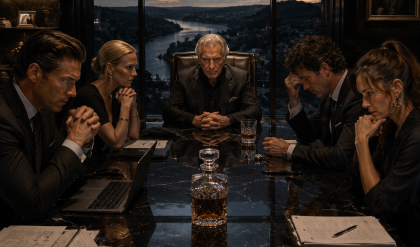
The board meeting began at 8:00 a.m. Wednesday.
Nine members sat around the long walnut table at Hartwell Holdings. Three had known Harrison for decades. Six had joined after his death and had mostly known Grant’s version of the company.
Vivian entered with three binders.
Mason walked beside her.
He wore a clean flannel shirt and work boots. He did not pretend to be a man in a suit.
Vivian presented the evidence for forty-two minutes.
False disposal contracts.
Shell companies.
Over eight years of stolen assets.
Six point eight million dollars traced through private sales.
The severance withheld from Mason during Laura’s illness, diverted into an account Grant controlled.
Walt’s notarized statement.
Harrison’s letter.
The Custodial Trust.
No one interrupted.
When Vivian finished, the silence lasted almost a full minute.
Finally, one older board member leaned forward.
“The Bellamy sale?”
“Three million dollars transferred to Hartwell’s corporate operating account this morning,” Vivian said. “No commission taken by Cole’s Garage. Mr. Cole declined it in writing before the sale closed.”
Another board member looked at Mason.
“And the engines were restored by whom?”
Vivian turned slightly toward him.
“This man,” she said, “Mason Cole, the original chief engine engineer of the VP7 program. The man my father chose. The man this company wronged. The man who saved six engines we were tricked into throwing away.”
Mason’s face remained still, but his eyes moved once to the table.
Vivian continued.
“I move to formally reinstate the VP7 Heritage Program, appoint Mason Cole as chief engine engineer reporting directly to the CEO, honor the Custodial Trust, and authorize immediate repayment of all withheld compensation with interest.”
The vote was unanimous.
Before the secretary finished reading the resolution, one of the older board members stood. He had known Harrison Hartwell for forty years.
He walked the length of the table and held out his hand to Mason.
For a moment, Mason only looked at it.
Then he shook it.
The old man’s voice broke.
“Harrison was right about you.”
Mason nodded once.
“He was right about the engines.”
By the end of the week, Grant Ellison had been indicted. His accounts were frozen pending forfeiture. Three brokers were under investigation. Hartwell Automotive issued a public statement that said less than Vivian wanted and more than the lawyers liked.
The internet did what the internet always does.
A clip from the Corner Cup café surfaced first.
Vivian’s voice, cold and loud: “Perhaps you could wash your shirt before meeting my legal team.”
Then Mason’s calm reply: “You sure you don’t want block number three, Ms. Hartwell?”
By noon, the clip had two million views.
By dinner, Vivian had watched it once, closed her laptop, and sat alone in the dark.
The next morning, she drove to Hendersonville.
Mason was outside the garage, helping Ellie adjust the seat on her bicycle.
When Vivian stepped out of the Range Rover, Ellie looked between them with the cautious wisdom of children who have seen adults hurt each other and are waiting to learn what kind of grown-up will appear next.
Vivian walked toward Mason.
Then, before she could lose her nerve, she turned to Ellie.
“I owe your dad an apology,” Vivian said. “But I also owe you one.”
Ellie blinked. “Me?”
“Yes. I treated him badly in public. I treated him like his work didn’t matter. And when people do that to someone’s father, it hurts the people who love him too.”
Ellie studied her.
Mason said nothing.
“I’m sorry,” Vivian said.
Ellie held her gaze for a moment, then nodded.
“Mom used to say sorry only counts if you change after.”
Vivian swallowed.
“Your mom was right.”
“She usually was.”
Mason looked away, but not before Vivian saw the grief move across his face.
That afternoon, Vivian did not enter the office as a CEO. She entered as a person who had been wrong and wanted to learn how to stand in the room afterward.
She brought lunch from a diner down the road. She let Ellie explain why fries were better when stolen from someone else’s plate. She listened to Walt complain that modern coffee tasted like burnt river water. She asked Mason about the engines and did not interrupt when he answered.
Weeks passed.
Mason did not move to Charlotte.
“Ellie’s school is here,” he told Vivian in the parking garage after another board meeting. “The garage is here. Laura is buried here. I can drive to Charlotte twice a week.”
“Or I can come to Hendersonville more often,” Vivian said.
He looked at her.
“You could.”
Neither of them smiled exactly.
But something lighter passed between them.
The VP7 program was formally relaunched in December.
Hartwell Automotive reopened the old racing facility outside Charlotte and hired back several retired engineers who had thought their best work had been forgotten. Walt returned as a consultant and spent most of his time telling young technicians they held tools like nervous squirrels.
Ellie was given a small desk in the corner of the engineering trailer with a label that read Junior Data Assistant.
Mason pretended he had not made the label.
Everyone knew he had.
Six months after the truck dumped the engines at Cole’s Garage, Hartwell Racing arrived at Daytona International Speedway for the second weekend in March.
The rebuilt VP7 powered car number 17, the same number that had won at Sebring years earlier.
The paint scheme matched the old poster on Mason’s garage wall.
Blue. White. Silver.
Clean lines.
No apology.
Ellie stood between Mason and Vivian in the pit garage, wearing hearing protection over her hair and holding a notebook full of lap times, fuel pressure, and comments like sounds angry but good and Dad says green means breathe.
The race lasted four hours.
For three of them, car 17 led its class.
Mason stayed at the engineering console, headset on, voice steady over the radio. Vivian stood behind him, hands clasped so tightly her knuckles paled. Walt watched from the pit wall, pretending not to care while caring more than anyone.
On lap 191, the driver came over the radio.
“Need fuel numbers.”
Mason leaned toward the mic.
“You’re good to push. Bring it home.”
The car crossed the finish line first in class.
For a second, the garage froze.
Then it exploded.
Crew members shouted. Helmets flew. Somebody grabbed Walt and lifted him clear off the ground before realizing he was old enough to haunt them.
Ellie launched herself at Mason.
He caught her with one arm and, without thinking, reached his other arm toward Vivian.
Vivian stepped into it.
Only for a few seconds.
Long enough for Ellie to notice.
Long enough for Walt to look away with a smile he tried to hide.
Long enough for Mason to feel that not every ending had to be an ending.
That night, the ocean rolled black and silver beyond the hotel balcony. Ellie slept in the next room with her engine book open on her chest.
Vivian stood at the railing, the Daytona wind moving through her hair.
Mason stepped outside and stood beside her.
Not too close.
Not too far.
“My father would’ve been proud today,” Vivian said.
“He was proud before today,” Mason answered.
She looked at him.
“He was proud before you knew it.”
For a while, neither spoke.
Below them, waves folded over themselves in the moonlight.
“My dad used to say a good engine depends on timing,” Vivian said. “The exact right opening. The exact right closing. Too early, it tears itself apart. Too late, it loses power.”
Mason smiled faintly. “He said that about people too.”
“Did he?”
“All the time.”
Vivian looked down at her hands.
“I wish I’d known sooner.”
“So do I.”
“That sounds like regret.”
“It is,” Mason said. “But regret doesn’t mean the rest of the road disappears.”
She turned toward him.
He handed her a small wooden box.
Vivian opened it carefully.
Inside was a polished bronze piston, small enough to rest in her palm. An inscription had been etched around the base.
VP7. Block 0948. First restart.
“What is this?” she whispered.
“A piece from the first engine you started.”
“Why are you giving it to me?”
“Because you should keep something that came alive under your hand.”
Vivian closed the box slowly.
She did not say thank you.
Not because she wasn’t grateful.
Because for once, the words were too small.
The following Friday, she returned to Hendersonville.
And the Friday after that.
Sometimes for meetings. Sometimes for engine reviews. Sometimes because Ellie had made hot chocolate and claimed it tasted better when Vivian drank some too.
Cole’s Garage changed, but it did not become unrecognizable.
The sign stayed faded. The concrete stayed cracked. The office chair still squeaked. Customers still came for brake jobs and oil leaks, though now they sometimes slowed down in the driveway to stare at the famous engine builder who still fixed pickup trucks if someone needed him.
Mason kept the garage because it had held him together when the world had not.
Vivian kept coming because it reminded her that leadership was not a title inherited behind glass, but a choice made in rooms where people could tell when your hands were clean only because you never touched the work.
One afternoon, months later, Ellie stood beside block number three, now fully restored and mounted beneath protective lights at the Hartwell Heritage Center.
A crowd of reporters waited nearby.
Vivian had invited Mason to speak first.
He refused.
So Ellie stepped forward instead, holding a note card with both hands.
“My dad says engines are not dead just because someone gives up on them,” she read. “He says people are like that too.”
Her voice wobbled, but she kept going.
“Sometimes the world calls something junk because it doesn’t know what it is looking at. Sometimes the person who can fix it is the person everyone else ignored. And sometimes saying sorry is only the first repair.”
She looked up at Vivian.
Vivian’s eyes shone.
Ellie smiled.
“My mom would have liked these engines,” she added. “Because they came back.”
Mason closed his eyes.
For a moment, he could almost hear Laura laugh.
Not from the past.
From somewhere just beyond it.
After the ceremony, Vivian found Mason standing alone beside car 17.
“You okay?” she asked.
“No,” he said honestly. “But I’m good.”
She nodded.
That made sense to her now.
A person could be wounded and still whole.
A machine could be discarded and still run.
A company could inherit lies and still choose truth.
A woman could make a terrible mistake and spend the rest of her life becoming someone worthy of forgiveness.
And a single father in a stained flannel shirt could stand in front of the world, not as a man asking to be seen, but as a man who had known his own worth even when nobody else did.
Vivian looked at the restored engine beneath the lights.
“Do you ever think about what would’ve happened if I hadn’t sent them to you?”
Mason smiled.
“You didn’t send them to me.”
She frowned gently. “I signed the disposal order.”
“Grant sent them to trap me,” Mason said. “Your father left the proof. Walt brought the old hands. Ellie brought the hot chocolate.”
“And you?”
Mason looked at the six engines.
“I opened the door.”
Vivian stood beside him in the quiet after the crowd had moved on.
Outside, the sun was setting over Charlotte, turning the glass towers gold.
In Hendersonville, Cole’s Garage waited at the foot of the mountains. The lights would be off tonight because, for once, Mason had promised Ellie no late work. There would be pizza, a movie, and maybe Vivian sitting at the small kitchen table while Ellie explained why movie cars never sounded accurate.
Life, Mason had learned, did not always return what it took.
But sometimes, if you kept your hands steady, it gave you something rebuilt.
Not the same.
Not untouched.
But alive.
And sometimes alive was more than enough.
THE END