Part 3
The board meeting began at 8:00 a.m. with fresh coffee, sealed folders, and Victor Hale acting like a man attending someone else’s funeral.
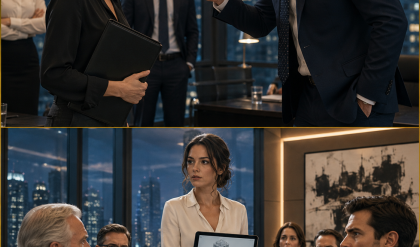
Eleanor sat at the head of the long conference table. The city of Detroit spread behind her through the windows, gray and bright under a hard morning sky. Around the table sat board members, outside counsel, senior engineers, and two investors who had asked for clarification after hearing whispers about a “temporary internal audit.”
Victor wore a charcoal suit and a wounded expression.
“I have to say,” he began, “I’m deeply concerned by the direction this has taken. We’re days away from finalizing the most important deal in company history, and we are now entertaining sabotage theories from a former employee who was terminated for policy violations.”
Nathan stood near the projector in a plain blue work shirt.
He did not react.
Eleanor did.
“Mr. Cole was terminated because I made a rushed and incorrect decision,” she said. “That decision has been reversed pending formal action.”
Victor’s smile thinned. “How generous.”
Denise Rowe opened a folder. “Before we proceed, the HR record shows that Mr. Cole’s disciplinary termination template was created at 7:12 p.m. the evening before he was fired.”
The room shifted.
Victor blinked. “That’s impossible.”
Denise pushed copies down the table. “The metadata has been verified by an outside forensic consultant.”
Eleanor watched Victor’s hand move toward his water glass. It trembled once.
Nathan connected his laptop to the projector.
“I’ll keep this simple,” he said.
The screen lit up with security logs.
“At 2:58 a.m., my employee account was suspended while I was documenting a non-original electronic module hidden inside Ms. Whitman’s Corvette. At 3:04 a.m., twelve minutes of footage from Service Bay Three were deleted. At 3:19 a.m., a deleted overtime authorization linked to my name was removed from the workflow archive.”
He clicked again.
“All three actions were routed through executive operations credentials.”
Victor leaned back. “Credentials can be cloned.”
Nathan nodded. “They can.”
He clicked to the next slide.
“So I looked for behavior, not credentials.”
A map of login times appeared.
“Whoever used those credentials also accessed the Aurora Drive thermal threshold documents, the rejected controller batch archive, and the vendor payment system from the same workstation over a three-week period. That workstation was physically unlocked using a biometric scan.”
He paused.
“Yours, Mr. Hale.”
Victor’s face darkened. “This is absurd.”
Owen Reddick, the lead systems engineer, sat two chairs down from Victor, sweating visibly.
Nathan turned to him.
“Owen, you signed off on the changed thermal warning thresholds. Did you make those changes?”
Owen’s lips parted.
Victor snapped, “Don’t answer that without counsel.”
Eleanor said, “He has counsel present.”
Owen looked at the attorney beside the wall, then at Eleanor.
“I changed them,” he whispered.
Victor’s chair scraped back. “Owen.”
Owen flinched, then kept talking.
“He told me it was temporary. He said if the board saw another thermal alert before the investor signing, they’d shut down the program and everyone in my department would be out of a job. He told me to bury the failed controller reports until after closing.”
Eleanor’s face went cold. “You hid a safety defect.”
Owen’s eyes filled. “I was scared.”
Nathan clicked again.
“This is the controller batch in question. The same digital signature appears in the device found in the Corvette.”
A board member at the far end whispered, “Dear God.”
Victor stood. “This is a setup. You’re all so desperate for a villain that you’re letting a disgruntled mechanic manipulate you.”
Nathan’s expression did not change.
“Then explain the money.”
The next slide showed bank transfers moving through three shell entities.
Victor went still.
Nathan said, “An outside company called Meridian Component Holdings began purchasing options tied to Whitman’s valuation six weeks ago. Meridian is registered in Delaware, but its controlling interest traces to a private account connected to you. If the investor deal collapsed during a public test failure, Whitman’s market value would crater. Meridian would purchase a controlling stake through emergency financing.”
Eleanor stared at Victor, the man who had sat in her strategy meetings, shaken her hand, praised her father’s legacy.
“You were going to take my company.”
Victor’s face had gone bloodless, but his voice stayed sharp. “Your company was already dying. I was going to save it from your sentimentality.”
“My sentimentality?”
“You built an investor ceremony around a dead man’s car,” he said. “You protected old workers, old habits, old stories. The market doesn’t care about loyalty, Eleanor. It cares about control.”
Nathan stepped forward. “You put an unstable controller in a vehicle she was going to drive.”
Victor’s eyes flashed. “It would have stalled outside the gate. Embarrassing, not fatal.”
“You didn’t know that.”
“I knew enough.”
“No,” Nathan said. “You knew enough to risk someone else’s life.”
The room went silent.
For the first time, Victor looked away.
Outside counsel called federal investigators. Denise handed over printed evidence. Caleb stood in the corner, fists clenched, watching security escort Victor from the room as employees gathered in the hall.
Victor did not shout as he left.
Men like him rarely did when the mask came off. He simply straightened his jacket and walked between two officers with his eyes fixed ahead, as if disgrace were just another meeting he intended to survive.
But the company saw him.
And the company remembered.
The investor deal did not collapse.
It paused.
Eleanor made the call herself. She stood before the investors and told them the truth. Not the polished version. Not the legal version. The human one.
She told them an internal safety concern had been discovered by a technician. She told them leadership had failed to listen quickly enough. She told them the launch would be delayed until the Aurora Drive passed a full independent review.
The room was silent when she finished.
One of the German investors, a woman named Dr. Lena Strauss, closed her folder and said, “Ms. Whitman, I came here to invest in technology. I am still interested. But after today, I may also be interested in your integrity.”
Six months later, the Aurora Drive passed every independent safety test.
The $300 million partnership was signed in the same glass conference center, but the ceremony was different this time. There were fewer cameras and more employees. The assembly workers stood beside engineers. HR stood beside machinists. Nathan’s daughter Lily sat in the front row wearing a blue dress and clutching a sketchbook full of cars.
Eleanor took the stage without a script.
“There was a morning in this building,” she said, “when I confused authority with judgment. I looked at a man who had given more than anyone asked, and I saw only a number on a clock.”
No one moved.
“Nathan Cole was forty-seven minutes late because he had worked all night protecting this company. I fired him before I listened. That was not leadership. That was fear wearing a suit.”
Nathan stood near the side wall, uncomfortable with attention.
Eleanor turned toward him.
“I am sorry,” she said. “Publicly, permanently, and without excuse.”
The applause began softly.
Then it grew.
Not wild. Not performative. Something deeper. The sound of people recognizing that a place could change if the person at the top was brave enough to be ashamed.
Nathan returned to Whitman, but not as a mechanic.
He accepted the newly created position of Director of Technical Integrity and Safety Oversight, on three conditions.
First, no employee could ever again be terminated for cause without a formal hearing and the chance to tell their side.
Second, safety reports would go into an independent system no executive could alter for financial reasons.
Third, every overtime request involving emergency work had to include human confirmation, not just electronic approval.
Eleanor signed all three conditions without negotiation.
“You know this gives you the power to stop production,” she said.
Nathan looked at her. “That’s the point.”
Lily adjusted to the changes faster than her father did. She loved his new office because it had a window and because Eleanor once let her sit in the Corvette while Nathan checked the timing.
“Don’t get used to this,” Nathan warned.
Lily grinned from behind the wheel. “Too late.”
Eleanor laughed, and for a moment the old factory felt less like a battlefield and more like what Robert Whitman had meant it to be.
A place where people built things worth trusting.
Spring came late that year, softening Detroit’s hard edges with rain and green leaves along the river. One Friday afternoon, the red 1963 Corvette rolled into Nathan’s service bay, shining under the sun as if it carried every lesson of the past six months in its paint.
Nathan walked out with a clipboard.
“Problem?” he asked.
Eleanor leaned against the open driver’s door. She was wearing jeans, a white blouse, and the cautious smile of someone still learning how to ask instead of command.
“I heard something.”
Nathan opened the hood. The engine idled perfectly, smooth as a heartbeat.
He listened for thirty seconds.
Then he looked at her.
“There is absolutely nothing wrong with this car.”
“I know,” Eleanor said.
Nathan raised an eyebrow.
She glanced toward the factory floor, where workers moved through the afternoon shift with ordinary purpose. “I just wanted to make sure the best safety expert in Michigan was still paying attention.”
Nathan tried not to smile and failed.
From the office window, Lily waved a sketchbook at him. On the page was a drawing of the Corvette, Eleanor, Nathan, and half the factory standing behind them like a family nobody had planned but everyone had somehow chosen.
Eleanor saw it too.
“She’s talented,” she said.
“She gets that from her mother.”
“And the stubbornness?”
Nathan closed the hood gently. “That’s probably mine.”
For a while, neither of them spoke.
The Corvette’s engine purred between them, alive because one tired man had refused to ignore a problem everyone else had missed. The factory hummed beyond the glass, alive because one proud woman had finally learned that being in charge meant having the courage to be corrected.
Eleanor looked at Nathan and said, “My father used to tell me every engine has a story.”
“He was right.”
“What story does this one tell?”
Nathan rested a hand on the warm red fender.
“That you should never judge the noise before you know what’s causing it.”
Eleanor nodded, her eyes bright but steady.
The Corvette rolled out of the service bay a few minutes later, moving slowly toward the open gate. Sunlight struck the windshield, flashed across the hood, and spilled over the factory floor like a promise.
And long after the car disappeared into the afternoon traffic, the people of Whitman Performance Systems kept telling the story of the morning a single father was fired for being late, the secret he left behind, and the truth that saved them all.
THE END