People always imagine leaving a powerful man as a dramatic escape. A midnight flight. A new identity. A black car speeding through rain.
For Clara, leaving looked like sitting in the back seat of a rideshare with one suitcase, one sweater, and one hand pressed against her stomach while the driver asked if she was okay.
She almost said yes.
That was the lie women learn to tell when their entire life is falling apart but they do not want to become a stranger’s problem.
Instead, Clara looked out the window at the blurred lights of Chicago and whispered, “Not yet.”
The driver did not push.
He only turned the heat up.
That small kindness nearly broke her.
Naomi Fletcher lived in a brownstone in Lincoln Park with too many law books, two rescue cats, and a front door camera that captured every face on the sidewalk.
When Clara arrived, Naomi opened the door before she knocked.
“Oh, honey,” Naomi said.
Clara stepped inside and finally let the suitcase fall from her hand.
“I left him.”
Naomi closed the door and locked it.
“Good.”
Clara looked up, startled.
Naomi’s face softened.
“I know you love him. But love does not require you to stand still while someone slowly teaches you to disappear.”
That sentence hurt because it was true.
Clara sat on Naomi’s couch while one of the cats climbed into her lap as if appointed by the universe to keep her from falling apart completely.
Naomi made tea.
Not because tea could fix anything.
Because when someone has lost their home in one night, warm things matter.
For the next hour, Clara told her everything.
Roman’s silence.
The accusation.
Elias Vale.
The messages she had sent warning Roman about strange calls, missing papers, and a driver who had followed her twice after church.
The way every warning disappeared.
The way Roman’s eyes changed when he looked at her.
The pregnancy test.
The divorce papers.
The suitcase.
Naomi listened without interrupting.
That was one reason Clara loved her.
Naomi never rushed pain into a summary.
When Clara finished, Naomi picked up her phone.
“I’m moving you somewhere safer.”
Clara shook her head immediately.
“No police.”
“I didn’t say police.”
“Roman has people everywhere.”
“Then we use someone who hates owing Roman Calder anything.”
Clara almost smiled.
“Who?”
“My aunt June.”
Within two hours, Clara was sleeping in a guest room above a flower shop in Evanston owned by June Fletcher, a sixty-seven-year-old woman with silver hair, strong arms, and the calm confidence of someone who had outlived every man who underestimated her.
June did not ask questions.
She only handed Clara clean pajamas and said, “Bathroom’s down the hall. Cat sleeps wherever he wants. If anyone knocks after nine, we don’t open.”
Clara stood in the doorway, overwhelmed.
“Thank you.”
June waved a hand.
“Thank me by eating breakfast.”
That night, Clara slept with the lights on.
At the Calder mansion, no one slept at all.
Roman stood in his study surrounded by every message Clara had ever tried to send him.
Marcus, his head of security, had recovered them from a private filter installed on the household communication system.
Someone had rerouted her emails.
Someone had deleted call logs.
Someone had intercepted two letters from Naomi’s office.
Someone had wanted Roman to believe Clara was silent because she was guilty.
Matteo stood against the wall, pale and sweating.
Vittoria sat in a chair like a queen awaiting trial, refusing to look ashamed.
Roman placed Clara’s first message on the desk.
It was dated four months earlier.
Roman, I saw the same black SUV twice today. Once near the church, once outside the west gate. Please do not dismiss this. I don’t think this is random.
He placed the second message beside it.
Roman, your meeting location changed before you told anyone. Someone inside the house knew. Be careful who receives your printed schedules.
Then the third.
Roman, if you are angry with me, say it to my face. But please believe me about this: Elias Vale knew things he should not know. Someone close to you is feeding him information.
Roman read that last line until the words blurred.
Someone close to you.
He had thought Clara meant herself.
She had meant the person standing in his own bloodline.
He looked at Matteo.
“Why?”
Matteo’s mouth trembled.
“You never listened to me.”
Roman stared at him.
That was his answer?
All the damage.
All the fear.
All the months of turning his wife into a ghost.
Because Matteo felt ignored.
“You had everything,” Matteo said, voice rising. “Father gave you the name. Mother gave you the seat. Men followed you when you were twenty-eight and laughed when I spoke.”
Roman’s voice was low.
“So you sold information to Elias.”
“I gave him small things.”
“You gave him my routes.”
“I never meant for anyone to get hurt.”
Roman slammed his hand on the desk so hard everyone flinched.
That was the only loud thing he did.
Then he became terrifyingly calm.
“You meant to make me bleed just enough to need you.”
Matteo looked away.
Vittoria finally spoke.
“Your brother made mistakes. But Clara was becoming a distraction. She made you question the family.”
Roman turned to his mother.
“No. Clara made me question cruelty.”
Vittoria’s eyes sharpened.
“You are alive because this family taught you not to trust soft things.”
Roman picked up the pregnancy test from his desk.
His hand shook.
“I was loved by something soft. And I treated it like a threat because you taught me fear and called it wisdom.”
For the first time, Vittoria had no answer.
Roman looked at Marcus.
“Matteo is removed from every account, every property, every meeting. He does not speak for me. He does not travel with my name. He does not enter my home.”
Matteo stepped forward.
“Roman, you can’t do this.”
“I can.”
“I’m your brother.”
Roman’s face twisted with pain.
“And Clara was my wife.”
The words came out rough.
Not polished.
Not controlled.
Real.
He turned back to Marcus.
“My mother will return to the Oak Street house. Her staff remains, her accounts remain, but she does not enter this mansion again without Clara’s permission.”
Vittoria stood.
“You would exile your mother for that girl?”
Roman looked at her.
“No. I am removing the woman who taught me to punish my wife for another man’s betrayal.”
Vittoria’s face went white.
That was the first consequence.
Not violence.
Not revenge.
Boundary.
In Roman’s world, boundaries were often more shocking than blood.
By dawn, the Calder mansion had changed.
Men who used to move confidently through its halls now whispered.
The guest suite Roman had occupied for months was empty.
The bedroom he had abandoned still smelled faintly of Clara’s lavender soap.
Roman entered it alone.
He sat on the edge of the bed where she had probably sat before placing the papers on his desk.
He imagined her holding the test.
Alone.
Afraid.
Maybe hopeful for one second before remembering the man he had become.
That thought bent him forward until his elbows rested on his knees and his hands covered his face.
Roman Calder had faced enemies without flinching.
But he did not know how to face the image of his wife crying quietly in a room he had made cold.
At 7:12 a.m., Marcus knocked once.
“We found her location.”
Roman stood too fast.
“Where?”
“Evanston. Flower shop. Naomi Fletcher’s aunt.”
Roman grabbed his coat.
Marcus stepped in front of him.
It was the bravest thing the man had ever done.
“Boss.”
Roman stopped.
Marcus swallowed.
“You said we weren’t going to scare her.”
Roman’s jaw tightened.
“I know what I said.”
“You arriving with three black cars will scare her.”
Silence.
Roman looked past him toward the window.
The old Roman would have gone anyway.
He would have called it protection.
He would have surrounded the building.
He would have demanded a conversation and mistaken access for love.
But the old Roman had driven Clara out of their home.
The new one had not earned the right to follow.
“What do I do?” Roman asked.
Marcus was quiet for a second.
Maybe he had never heard Roman Calder ask that question honestly.
“You ask,” Marcus said. “Through her lawyer. And you accept the answer.”
Roman hated every part of it.
Which was how he knew it was probably right.
At 8:30 a.m., Naomi’s phone rang.
Clara was awake, sitting at June’s kitchen table with toast she could not eat.
June was downstairs opening the flower shop.
The cat had claimed Clara’s suitcase like conquered territory.
Naomi looked at the caller ID.
“It’s Marcus.”
Clara’s fingers tightened around her mug.
“Roman?”
“No. Marcus.”
“Answer.”
Naomi put the call on speaker.
Marcus’s voice came through formal and careful.
“Ms. Fletcher. Mr. Calder knows Clara is safe. He is not coming there unless she gives permission. He asks if he may send a letter.”
Clara closed her eyes.
A letter.
Not a command.
Not a car.
Not a demand.
A letter.
Naomi looked at her.
Clara nodded.
“He may send it to my office,” Naomi said.
Marcus paused.
“He also asked me to say that the house has been secured, Matteo has been removed, and Vittoria has been sent away.”
Clara’s eyes opened.
Naomi’s expression hardened.
“Sent away because?”
Another pause.
“Because the accusation against Clara was false. Matteo was the leak. Mrs. Calder tried to warn him. Her messages were intercepted.”
The room tilted.
Clara reached for the table.
Naomi’s face filled with fury.
“I want copies.”
“You’ll have them.”
“And Marcus?”
“Yes, ma’am?”
“If he tries to use this as an excuse to pressure her, I will personally make his life legally miserable.”
For the first time, Marcus sounded almost amused.
“I’ll warn him.”
The call ended.
Clara sat perfectly still.
For months, she had wondered if she was losing her mind.
If she had misunderstood Roman’s world.
If maybe her fears were only loneliness turning shadows into enemies.
But she had been right.
She had been right, and still she had not been believed.
That realization did not feel like victory.
It felt like grief.
Naomi sat beside her.
“I’m sorry.”
Clara shook her head.
“I kept thinking if I could just explain better, he would hear me.”
“That’s what happens when someone teaches you their disbelief is your communication failure.”
Clara pressed a hand to her stomach.
“I don’t know what to do.”
“You don’t have to decide today.”
That was the first kindness of freedom.
No immediate decision.
No performance.
No wife role to return to.
No husband waiting downstairs with rage and flowers.
Just time.
Roman’s letter arrived that afternoon.
Naomi read it first, then handed it to Clara.
The envelope contained three pages written in Roman’s hand.
Not typed.
Not dictated.
Written.
Clara,
I do not know how to ask forgiveness without sounding like I believe I deserve it. I do not.
I believed the worst of you because believing it protected me from admitting the danger was inside my own family. I let silence become punishment. I let my pride turn your home into a place where you had to measure every breath.
You warned me. I did not listen.
You loved me. I treated your love like strategy.
You were carrying our child, and I made you feel alone.
There is no defense for that.
Matteo was the source of the leak. My mother helped bury your warnings because she believed your heart made me weak. I believed her because I was raised to fear tenderness more than betrayal.
That failure is mine.
I am not asking you to come home.
I am not asking to see you.
I am asking permission to make sure you have medical care, legal protection, and anything else you need, through Naomi, without contact unless you choose it.
If you never forgive me, I will still spend the rest of my life making sure no one can punish you for telling the truth.
Roman
Clara read it once.
Then again.
On the third time, she cried.
Not because the letter fixed anything.
Because the man she loved was finally speaking in a language that did not require her to shrink.
But love does not erase fear.
And apology does not rebuild trust overnight.
For two weeks, Clara did not answer.
Roman did not come.
That mattered.
He sent financial documents through Naomi, transferring Clara full access to a private account in her name only. Naomi reviewed everything.
He sent proof that her old phone, email, and home security logs were being preserved.
He sent a list of properties she could use if she wanted to move somewhere more secure.
She chose none of them.
Instead, she stayed above June’s flower shop and helped arrange bouquets in the mornings when nausea and sadness allowed.
June never asked about the baby unless Clara brought it up.
But every day, she placed a bowl of crackers near the register and pretended they were for customers.
One Thursday, Clara was tying ribbon around a bouquet of yellow roses when a little girl came into the shop with her grandmother.
The child pointed to Clara’s stomach.
“Is there a baby in there?”
The grandmother gasped.
“Mia!”
Clara surprised herself by smiling.
“Yes.”
“Do you know if it’s a boy or a girl?”
“Not yet.”
“Do you want a boy or a girl?”
Clara placed the bouquet in paper.
“I want a happy child.”
The little girl nodded seriously.
“My mom says happy is harder than pink or blue.”
June laughed from behind the counter.
“Your mom is smart.”
After they left, Clara stood very still.
A happy child.
That was the dream now.
Not a Calder heir.
Not a symbol.
Not proof that Roman’s bloodline would continue.
A child who could grow up without learning that love and fear belonged in the same room.
That night, Clara finally wrote back.
Roman,
I received your letter.
I believe you are sorry.
I do not know yet if sorry is safe.
I will accept practical support through Naomi. I will not return to the mansion. I will not meet with you alone. I will not allow our child to become a bridge you use to walk back into my life before trust exists.
If you want to become someone this child can know one day, start by becoming someone I do not have to fear today.
Clara
Naomi read it and nodded.
“Perfect.”
Clara frowned.
“It sounds cold.”
“It sounds clear. Women are often told clarity is cold by people who benefited from confusion.”
June, who had absolutely been listening from the doorway, called out, “That belongs on a mug.”
Roman received the letter at midnight.
He was in his study, the room where he had found the test and papers.
For a long time, he only stared at the line:
I do not know yet if sorry is safe.
That sentence became his punishment and his map.
Sorry was not enough.
He had to become safe.
Roman had no idea how to do that.
So he began with the only thing he understood: removing threats.
But this time, Marcus stopped him again.
“Boss, becoming safe isn’t just making other people afraid.”
Roman looked irritated.
Marcus continued carefully.
“It’s making sure she doesn’t have to be afraid of you.”
That truth was harder.
Roman could protect Clara from enemies.
But who protected Clara from Roman’s pride?
The answer had to be Roman himself.
He began therapy three days later.
Privately.
Quietly.
With a man named Dr. Samuel Grant, who looked unimpressed by money and did not flinch when Roman said, “People call my family criminal.”
Dr. Grant only asked, “What do you call yourself?”
Roman almost left.
He stayed.
The first sessions were useless because Roman treated them like negotiations.
By the fourth session, Dr. Grant said, “You answer every question as if there is a courtroom in the room.”
Roman snapped, “There usually is.”
“And where is your wife in that courtroom?”
Roman said nothing.
Dr. Grant waited.
That was the thing about good therapists and dangerous men.
They both understood silence.
Finally, Roman said, “On the witness stand.”
“Who put her there?”
The question stayed with him for days.
Who put her there?
He had.
He had made Clara prove innocence in a marriage that should have offered trust.
He had turned love into testimony.
Meanwhile, Clara built a small life that did not belong to the Calder name.
She worked at the flower shop when she felt strong enough.
She walked near the lake with Naomi.
She learned to sleep without listening for Roman’s footsteps.
Some days she missed him so badly it felt physical.
Some days she hated him.
Some days both feelings sat beside each other like strangers waiting for the same bus.
Pregnancy made time strange.
Her body changed while her future remained undecided.
Roman received updates through Naomi only when Clara approved them.
A short message after appointments.
A note that the baby was healthy.
A list of costs covered by the account Naomi controlled.
No photos.
No sentimental details.
No “your child kicked today.”
Clara kept those moments for herself.
Not out of revenge.
Out of ownership.
Roman had missed the beginning by choice.
He could not demand the middle.
Three months after Clara left, Matteo tried to contact her.
Not directly.
Through a former Calder driver who appeared outside June’s flower shop pretending to buy roses.
June knew trouble the way some people know weather.
She looked at the man’s shoes, then at the expensive watch under his sleeve, then at the black car parked too long across the street.
“No,” she said before he spoke.
The man blinked.
“I’m sorry?”
“No.”
“I wanted to order flowers.”
“You wanted to breathe near my counter with bad intentions. Leave.”
He left.
June called Naomi.
Naomi called Marcus.
Marcus called Roman.
Roman wanted to go personally.
Marcus did not even have to speak this time.
Roman closed his eyes.
“Handle it legally.”
Marcus blinked.
“Legally?”
Roman looked at him.
“Did I stutter?”
Within hours, Naomi filed for a protective order using security footage and the prior evidence of interference. Matteo’s connection to the driver was documented. Roman signed a statement supporting Clara’s claim.
That cost him.
Not money.
Pride.
For a man like Roman, admitting in writing that his family posed a risk to his wife was a public fracture in the mythology he had inherited.
He did it anyway.
When Clara received the copy, she sat on June’s back stairs and read Roman’s statement twice.
He did not make himself the hero.
He did not say he had fixed everything.
He wrote plainly:
My wife reported concerns that were ignored. My family members contributed to circumstances that made her unsafe. I support her request for protection and will comply with all boundaries set by her counsel.
Clara touched the page.
Maybe sorry was not safe yet.
But truth was beginning to build a floor under it.
The first time Clara agreed to see Roman, it was not romantic.
It was in Naomi’s office.
Naomi sat beside Clara.
Marcus sat outside.
Roman entered alone, wearing a dark suit and no wedding ring.
Clara noticed immediately.
Not because she wanted him to wear it.
Because his hand looked painfully bare.
He stopped several feet from her.
“Clara.”
His voice almost broke.
She nodded.
“Roman.”
For a long moment, they only looked at each other.
He had lost weight.
There were shadows under his eyes.
She wondered if he saw the changes in her too: the roundness under her green dress, the tiredness, the new steadiness that had not existed before.
His eyes dropped to her stomach for half a second, then returned to her face.
That mattered.
The old Roman might have looked at the baby first.
This Roman looked at the woman carrying the baby.
“Thank you for seeing me,” he said.
“I haven’t decided anything.”
“I know.”
“I may never come back.”
“I know.”
“You may only be part of this child’s life under strict conditions.”
“I understand.”
She studied him.
“Do you?”
He took a breath.
“No. Not fully. But I’m trying to understand without making you teach me while you’re still healing.”
That answer was not perfect.
But it was honest enough to hurt.
Naomi remained silent, though Clara could feel her approval from the chair beside her.
Roman reached into his jacket slowly and removed a small envelope.
Naomi stiffened.
Roman placed it on the table, not near Clara’s hand.
“This is not for you to answer now. It’s a proposal for changes to the trust, property, and business structures. Everything that affects you or the baby is separated from Calder family control. Naomi can review it.”
Clara looked at the envelope.
“Why?”
“Because if I die, disappear, or fail, I don’t want you trapped under my mother’s mercy.”
The bluntness startled her.
In Roman’s world, people did not say such things plainly.
He continued.
“And because protection that depends on me staying powerful is not protection. It’s another cage.”
Clara swallowed.
There he was.
Not forgiven.
Not restored.
But learning.
“What do you want from me today?” she asked.
His eyes shone.
“Nothing.”
She almost cried at that.
A man who once filled every room with expectation now sat in front of her asking for nothing.
“I wanted to tell you that I heard you,” he said. “And that I should have heard you sooner.”
Clara’s hands tightened in her lap.
“Do you know what the worst part was?”
He shook his head.
“That I kept loving you while you were making me feel crazy.”
Roman’s face changed as if she had struck him.
She continued.
“I would tell myself, he’s tired, he’s under pressure, he’ll come back to himself. I kept waiting for the man who brought me coffee and saved birds and remembered tulips. But the longer I waited, the smaller I became.”
A tear slipped down her cheek.
Roman did not move to wipe it.
Good.
That intimacy had not been earned back.
“I am sorry,” he whispered.
“I know.”
“I hate that I made you afraid to tell me about our child.”
“You should.”
He nodded, tears in his eyes now.
“I do.”
Naomi handed Clara a tissue.
The meeting lasted twenty-seven minutes.
When it ended, Roman stood.
Before leaving, he looked at Clara one last time.
“May I ask one question?”
Naomi looked ready to object, but Clara nodded.
Roman’s voice was rough.
“Are you eating enough?”
For some reason, that broke the tension.
Clara laughed once through tears.
Naomi sighed.
“Of all the questions.”
Roman looked embarrassed.
Clara wiped her face.
“Yes. June is forcing me to eat like I’m training for a winter expedition.”
A faint smile touched his mouth.
“Good.”
Then he left.
Clara sat back, exhausted.
Naomi watched her carefully.
“How do you feel?”
Clara looked at the closed door.
“Sad.”
“That makes sense.”
“And relieved.”
“That also makes sense.”
“And angry that I’m relieved.”
Naomi smiled gently.
“Healing is rude like that. It refuses to be simple.”
The months that followed were built from small, careful steps.
Roman did not become gentle overnight.
Some habits had claws.
When worried, he still gave orders.
When frightened, he still sounded cold.
When powerless, he still reached for control like a weapon left on the table.
But now, sometimes, he stopped.
Sometimes he would catch himself and say, “That came out wrong.”
Sometimes he would ask, “What do you need from me right now?”
Sometimes he would accept the answer even when it wounded him.
Clara did not move back to the mansion.
Instead, with Naomi’s help, she rented a small house near Lake Bluff with pale blue shutters and a garden full of weeds she planned to tame.
Roman hated the security risk.
He said so once.
Only once.
Clara looked at him and said, “This house feels peaceful.”
Roman looked at the cracked front step, the old fence, the tiny kitchen visible through the window.
Then he said, “Then we make it safe without making it a fortress.”
That became the rule.
Safety without cages.
Protection without ownership.
Love without surveillance.
Three weeks before the baby was due, Vittoria Calder sent a letter.
Clara almost threw it away unopened.
But curiosity, unfortunately, survived even heartbreak.
The letter was written on thick cream paper in Vittoria’s elegant hand.
Clara,
I believed I was protecting my son from softness. I see now that I was protecting myself from losing influence over him.
I will not insult you by asking forgiveness.
I will say only this: I was wrong about you.
You were not weakness.
You were the last honest thing in that house.
Vittoria Calder
Clara read it once.
Then placed it in a drawer.
Not every apology required a response.
Not every wrong earned a reunion.
Still, the sentence stayed with her.
The last honest thing in that house.
When Clara went into labor on a rainy Tuesday morning, Roman was in a meeting with lawyers finalizing the removal of Calder family businesses from anything illegal, violent, or inherited through fear.
It had taken months.
It would take years more.
But the first signatures were happening that day.
Marcus entered the conference room and whispered in Roman’s ear.
Roman stood so fast his chair hit the wall.
Every lawyer froze.
Marcus held up a hand.
“Calmly.”
Roman closed his eyes.
Then he picked up his phone and called Naomi first, because that was the plan.
Not Clara.
Naomi.
Respect the boundary.
Naomi answered on the first ring.
“She’s on the way to the hospital. June is with her. You may come. You may not bring an army. You may not argue with medical staff. You may not scare anyone.”
“I understand.”
“Do you?”
“Naomi.”
“Say the words.”
Roman exhaled.
“I will come alone. I will listen. I will not make this about me.”
“Good. You’re learning.”
“I am aware everyone enjoys saying that.”
“They do because it’s true.”
When Roman arrived at the hospital, he wore a black coat, no entourage, and the terrified expression of a man who had no empire useful enough for this moment.
Naomi met him in the hallway.
“She asked for you.”
Roman’s face broke open.
“She did?”
“Yes. Don’t make her regret it.”
He nodded.
Inside the room, Clara looked exhausted, furious, beautiful, and very much not interested in anyone’s dramatic emotions.
Roman approached slowly.
“I’m here,” he said.
Clara gripped his hand.
“I hate you a little right now.”
A startled laugh escaped him.
“That seems fair.”
“No jokes.”
“No jokes.”
“Don’t tell me to breathe.”
“I would never.”
She glared.
“You were about to.”
“I was absolutely not.”
June, from the corner, muttered, “He was.”
Naomi said, “Definitely.”
Even Clara smiled for half a second.
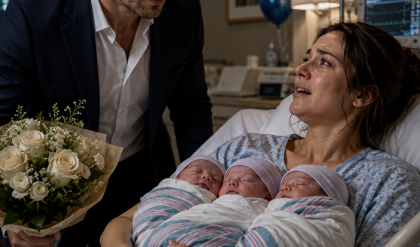
Hours later, their son was born.
Luca James Calder came into the world with a furious cry, dark hair, and one tiny fist raised as if ready to argue with the universe.
Roman held him only after Clara nodded permission.
When the baby was placed in his arms, Roman went completely still.
Not cold still.
Reverent still.
His son blinked up at him.
Roman’s mouth trembled.
“I am sorry,” he whispered.
Clara, half-asleep, heard him.
“For what?”
Roman looked at the baby.
“For the world I almost brought you into.”
Clara’s eyes softened.
“Then bring him into a better one.”
Roman looked at her.
“I will.”
She closed her eyes.
“Start with yourself.”
He nodded.
“I know.”
The next year did not become a fairy tale.
Clara refused to marry him again immediately.
Technically, the divorce had been paused but not finalized. She restarted the process after Luca’s birth, then paused it again.
Not to punish him.
To give herself space to choose without pressure.
Roman visited under agreed rules.
At first, he came three afternoons a week.
Then dinners.
Then bedtime routines.
He learned that babies did not care who feared their father. Luca screamed at Roman exactly as loudly as he screamed at anyone else.
That humbled him more than any enemy had.
Clara watched Roman learn small things.
How to warm a bottle.
How to fold tiny clothes.
How to sit on the floor with no phone while Luca grabbed his finger.
How to leave when Clara said she needed rest.
The leaving mattered most.
Every time Roman walked out without resentment, Clara trusted him one inch more.
Not a mile.
An inch.
Trust returned like that.
Not as a flood.
As drops.
Roman also changed the larger world around him.
Not perfectly.
Not publicly at first.
But steadily.
He cut ties with men who treated loyalty like permission to destroy.
He sold clubs that ran on fear.
He moved legitimate businesses into separate control.
He created a foundation under Clara’s name only after she approved the mission and refused to let it be called Calder anything.
The foundation helped women leaving controlling homes find legal, financial, and housing support.
Clara insisted on one rule:
No woman would be pressured to return just because a man apologized loudly.
Roman agreed.
That agreement hurt him.
It was also why she believed it.
One evening, when Luca was fourteen months old, Clara found Roman in the garden of her Lake Bluff house, kneeling beside the fence.
“What are you doing?”
He looked up, guilty.
“Fixing the loose board.”
“I didn’t ask you to.”
“No.”
She crossed her arms.
“Roman.”
He stood, wiping his hands on a rag.
“I saw it was loose.”
“And?”
“And I wanted to fix it.”
“And?”
He sighed.
“And I should have asked before changing something at your house.”
She tried not to smile.
“Correct.”
He looked at the fence like it had betrayed him.
“May I fix the loose board?”
“Yes.”
“Thank you.”
She watched him kneel again.
There was something oddly moving about it.
The man who once controlled rooms with a glance was now asking permission to repair a fence.
That was not weakness.
That was growth.
Later, after Luca fell asleep, Clara and Roman sat on the porch.
Fireflies moved through the yard.
For a long time, they said nothing.
Then Roman spoke.
“I miss our home.”
Clara’s body tightened.
He noticed.
“I don’t mean the mansion,” he said quickly. “I mean the mornings. Coffee. Tulips. You reading in the east room. Me pretending not to watch you.”
Clara looked at him.
“I miss that too.”
Hope flashed across his face, but he controlled it.
Good.
She continued.
“But I don’t miss who I became there.”
“I don’t either.”
“You don’t get to rush me because you changed.”
“I know.”
“Do you?”
“Yes,” he said softly. “Because you are not a reward for my improvement.”
Clara looked away before he could see how deeply that landed.
The next spring, Clara attended a charity event for her foundation.
She wore a deep green dress and carried Luca on her hip. Roman stood beside her, not touching her lower back the way he used to at public events, not guiding her, not claiming her.
Just beside her.
A reporter asked, “Mrs. Calder, is this foundation inspired by your own experience?”
Clara glanced at Roman.
Then answered truthfully.
“Yes. It was inspired by the years I confused silence with strength.”
The reporter shifted.
“And Mr. Calder’s role?”
Clara smiled faintly.
“He funds what I approve.”
Roman looked down to hide his smile.
The clip went viral by morning.
People praised her.
Some criticized him.
Many speculated about their marriage.
Clara did not read most of it.
She had learned that strangers love turning real pain into simple entertainment.
But messages also came from women.
Hundreds of them.
I needed to hear that.
I thought his apology meant I had to go back.
I didn’t know I was allowed to require change.
Your story made me call a lawyer.
Your story made me tell my sister.
Your story made me stop feeling crazy.
Clara read those.
Not all at once.
Not when they were too heavy.
But she read enough to understand that her leaving had become more than survival.
It had become a lantern.
Two years after the night Roman found the test on the divorce papers, Clara stood again in the Calder mansion.
Not as a wife returning.
As a woman choosing what parts of the past could be reclaimed.
The mansion had changed.
The guest suite Roman had used during those cruel months was now a library for the foundation’s legal clinics.
Vittoria’s sitting room had become a playroom for Luca when he visited.
The study remained, but Roman had removed the old desk.
“I hated it,” he said when Clara noticed.
She looked at the empty space.
“That’s where you found them.”
“Yes.”
“The papers and the test.”
He nodded.
“What did you do with the desk?”
“Burned it.”
Clara raised an eyebrow.
“Dramatic.”
“I am working on subtlety.”
“Slowly.”
“Very slowly.”
Luca toddled through the doorway carrying a wooden block, completely unaware of the emotional history of furniture.
He dropped the block on Roman’s shoe.
Roman bent down.
“Thank you, son. A gift.”
Luca clapped.
Clara laughed.
The sound filled the room differently now.
Not cautiously.
Freely.
Roman looked at her then with such open love that it almost frightened her.
Not because love was bad.
Because being loved by someone who once hurt you requires a new kind of courage.
The courage to see what has changed without denying what happened.
The courage to forgive without erasing the cost.
The courage to choose slowly.
That evening, Clara asked Roman to walk with her in the garden.
The tulips were blooming.
White, because he remembered.
They stopped near the fountain where he had once kissed her after their first real argument, back when conflict ended in laughter instead of silence.
Clara held out an envelope.
Roman went still.
“Is this bad?”
“No.”
He took it carefully.
Inside was a single page.
A legal document.
His eyes moved over it.
Then lifted to hers, stunned.
“You withdrew the divorce petition.”
Clara nodded.
“I’m not moving back tomorrow. I’m not pretending the past vanished. I’m not giving you the old marriage.”
“I don’t want the old one.”
“I know.”
His eyes filled.
She continued.
“I want a new one. With rules. With honesty. With therapy. With separate accounts. With no secrets that touch my safety. With no family member having access to our home unless I agree. With no silence used as punishment.”
“Yes,” he said immediately.
“I’m not finished.”
He closed his mouth.
She almost smiled.
“With Luca growing up knowing his father is strong because he can apologize, not because people fear him. With me never again having to prove my loyalty by tolerating pain. With you understanding that if I leave a room, you do not chase me. You ask if I want you to follow.”
Roman’s tears fell then.
He did not hide them.
That was new too.
“Yes,” he said. “To all of it.”
Clara touched his face.
“I love you, Roman.”
His breath broke.
“I love you.”
“But if you ever become the man who made me sign those papers, I will leave again.”
He covered her hand with his.
“I know.”
“And you will let me.”
His jaw tightened with pain, but he nodded.
“Yes.”
That was the vow that mattered.
Not forever.
Not ownership.
Not never leave me.
The vow was this:
If staying ever costs you yourself, I will not call it love.
They renewed their vows six months later.
Not in a cathedral.
Not in front of crime families, business allies, or anyone who cared about the Calder name.
They stood in June Fletcher’s flower shop after closing, surrounded by buckets of tulips, roses, eucalyptus, and one extremely judgmental cat asleep in the window.
Naomi officiated because she had gotten licensed online and claimed it was “for emergencies and dramatic women.”
June cried openly.
Marcus stood in the back holding Luca, who tried to eat his tie.
Clara wore a simple cream dress.
Roman wore a dark suit and no armor.
His vows were not poetic.
That made them better.
“I once thought love meant keeping you close,” he said. “Now I know love means making sure you are free, even beside me. I will not ask silence from you. I will not call fear respect. I will not make our child inherit the worst parts of my name. I choose you without owning you.”
Clara cried then.
So did Marcus, though he denied it for years.
Clara’s vows were steady.
“I once loved you so much I forgot to protect myself. I will never do that again. I choose you now because you learned that my boundaries are not walls against love. They are doors love must know how to knock on.”
Naomi paused and whispered, “That was excellent.”
June whispered, “Put it on a mug.”
They laughed through tears.
It was not perfect.
Perfect things are often too polished to be true.
This was better.
It was earned.
Years later, people still told the story wrong.
They said the mafia boss found a pregnancy test and lost control.
They imagined broken glass.
Shouting.
Revenge.
A powerful man dragging his wife back into a mansion because he finally realized her worth.
But Clara always corrected them.
“He did lose control,” she would say. “But the important part is that he learned control was never love.”
And if someone asked whether she forgave him, she answered carefully.
“Yes. But forgiveness was not a door he kicked open. It was a key he earned one honest day at a time.”
Roman heard her say that once at a foundation event.
Later, in the car, he looked out the window for a long time.
“What are you thinking?” Clara asked.
“That I’m grateful you didn’t make forgiveness easy.”
She studied him.
“Why?”
“Because if it had been easy, I would have mistaken your heart for permission instead of grace.”
Clara reached for his hand.
Outside, Chicago passed in lights and shadows.
The city still knew Roman Calder’s name.
But inside their home, his name meant something different.
It meant the father who got on the floor to build block towers with Luca.
The husband who asked before solving.
The man who still had darkness in his history but no longer called darkness destiny.
It meant someone becoming.
And Clara?
She was no longer the woman waiting in a cold mansion for a man to remember how to love her.
She was a mother.
A wife by choice.
A founder.
A woman who had walked out with one suitcase and returned only when the door opened from both sides.
The positive test on top of the divorce papers did not save their marriage.
Truth did.
Boundaries did.
Time did.
Change did.
And the courage to say:
I can love you and still leave if loving you means losing myself.
That was the lesson Clara carried forever.
Because sometimes the most powerful moment in a woman’s life is not when a man realizes her worth.
It is when she realizes it first…
and refuses to forget it.