William lunged for the phone, but Lauren stepped between us.
“Touch her,” Lauren said, “and I promise you’ll regret it before lunch.”
William stared at me as if I were the one who had betrayed him.
“When did you become like this?”
I tilted my head.
“You mean when did I stop believing you?”
He took a breath, recovering his confidence. “You’re overreacting. Fine, I said things. People say things. That doesn’t mean you get to blow up a marriage.”
“No. You blew up the marriage.” I picked up the divorce agreement. “I just filed the paperwork.”
He looked at the folder, then at me.
“The estate is mine,” I said. “It was a wedding gift from my father. The deed has always been in my name. You have ten days to remove your belongings.”
For the first time, William looked truly afraid.
“That house is mine.”
“It isn’t.”
“I paid for renovations.”
“With marital funds.”
“You don’t even have a job.”
I opened a drawer, took out my business card, and placed it on the table.
Audrey Reynolds
Shareholder and Financial Adviser
Horizon Corp.
“My annual salary is one hundred and fifty thousand dollars,” I said. “Not Carson money. Mine.”
William stared at the card like it had slapped him.
For years, he had called me fragile. He had told me business was too ugly for me. He had said I should enjoy being cared for. What he really meant was that he wanted me isolated, uninformed, and grateful.
“Get out of my house, William.”
His mouth twisted.
“You’ll see,” he said.
He slammed the door behind him.
Lauren exhaled. “That was better than therapy.”
“Good,” I said, walking toward my closet. “Now help me choose a dress.”
Her eyes widened. “For what?”
“His mother’s birthday party.”
“Are you insane?”
“No.” I pulled out a sleek black dress. “I’m ending this in public.”
By noon, I stood at the front door of Edward and Vivian Carson’s mansion holding the dry-aged prime rib Vivian had ordered me to bring.
Martha, their housekeeper, opened the door. Her face softened when she saw me.
“Mrs. Carson.”
“Happy birthday, Martha,” I said quietly, handing her an envelope.
Her eyes filled. The Carsons had forgotten her birthday every year. I never had.
From the dining room, Vivian Carson’s voice rang out.
“Is that Audrey? Bring her in. Everyone is waiting.”
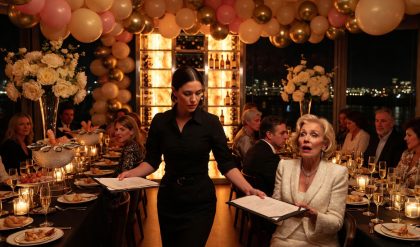
The dining room glittered beneath a crystal chandelier. Three tables were filled with relatives, donors, investors, and city people who knew how to smile while counting favors. Edward Carson sat at the head table beside Commissioner Bradley. Vivian floated around like a queen. William sat stiffly near an empty chair meant for me.
When Vivian saw the roast, she beamed.
“Our Audrey is always so thoughtful,” she announced. “A perfect daughter-in-law.”
I smiled.
For now.
Mrs. Bradley, seated across from me, studied my face.
“Audrey, I hear Horizon’s Palm Beach project is doing beautifully.”
Vivian’s smile flickered. The Carsons hated being reminded that my family did not need them.
“Thankfully, yes,” I said. “My father always says good business means never taking what doesn’t belong to you.”
Edward’s eyes sharpened.
Under the table, William pinched my thigh hard enough to bruise.
Without flinching, I reached into my clutch and pulled out the divorce agreement.
I placed it on the lazy Susan and gave it a gentle spin.
The folder turned slowly, almost beautifully, before stopping in front of Edward Carson.
“Since everyone is gathered,” I said, “William and I have an announcement.”
Vivian grabbed the folder first. Her face changed when she read the first page.
“What is this?”
“A divorce agreement,” I said. “William signed it last night.”
The room went silent.
William shot to his feet. “Audrey, what the hell are you doing?”
I looked up at him.
“Didn’t you tell Madison Blake I was an old hag and that she was your true love?”
Vivian shrieked, “My son would never say that.”
I played the recording.
William’s voice echoed beneath the chandelier.
“What does that old hag matter?”
The guests froze.
Mrs. Bradley lowered her wineglass very slowly.
I placed the photos on the table next. William and Madison outside hotels. William and Madison in Cabo. William and Madison in the very theater where he used to hold my hand.
“He bought her a condo,” I said. “Funded her boutique coffee shop. Took her on vacations. All while telling me he was working late.”
Vivian lunged toward me, her diamond bracelet flashing.
“You trapped my son!”
I stepped aside. She nearly fell.
“No,” I said. “He signed because he thought I was stupid.”
Edward stood so abruptly his chair scraped the floor.
“Enough.”
He dismissed the guests with a stiff apology, but whispers had already started moving through the room like sparks in dry grass.
When the outsiders left, Edward grabbed William by the collar.
“You signed without reading?”
William stammered, “I didn’t know she recorded me.”
“The recording isn’t the problem,” Edward snapped. “The problem is that you got caught.”
That sentence told me everything.
Not remorse. Not morality. Only reputation.
Vivian turned on me. “After everything we did for you?”
I laughed once.
“My father gave me a two-million-dollar dowry. I helped secure your zoning approvals. I hosted your donors. I protected your image. You didn’t support me, Vivian. You used me.”
Then I picked up my clutch.
“My lawyer will contact yours. William has ten days to leave the Greenwich estate.”
William blocked the doorway.
“You think you can just walk away?”
“I already have.”
I leaned closer.
“And if Madison enjoys seeing her name in Page Six, keep pushing.”
That shut him up.
Outside, rain poured over the stone steps. Martha handed me an umbrella, crying.
“Take care of yourself,” I whispered.
I stepped into the rain without opening it.
For the first time in ten years, I was not walking away from a family.
I was walking back to myself.
Part 2
I went straight to Horizon Corp.
My father’s office overlooked Midtown Manhattan, all glass, steel, and cold morning light. James Reynolds listened without interrupting while I told him everything: William, Madison, the signed agreement, the birthday party, the threat.
When I finished, he turned from the window.
“Are you ready for total war?”
“I’m ready to get my life back.”
“That may be the same thing.”
He opened his desk drawer and took out a file.
“The Carsons are in trouble. Liquidity problems. Hidden debt. And there’s something else.” He slid the file to me. “The textile factory from your dowry. The one William’s family has been managing.”
I flipped through the documents. Numbers blurred, but the pattern was clear enough.
“They’ve been siphoning money.”
“That’s what it looks like,” Dad said. “And they may be preparing to force a liquidation.”
The factory was fifty-one percent mine.
William had not only betrayed my marriage. He had come for my property.
That afternoon, I walked into Carson Enterprises for the first time in seven years.
The lobby smelled like polished stone, expensive flowers, and fear. People recognized me before they knew what to say. I wore a black power suit, my hair pulled back, my heels clicking against the marble like a countdown.
“I’m here to see Clare Mitchell,” I told the receptionist.
The finance director arrived five minutes later. Clare was in her mid-thirties, sharp-eyed behind gold-rimmed glasses, with the exhausted elegance of a woman who had survived too long in a room full of dangerous men.
“Mrs. Carson,” she said.
“Miss Reynolds,” I corrected. “Soon enough.”
Her mouth twitched.
In her office, I placed my ownership documents on her desk.
“I want the real ledgers for my factory.”
“That requires Mr. Carson’s approval.”
“No,” I said. “It requires the majority owner’s request.”
Clare’s fingers tapped once against the desk.
“Miss Reynolds, there are protocols.”
“Director Mitchell, you know William is embezzling money. You also know that when this collapses, the finance director will be the easiest person to blame.”
Her face went still.
For a long moment, neither of us spoke.
Then she took off her glasses, cleaned them, and put them back on.
“I need protection.”
“You’ll have it.”
She wrote a number on the back of a business card.
“Use this carefully.”
I left Carson Enterprises knowing two things. First, Clare had evidence. Second, someone would notice she had spoken to me.
I was right.
When I returned to the Greenwich estate, the property manager called in a panic.
“Miss Reynolds, Mr. Carson came in with a young woman. He says he owns the property.”
My blood chilled.
I drove faster than I should have.
William’s red sports car sat in the driveway. Inside, I heard laughter and the clink of champagne glasses. I followed the sound to the terrace.
William sat there with Madison Blake draped over him like a trophy. She was wearing my silk robe.
The one I had bought for myself after my last birthday, when William claimed he had an emergency at the firm.
Madison smiled, all glossy lips and sharp teeth.
“So you’re Audrey.”
I looked at William.
“This is trespassing.”
He laughed. “You’re delusional. This is my house.”
Madison touched the collar of my robe. “William said you wouldn’t dare make trouble.”
I pulled out my phone.
“I’m calling the police.”
William stood, his face darkening. “Listen carefully. Madison likes this house. She’s going to live here. You can leave the easy way.”
“If not?”
His hand lifted.
I raised my phone higher.
“Hit me,” I said. “I’ll send the video to the police, the press, and every investor you’re still lying to.”
His hand froze.
He lowered it, breathing hard.
I walked past them into the study.
“I’m collecting documents.”
In truth, I turned on my recorder.
Their voices carried from the terrace.
“Why is she so arrogant?” Madison whined. “You said she was pathetic.”
“She is,” William snapped. “The agreement won’t hold. My father hired the best lawyers in New York. Once the company loan closes, I’ll buy you the ring. Europe, too.”
“And the house?”
“It’ll be ours.”
“And her factory?”
“She won’t know what hit her.”
There it was.
When I left, I smiled at them.
“I forgot to mention,” I said. “I installed security cameras yesterday.”
William went pale.
Madison stood so quickly champagne spilled across the stone.
That night, Clare texted me.
Tomorrow. Ten a.m. Cafe near Central Park. Come alone.
I did not come alone. Detective Harris, a retired NYPD investigator my father trusted, sat two tables away reading a newspaper.
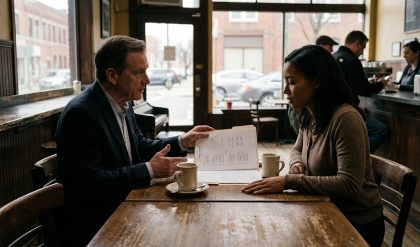
Clare arrived in jeans and a gray T-shirt, looking nothing like the finance director I had met. She slid into the booth and pushed a thick envelope toward me.
“These are the real books,” she whispered. “The factory is profitable. William created false losses and moved almost twenty million dollars into a Carson shell company. He also forged your signature to mortgage the factory.”
The room tilted.
“He forged my signature?”
Clare nodded. “There’s more. Carson Enterprises has been inflating revenue to secure loans. Madison Blake’s father is a senior bank executive. He helped approve several of them.”
So Madison was not just a mistress.
She was a transaction.
Clare handed me a flash drive.
“Emails. Loan documents. Offshore transfers. Enough to bury them if your lawyer handles it right.”
“Why help me?” I asked.
Her lips pressed together.
“Because last year I had a tumor. I asked Edward Carson for medical leave. He told me to come back in a week or not at all. Because I have a conscience. And because if I stay silent, they’ll make me the scapegoat.”
I reached across the table and squeezed her cold hand.
“You won’t stand alone.”
The cafe door opened.
Clare stiffened.
A large man in a black suit scanned the room.
“Frank Russo,” she whispered. “Carson security. Fixer.”
“Bathroom,” I said. “Back exit.”
She grabbed her bag and moved.
Russo approached my table.
“Have you seen a woman in a gray shirt?”
I looked up, calm.
“Do I look like your receptionist?”
His eyes narrowed. “You’re Audrey Reynolds.”
“Correct. And unless you want me to call the NYPD and report harassment, step away from my table.”
He hesitated.
I smiled.
“Today, Frank.”
He left.
Five minutes later, Clare texted: Out clean. Watch yourself.
By sunset, Mr. Donovan had the evidence. By midnight, my father knew the Carsons’ plan.
They were betting everything on the South Harbor Revitalization Project, a waterfront development worth hundreds of millions. They needed my factory as collateral. If the project closed, they would survive. If it failed, they would collapse.
“So we strike before the bidding closes,” I said.
Mr. Donovan raised an eyebrow.
“That is aggressive.”
“It’s precise.”
Dad looked at me with something between worry and pride.
“My daughter is awake,” he said quietly.
The next few days moved like a storm.
I filed to freeze the factory assets. I handed over evidence of forged signatures. I met with forensic accountants. I sold the Greenwich estate for five and a half million dollars cash to a tech entrepreneur from Austin with no Carson ties.
When Vivian found out, she came to the gate screaming.
“That is our family home!”
I watched from the security camera as the guards refused her entry.
“No,” I whispered. “It was never yours.”
Then came the federal reports.
IRS. SEC. U.S. Attorney’s Office.
Tax evasion. Fraudulent loans. Embezzlement. Bribery. Insider trading.
Each envelope I submitted felt less like revenge and more like removing poison from a wound.
The news broke the same afternoon.
Breaking: Carson Enterprises Under Federal Investigation.
By dinner, the company’s shares had halted. By morning, banks were calling loans. The South Harbor bidding was suspended. William was subpoenaed. Madison’s father was taken in for questioning.
Then Edward Carson died of a heart attack at Mount Sinai at 3:17 a.m.
When I saw the news, I sat down hard.
“I didn’t want this,” I told my father. “I wanted justice. Not death.”
Dad sat beside me.
“Edward Carson built his life on greed, intimidation, and fraud. His heart failed because his empire did. That is not your crime.”
I wanted to believe him.
But victory did not taste sweet.
It tasted like smoke.
That evening, William called from a blocked number.
I answered only because Lauren dared me to let him beg.
“Ten minutes,” I said when he asked to meet.
We met at a Starbucks across from my condo.
I almost didn’t recognize him. His suit was wrinkled. His hair was uncombed. His face had gone hollow.
“Audrey,” he said, gripping his coffee like a lifeline. “I’m sorry.”
I said nothing.
“I was wrong. About everything. The company is dying. My father is dead. I could go to prison.” His voice cracked. “Please. Help me.”
“How?”
“Tell them the evidence was a misunderstanding. Say you were emotional. Say you wanted revenge.”
I stared at him.
“You’re asking me to commit perjury.”
“I’m asking you to remember we were married for ten years.”
“The same ten years you forgot while calling me an old hag?”
He flinched.
“I loved you,” he whispered.
“No,” I said. “You loved what my name could do for you. You loved my father’s connections, my silence, my loyalty. And when you thought I had nothing left to offer, you tried to gut me.”
His eyes hardened for one second. There he was. The real William.
Then the mask of sorrow returned.
“What about the employees?” he asked. “Thousands of innocent people will suffer.”
“If you cared about employees, you wouldn’t have run the company like a crime scene.”
His shoulders collapsed.
I stood.
“You reap what you sow, William.”
Outside, sunlight hit my face. I expected triumph. Instead, I felt tired.
That was the moment I understood something important.
Revenge can open the cage.
But it cannot teach you how to live outside it.
Part 3
The final divorce hearing was held on a gray morning in downtown Manhattan.
Lauren sat beside me in the courtroom wearing sunglasses indoors because, as she whispered, “I refuse to let William see my facial expressions for free.”
William arrived with two lawyers and no confidence. The man who once walked into rooms like he owned the oxygen now kept his eyes on the floor.
The judge reviewed the agreement. The signature. The property deed. The evidence of marital funds spent on Madison Blake. The forged mortgage papers. The asset transfers.
William’s attorney tried to argue undue pressure.
The judge looked over her glasses.
“Mr. Carson is an experienced corporate executive, correct?”
“Yes, Your Honor.”
“He signed a notarized agreement without reading it?”
William’s lawyer swallowed. “That appears to be the case.”
“Then perhaps Mr. Carson should have read it.”
Lauren squeezed my arm so hard I almost laughed.
The agreement stood.
The estate was already sold. The proceeds were mine. The factory shares remained mine. William’s hidden accounts would be examined. Madison’s condo was dragged into the marital asset dispute. His arrogance had become a legal document.
Outside the courthouse, reporters swarmed.
I said only one sentence.
“I trusted the law, and today the law protected me.”
That clip went everywhere.
By evening, strangers were calling me cold, brave, ruthless, iconic, heartless, inspirational. I stopped reading comments after ten minutes.
That night, Madison Blake texted me from an unknown number.
I have proof William moved money offshore. Audio too. Plaza Hotel cafe. 10 a.m. Come alone.
I did not come alone.
Mr. Donovan sat nearby pretending to read The New York Times.
Madison arrived in oversized sunglasses and a scarf, thinner than before, with a bruise poorly hidden near her eye.
For a second, all my anger paused.
“William did that?” I asked.
She touched the bruise and looked away.
“After he found out I contacted you.”
I had hated Madison for two years without knowing her. She had mocked me in my own home. She had worn my robe and called me old. She had taken gifts bought with money stolen from me.
But sitting across from me now, she looked less like a villain and more like a girl who had mistaken a predator for a prince.
“The evidence,” I said.
She slid over a flash drive.
“Bribes. Offshore accounts. Recordings. Enough to put him away for a long time.”
“What do you want?”
“Money. Protection. For me and my dad.”
“I can pay for verified evidence,” I said. “I cannot buy your father a lighter sentence. That’s between him and the federal government.”
Tears filled her eyes.
“I thought William loved me.”
“So did I.”
For the first time, we looked at each other not as wife and mistress, but as two women who had been lied to by the same man in different languages.
“I’ll have Mr. Donovan verify this,” I said. “If it’s real, you’ll be paid fairly. Not five million. Fairly. And Madison?”
She looked up.
“Get somewhere safe. Men like William don’t become harmless just because they lose.”
Her lip trembled.
“Why are you helping me?”
“I’m not helping you,” I said. “I’m refusing to become him.”
Two days later, federal agents arrested William Carson at a private marina in New Jersey. He had been trying to leave on a boat registered under a shell company.
Madison’s flash drive helped seal the case.
William pleaded guilty to multiple counts after Samantha Carson, his sister, came to Mr. Donovan’s office with a face full of grief and a voice stripped of pride.
“We’ll accept the divorce settlement,” she said. “No appeals. No more fighting. Just leave us a way to survive.”
Mr. Donovan slid the agreement across the table.
The Carsons would surrender all remaining claims to my factory. William would cooperate with federal investigators. The family could keep Vivian’s primary residence and clean personal savings. Nothing stolen. Nothing hidden.
Samantha read it, her hands shaking.
“This leaves us with almost nothing.”
“No,” I said. “It leaves you with more than many families have. A home. Legal money. A chance to live honestly.”
She signed.
At the door, she paused.
“Audrey,” she said, voice breaking, “William really did love you once.”
I looked at her for a long time.
“Maybe,” I said. “But love that turns into cruelty is not something I owe my life to.”
After she left, I sat alone in the conference room.
I thought of the girl I had been in college, waiting under cherry blossoms while William rehearsed the perfect proposal. I thought of the woman in the hallway holding tea. I thought of the wife who had swallowed insults because she believed patience was love.
Then I thought of the woman I was becoming.
Not a victim.
Not an avenger.
Something stronger and quieter.
Free.
Months passed.
Carson Enterprises was dismantled. Some divisions were sold to responsible buyers, saving more jobs than anyone expected. Clare Mitchell testified, then left for Singapore for a while before returning as my personal wealth manager. Madison entered witness protection after cooperating. Her father was convicted. Vivian Carson disappeared from society pages.
William served time.
The factory became mine in full.
I renamed it Reynolds Textile Group and kept every worker I could. I raised wages. I hired independent auditors. I built a scholarship fund for employees’ children.
Lauren called it my revenge fund.
I called it proof that pain could be recycled into something useful.
A year later, my foundation opened in SoHo. It helped women leaving financially abusive marriages find lawyers, accountants, housing, and therapists. The first day we opened, Martha came by with flowers.
“I always knew you were kind,” she said, hugging me.
I almost cried.
Not because I was sad.
Because someone had remembered the version of me I feared I had lost.
The following summer, Lauren dragged me to our college reunion.
“You need to come,” she said over the phone. “You’re hot, rich, divorced, and emotionally evolved. That is a public service.”
“I hate reunions.”
“William is going.”
I went silent.
“He’s out on parole,” she added. “And before you say no, this isn’t about him. It’s about you walking into a room where people once knew you as his wife and letting them meet Audrey Reynolds.”
So I went.
I wore a crimson cocktail dress and let my hair fall loose over my shoulders. Nothing armor-like. Nothing defensive. Just me.
The restaurant near campus was loud when I arrived, then briefly quiet.
“Audrey!”
People hugged me. Complimented me. Asked about the foundation. Told me their sisters, cousins, friends had used our resources.
Across the room, I saw William.
He was thinner. Older. His suit did not fit. His face had lost the golden ease that money once gave him. He watched me all night, but I did not look back.
Near the end, I stepped onto the terrace for air.
He followed.
“Audrey.”
I turned.
“William.”
His hands shook slightly around his glass.
“I’ve done a lot of thinking,” he said. “I was wrong. I was so wrong.”
“I hope that’s true.”
“I lost everything before I understood what mattered.”
“And what mattered?”
His eyes filled.
“You.”
Once, that word would have undone me.
Now it only made me sad.
“William,” I said gently, “you don’t love me. You miss the life you had when I was still willing to protect you from yourself.”
He opened his mouth.
I lifted a hand.
“No. Don’t explain. If the company had survived, if Madison hadn’t betrayed you, if the money hadn’t disappeared, would you be standing here telling me I mattered?”
He looked away.
There was my answer.
“I loved you once,” he whispered.
“I loved you too.”
His head snapped up, hope flashing.
“But that love died in pieces,” I continued. “Every lie took one. Every insult took one. Every time you let your family humiliate me and called it peace, another piece disappeared. By the time I heard you call me an old hag, there was almost nothing left to kill.”
He looked destroyed.
“I’m sorry.”
“I believe you’re sorry now.”
“Can we start over?”
I looked through the glass doors at Lauren laughing with our old friends. At my phone lighting up with a message from Clare about a new investment. At the version of my life that had grown in the space where William used to stand.
“No,” I said. “We can’t.”
His lips trembled.
“But I do hope you build something honest with whatever life gives you next.”
I walked back inside.
Lauren rushed over.
“What did garbage boy want?”
I smiled.
“A past that no longer exists.”
She studied me. “Are you okay?”
I looked around the room. I thought of my father, my friends, my work, my foundation, the women who had walked through our doors trembling and left with plans. I thought of the estate I sold, the marriage I buried, and the tea I never gave him.
“Yes,” I said. “I really am.”
That night, I drove home through Manhattan with the windows down.
The city was bright and restless, full of strangers chasing love, money, forgiveness, escape. For years, I had mistaken endurance for devotion. I had believed that leaving meant failure.
But sometimes leaving is the first honest thing a woman does for herself.
William lost his company, his mistress, his reputation, his inheritance, and the illusion that I was weak.
I lost a husband who never deserved me.
And in the empty space he left behind, I found my name again.
Audrey Reynolds.
Not old.
Not broken.
Not anyone’s fool.
THE END