“MY GOLDEN-CHILD SISTER STOLE MY WEDDING DATE, MY PARENTS CHOSE HER BLACK-TIE BALLROOM OVER ME, AND MY MOTHER LOOKED ME DEAD IN THE EYE AND SAID, “YOU’LL UNDERSTAND”—SO I SMILED, SAID NOTHING, AND LET THEM ARRIVE TEN MINUTES LATE TO MY CEREMONY STILL DRESSED FOR HER RECEPTION… RIGHT UP UNTIL THEY WALKED THROUGH THOSE DOORS, SAW THE FIRE CHIEF, THE HOSPITAL CEO, THE CAMERAS, THE DONOR WALL, AND FINALLY REALIZED I HAD NEVER BEEN PLANNING SOME SMALL, SAD LITTLE WEDDING THEY COULD LEAVE EARLY WITHOUT CONSEQUENCES. My phone started buzzing while I was drawing up medication in the PICU, and it kept buzzing until the monitor alarms settled long enough for me to step into the supply room and look. Forty-seven messages in the family thread. Engagement photos. Champagne flutes. Ashley’s ring held up to restaurant light. Trevor’s hand at her waist. Then the line that turned my fingers cold. June 14, 2025. My date. The one Sam and I had announced over Christmas. The one I had booked back in September. The one still hung on my refrigerator in Ravenswood under a Montrose Beach magnet, where Sam had proposed at sunrise with a ring he spent eight patient months saving for because he refused to finance a promise he couldn’t afford. Kesha, my coworker, pushed open the supply-room door, took one look at my face, and stopped. “You okay?” “Just family stuff,” I said. Her eyes dropped to the medication cup in my hand. “Want me to double-check your math?” I handed it over without arguing. My hands were shaking too hard to trust myself. Driving home after shift, I kept replaying Christmas dinner at my parents’ townhouse in Lincoln Park. Ashley had arrived glowing beside Trevor, all polished ease and expensive plans. He worked in finance. She sold oncology drugs, made more money than anyone needed to mention, and posted her life online like it had already been approved by strangers before it even happened. Sam had come straight from the firehouse, tired and quiet, with that steadiness people in real service jobs carry without performing it. My parents were always polite to him in the way people are polite to someone they consider respectable but not impressive. When we announced our engagement, my mother took my hand, tipped my ring toward the candlelight, and smiled the same smile she used when pretending to be generous. “It’s lovely,” she said. Then, after the smallest pause, “Small, but lovely.” I still remember the way Sam glanced down for one second and said nothing, because dignity was the only thing nobody in that room could take from him. Later, when I said our wedding would be June 14, I saw Ashley’s smile tighten so fast I nearly missed it. Three weeks after her own engagement, she booked the exact same date and told everyone the Jefferson Hotel had only one Saturday left for the entire season. I called the hotel myself on my lunch break. It was a lie. When I asked my parents to step in, my father called it “a conflict” like my sister had accidentally double-parked instead of deliberately trying to erase me. My mother used the soft voice she saved for moments when she wanted obedience to sound graceful. “You’ll understand, Jenny,” she said. “Ashley’s wedding is the one people will talk about.” That was how it had always worked. Ashley fit the shape of success my parents understood. I was the daughter described in smaller words. Stable. Helpful. Independent. The one who could handle disappointment because everyone assumed she always would. One Thanksgiving, I worked overnight after a wreck on I-94 sent two children into our unit half an hour apart. My phone filled with family photos and a text from my mother saying they missed me but understood work came first for me. Three days later, she spent almost forty minutes telling me about Ashley’s promotion before asking one question about my holiday. “Was it busy?” That was the whole shape of things. Ashley got follow-up questions. I got summary lines. When I told Sam what Ashley had done with the date, he sat up on the couch so fast the remote hit the floor. “That’s not an accident.” “No,” I said. “It’s not.” Then I looked at him and said the only thing that still felt like mine. “I’m keeping my date.” He took my hand immediately. “Good.” February through May turned into Ashley headquarters. Dress fittings. Cocktail menus. Seating charts. Black-tie logistics. Relatives who had known my date for months suddenly found polite reasons they couldn’t be in two places at once. Most chose hers. Nobody actually said why. They didn’t have to. Ashley’s wedding promised chandeliers, status, and something beautiful to post before dessert. Mine, in their minds, was probably a small, dutiful ceremony somewhere near the hospital with bad parking and folded napkins. I let them think that. What they never bothered to ask was what happens when a family you met on the worst nights of their lives decides not to forget you. In 2021, a six-year-old girl named Mia Hartley came into my unit in septic shock during leukemia treatment. I still remember the sound of her mother crying in the hallway when we finally stabilized her. I remember sitting with her father after midnight while he stared at a vending-machine coffee and asked me, in a voice stripped raw, whether hope had a percentage. I remember brushing knots from Mia’s hair weeks later when she was strong enough to complain about the brush and weak enough that the complaint felt like a miracle. I stayed with that family through some of their hardest nights, long after performance would have been useless and only care mattered. Mia survived. Nearly three years later, her father sent me a handwritten note after a hospital foundation event. He wrote that gratitude should take a form when it can. He wrote that if I ever needed a certain room with glass walls and gold lettering, I should call him directly. I folded that note into the back of my planner and told almost no one.
→
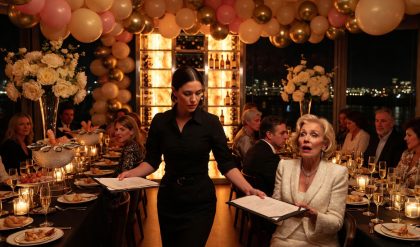
On June 14, 2025, at 4:40 PM, my parents, Ashley, Trevor, and half the extended family burst through the grand glass doors of the Chicago Memorial Hospital Atrium ten minutes late, still dressed in full black-tie formal wear. Ashley’s gown shimmered under the lights like she had walked straight out of her own reception. My mother’s face already carried that practiced mix of mild annoyance and superiority, ready to whisper how they’d slip out early “for Ashley’s big night.”
The string quartet stopped mid-note.
Every head in the room turned.
They froze on the wide marble staircase.
Because this was not the small courtyard ceremony they had imagined. This was the hospital’s prestigious donor atrium — floor-to-ceiling glass walls overlooking the city skyline, white florals everywhere, two hundred people in attendance. Fire Chief Ramirez stood in full dress uniform beside Sam’s firehouse brothers. The hospital CEO was there with his wife. Mia Hartley, now a healthy nine-year-old, held a basket of petals beside her grateful parents. Cameras from the hospital foundation and local news rolled quietly in the background. A large donor wall behind the altar bore my name in gold lettering for the pediatric ICU wing I had quietly helped fundraise for years.
My mother’s mouth fell open. Ashley’s perfect smile shattered.
I stood at the top of the stairs in my elegant white gown, Sam beside me looking sharp in his tux, calm and proud. I didn’t raise my voice. I didn’t need to.
“You’re late,” I said simply, voice carrying through the hushed atrium. “But don’t worry. We waited. Because unlike some people, I don’t erase family.”
My father blinked rapidly, staring at the donor wall with my name on it. My mother’s face went pale as the realization hit — this was the wedding people would talk about. Not Ashley’s.
Ashley stepped forward, voice tight. “Jenny, this is… you never said—”
“I didn’t have to,” I replied, meeting her eyes. “You never asked. You assumed the quiet daughter would just adjust. Again.”
Sam squeezed my hand. The officiant smiled and continued the ceremony without missing a beat. My family stood awkwardly on the stairs in their over-dressed confusion while vows were exchanged, rings slipped on, and applause erupted from people who actually knew my worth.
They stayed for the entire reception. No one left early. No one dared.
Ashley’s own wedding the following week felt noticeably smaller after the photos of my ceremony circulated. My mother tried to call me the next day, voice shaky. “We didn’t know, sweetheart. We’re so proud of you.”
I let the silence stretch before answering. “You will understand one day, Mom. Some daughters don’t need to be loud to be extraordinary. They just need to stop shrinking themselves so others can shine.”
I hung up gently.
Sam and I honeymooned in Italy. I returned to the PICU stronger, lighter, and finally seen. Ashley slowly faded from the center of every conversation. My parents started showing up for my shifts with coffee and real questions about my life.
I never raised my voice. I never needed revenge.
I simply stopped dimming my light so theirs could feel brighter.
And the world finally noticed.”