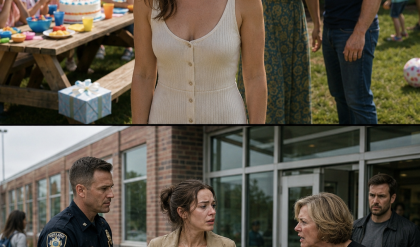
I did not cry in the taxi.
That surprised me.
Maybe because humiliation has different stages, and I had passed the crying stage somewhere between Patricia’s laughter and my own son telling me not to take it badly. I sat in the back seat with the little white envelope inside my cloth bag, the same cloth bag I had carried to markets, hospitals, school meetings, bank offices, and my husband’s funeral. On one side of the bag was the cruel note. On the other was the warmth left from the shawl I had given Valeria, my granddaughter, the only person in that house who had understood that love does not become cheap just because it arrives wrapped in old hands.
“Are you okay, señora?” the taxi driver asked, glancing at me through the mirror.
I looked out at the lights of Zapopan passing by like someone else’s Christmas.
“Yes,” I said.
It was a lie, but not a weak one. It was the kind of lie women tell when they are not ready to explain that they have just been broken open in public by the very people they once fed with their last coin.
When I reached my small apartment in Santa Tere, I placed the romeritos container on the counter, even though no one had eaten them. I washed my hands. I changed out of my good blouse. I made tea. Everything slowly. Carefully. Not because I was calm, but because if I moved too quickly, I might start screaming.
Then I opened my bag and took out Patricia’s Christmas gift.
Two hundred pesos.
A folded bill and a hundred-peso note, both new enough to look insulting.
The paper note said:
For your tortillas, doña. Don’t spend it all.
I placed it in the center of my kitchen table.
For a long time, I just stared.
Not at the money. At the handwriting. Big letters, ugly humor, the cruelty of someone who had never known hunger and thought poverty was a costume older people wore for convenience.
Then I stood, walked to the bedroom, pulled a chair to the closet, and reached for the metal box on the top shelf.
It was navy blue, dented on one side, with a little lock that had belonged to my husband, Armando. He used to say, “Meche, one day this box will save us from people with pretty smiles and empty memories.”
At the time, I thought he was only being dramatic.
That night, I understood he had known our son better than I wanted to admit.
Inside the box were documents. Property copies. Old bank letters. The guarantee agreement for Daniel’s construction company. The mortgage structure for the Ciudad del Sol house. The credit line for the truck. The emergency supplier financing I had co-signed when Daniel almost lost his first project. The notarized letter that said if Daniel defaulted, the bank could come after me—but also the private side agreement he had signed with me, the one Patricia never cared to read because she thought old women only kept recipes and holy cards.
My signature had opened doors for Daniel.
My signature could close them too.
I had not given him my name because he deserved a luxury life. I had done it because he was my son.
Five years earlier, Daniel had come to me crying.
Not a polite tear. A full collapse.
His construction business had nearly failed after a client refused to pay on time. He had workers to cover, suppliers threatening legal action, and Patricia pregnant with their youngest. He sat at this same kitchen table with his head in his hands and said, “Mamá, I’m going to lose everything.”
I had not asked whether Patricia respected me.
I had not asked whether he called me often enough.
I had not asked whether one day they might seat me by the hallway at Christmas.
I simply opened my files, looked at what I still owned, and said, “Let’s see what can be done.”
Because mothers are dangerous when their children are drowning.
I used my credit history. My old accounting contacts. A small property I had inherited from my sister. My pension records. My reputation as a woman who had never missed a payment in forty years.
I did not hand Daniel money freely. I was not foolish. I structured it. I made him sign protections. I retained oversight rights. I required quarterly statements. I kept a revocation clause tied to misuse, default, or disrespectful risk to my assets.
Daniel joked at the time.
“Mamá, you’re tougher than the bank.”
I answered, “The bank didn’t raise you.”
He kissed my forehead and said he would never forget.
People always say that before forgetting becomes convenient.
At 2:17 in the morning, I found the page I needed.
Clause Eight.
If the guarantor determines that the debtor has misrepresented financial stability, concealed obligations, or placed the guarantor’s assets or dignity at unreasonable risk, the guarantor may request immediate review, suspension of secondary credit support, and formal notification to all lenders and interested parties.
Dignity.
That word was mine.
The notary had laughed when I insisted on including it.
“Doña Mercedes,” he said, “banks do not measure dignity.”
“No,” I told him. “But I do.”
Now, five years later, Patricia had placed a price on it.
Two hundred pesos.
I slept at sunrise for one hour.
At eight, I called Licenciado Ramírez, the notary who had handled the original agreement. He was nearly eighty now, sharp as a sewing needle, and still answered his own phone because he trusted no secretary with important gossip.
“Mercedes,” he said, “Merry Christmas.”
“Merry Christmas, licenciado. I need to activate the review clause on Daniel Aguilar’s guarantees.”
There was a pause.
Then his voice changed.
“What did he do?”
I looked at the note on the table.
“He forgot who signed.”
By ten-thirty, I was in his office wearing a gray sweater, comfortable shoes, and the pearl earrings Armando bought me on our thirtieth anniversary. Not expensive pearls. Real enough for me. The kind of earrings Patricia would have dismissed as “simple.” Good. I did not need to look wealthy. I needed to look awake.
Licenciado Ramírez read the note twice.
His mouth tightened the second time.
“Did your son know about this?”
“He laughed.”
The old man removed his glasses.
“That may not be legally relevant, but it is spiritually disgusting.”
I almost smiled.
We began with notices. One to the bank that held the mortgage structure. One to the lender tied to Daniel’s business credit. One to the vehicle financing company. One to the supplier line backed by my guarantee. One to Daniel himself, requesting immediate financial disclosure under the private agreement he had signed.
Then I did something even more important.
I called the accountant.
Not Daniel’s accountant. Mine.
Her name was Clara Montes, a former student of mine from years ago, now running a forensic accounting practice downtown. She had once told me, “Doña Meche, if anyone ever tries to confuse you with papers, call me before you sign anything.”
I called.
By that afternoon, Clara was sitting at my kitchen table with her laptop open, the 200 pesos and Patricia’s note placed inside a plastic sleeve like evidence.
She reviewed the company filings Daniel had been sending me.
At first, her face was neutral.
Then it became still.
I knew that stillness. Accountants go still when numbers begin to confess.
“Doña Mercedes,” she said carefully, “has Daniel shown you his current debt position?”
“He sends summaries.”
“These summaries are not complete.”
My stomach tightened.
“How incomplete?”
She turned the laptop toward me.
Daniel’s construction company had taken on private short-term loans—expensive ones. He had used projected contracts to secure advances. He had delayed tax payments. There were supplier disputes. Worse, several recent personal expenses were being passed through the company: luxury dinners, travel, jewelry, school fees, Patricia’s boutique memberships, and one very large payment labeled “client entertainment” that matched the date Patricia bought her mother’s Puerto Vallarta trip.
I closed my eyes.
My son had not only forgotten my help.
He had been standing on unstable ground while laughing at the person who still held one side of the bridge.
Clara scrolled further.
“There are transfers to an account under Patricia’s name.”
“How much?”
She hesitated.
“Enough that your guarantee is being used to maintain an appearance, not a business.”
I thought of the table full of expensive bottles.
The gold bracelet.
The phones.
The watches.
The white lights in the garden.
And my chair by the hallway.
“Can I protect myself?” I asked.
“Yes,” Clara said. “But it will hurt him.”
I opened the plastic sleeve and looked at the note again.
“For your tortillas.”
“Good,” I said quietly. “Pain teaches where gratitude failed.”
The first call from Daniel came at 12:06 the next day.
I was making coffee when the phone rang.
Mijo.
That was still how his name appeared on my screen.
I watched it ring.
Once.
Twice.
Three times.
Then I answered.
“Buenos días, Daniel.”
“Mamá,” he said, breathless. “What did you do?”
Not “How are you?”
Not “I’m sorry.”
What did you do?
I stirred sugar into my coffee.
“I called the notary.”
“Why? The bank just called me. They said there’s a review on the guarantee. My line of credit is frozen.”
“Suspended pending review.”
“Mamá, this is serious!”
“Yes.”
“You can’t just do this because of a joke.”
I sat down slowly.
“A joke?”
He groaned. “Patricia was being stupid, okay? But you know how she is.”
I smiled sadly.
That was the problem. I did know how she was. And he knew too.
“No, Daniel. I know how you let her be.”
Silence.
Then his voice softened, the way it used to when he was a boy asking for money for school trips.
“Mamá, please. We can talk. You’re upset. Come over tonight. Patricia will apologize.”
“Will she?”
A pause.
“I’ll make her.”
I laughed once. It came out harder than I expected.
“I do not need a forced apology from a woman who thinks my dignity costs two hundred pesos.”
“Mamá, don’t say it like that.”
“How should I say it?”
He lowered his voice. “The kids are here.”
“Good. Maybe they should learn that humiliating a grandmother has consequences.”
His breathing changed.
“You’re going to ruin me.”
“No, Daniel. I am reading what you signed.”
He went quiet.
I continued.
“You have until Friday to provide full financial disclosure to Licenciado Ramírez and Clara Montes. Company debts, supplier obligations, personal withdrawals, vehicle financing, mortgage documents, and any transfers to Patricia.”
At the mention of Patricia, his voice sharpened.
“Why are you bringing her into this?”
“Because her name is in the accounts.”
Another silence.
Longer this time.
He did not know I knew.
That told me enough.
By evening, Patricia called from her own phone. I almost did not answer, but curiosity is a dangerous old friend.
“Doña Mercedes,” she said, her voice sweet as spoiled fruit. “I think there has been a misunderstanding.”
“About the tortillas?”
A sharp inhale.
“I admit the note was in poor taste.”
“It was cruel.”
“It was a joke.”
“Jokes make everyone laugh. That one only fed people who already liked watching me shrink.”
She hated that. I could hear it.
“Look,” she said, dropping the sweetness, “I don’t know what Daniel told you years ago, but this house is ours. The business is his. You can’t just interfere because your feelings got hurt.”
“My assets are still attached to his business.”
“That was your choice.”
“Yes,” I said. “And withdrawing protection is also my choice.”
Her voice lowered. “Be careful. If Daniel falls, your granddaughter’s life changes too.”
That landed.
Because Valeria was my soft place.
The girl who had defended me in that room. The girl who wore my handmade shawl over her tablet and cried when people laughed. Patricia knew exactly where to press.
So I pressed back.
“Valeria’s life already changed when she saw her mother humiliate her grandmother and her father laugh.”
Patricia said nothing.
I continued.
“If you are worried about Valeria, begin by teaching her that money without decency is just decoration.”
She hung up.
That night, my granddaughter called.
“Abuelita?”
Her voice was small.
“Mi niña.”
“Are you mad at me?”
My heart cracked.
“No. Never at you.”
“My mom said you’re trying to take our house.”
I closed my eyes.
Of course she did.
“I am trying to protect what belongs to me, and to make your father tell the truth about money.”
“Are we poor now?”
I thought carefully.
Children deserve truth, but not adult fear poured into their little hands.
“No, mi niña. You are not poor. But your parents may have spent like money could never run out.”
She was quiet.
“I kept the shawl,” she whispered. “I slept with it.”
My eyes filled.
“Good.”
“Everyone is fighting.”
“I know.”
“Dad cried.”
That hurt.
No matter how old your son is, knowing he cried still pulls at the mother inside you.
But then I remembered him laughing.
Not embarrassed.
Laughing.
“Sometimes adults cry when consequences arrive,” I said. “That does not mean the consequence is wrong.”
Valeria was silent for a long time.
Then she said, “I told them it was mean.”
“I know you did.”
“I meant it.”
“I know.”
“Can I visit you?”
I looked around my small apartment. The old sofa. The plants. The kitchen table covered with documents and a plastic sleeve holding 200 pesos of insult.
“Yes,” I said. “Always.”
The next day, Daniel came without Patricia.
He knocked instead of using his key. That was new.
When I opened the door, he looked tired. His hair was messy, his eyes red, his expensive jacket wrinkled. For a moment, I saw the little boy who used to run into my arms after school, crying because someone had broken his pencil box.
Then I saw the man who had laughed while his wife called me vieja.
Both were true.
That is what makes family pain so difficult.
“Mamá,” he said. “Can I come in?”
I stepped aside.
He sat at the kitchen table. His eyes went to the plastic sleeve with the note.
He looked away.
“Patricia went too far,” he said.
I poured coffee into two cups.
“You went with her.”
He swallowed.
“I laughed because everyone laughed. I didn’t think.”
“No. You didn’t.”
“I’m sorry.”
I placed his cup in front of him.
“Are you sorry because the bank called?”
He looked up, hurt.
I did not soften.
It is not cruelty to ask a necessary question.
He looked at the table.
“At first, yes.”
I appreciated the honesty more than I expected.
“And now?”
He rubbed his face.
“Now I keep seeing Valeria’s face. She looked at me like she didn’t know me.”
“Maybe she saw you clearly.”
His eyes filled.
“I don’t want her to remember me like that.”
“Then become someone else before the memory hardens.”
He nodded, crying silently.
Then I opened Clara’s report.
“We need to talk about the company.”
His grief changed to fear.
“Mamá—”
“No. You will listen. You have unpaid supplier balances. Personal expenses in company accounts. Transfers to Patricia. Private loans. A mortgage depending on guarantees you no longer deserve. You have been building a house on borrowed respect.”
He stared at the papers.
“Patricia said we had to keep up appearances,” he whispered.
I almost laughed from sadness.
“Appearances do not pay suppliers.”
“I know.”
“Do you?”
He looked at me, ashamed.
“She wanted the house. The truck. The parties. Her family kept comparing us to her cousins. I thought if I looked successful long enough, real success would catch up.”
That sentence was foolish.
It was also painfully human.
“How much did Patricia transfer?” I asked.
He flinched.
“I don’t know exactly.”
“Daniel.”
“I didn’t want to know.”
“There is your problem. You wanted luxury without accounting.”
He gave a broken little laugh.
“You sound like when I was fifteen and crashed the motorcycle.”
“And you still don’t know how to brake.”
For the first time, a tiny smile appeared and vanished.
Then he became serious.
“What are you going to do?”
“What I should have done sooner. I am removing my guarantee unless you restructure under supervision, sell unnecessary assets, repay improper withdrawals, and formally protect Valeria’s education from your debt.”
His face went pale.
“The house?”
“You may lose it.”
“Mamá…”
“I lost things too. You were just not looking.”
He lowered his head.
For the next hour, we went line by line.
The truck had to go.
The Puerto Vallarta trip Patricia gave her mother had been paid from company funds. That had to be repaid.
The gold bracelet? Personal debt.
The supplier invoices? Priority.
The mortgage? Review.
The business? Possible, but only if cleaned.
Daniel looked smaller with every page.
Good.
Some men only become adults after the numbers stop lying for them.
Patricia arrived halfway through without warning.
She did not knock.
She walked in with sunglasses on her head and fury in her mouth.
“So this is where you are,” she snapped at Daniel.
Then she looked at me.
“You happy now?”
“No.”
“Don’t act humble. You’re enjoying this.”
I leaned back.
“Patricia, if I enjoyed humiliating people, I would have given you 200 pesos in front of your family and called it comedy.”
Daniel closed his eyes.
Patricia’s face flushed.
“You old—”
Daniel stood. “Enough.”
She stared at him.
I did too.
He looked shaken by his own voice, but he kept going.
“You don’t talk to my mother like that.”
Patricia laughed. “Now you defend her? After she froze your credit?”
“After I let you humiliate her in my house.”
“Our house.”
“With her signature under it.”
The words hit like a slap.
Patricia’s eyes widened.
Daniel turned to me. “I’m sorry I didn’t say that that night.”
I nodded once.
Not forgiveness.
Acknowledgment.
Patricia pointed at him. “You’re going to let her destroy us?”
“No,” he said. “I destroyed us by pretending we could afford a life we hadn’t earned.”
She stepped back as if he had betrayed her.
Maybe to her, honesty was betrayal.
The next weeks were chaos.
The bank review forced Daniel into the daylight. Suppliers demanded payment plans. The truck was listed for sale. Patricia’s mother returned the Puerto Vallarta voucher after a very uncomfortable call from Clara, who explained the difference between a gift and misappropriated company funds. Patricia screamed that Clara was harassing her. Clara, who had raised three sons and audited two corrupt municipal contractors, replied, “Señora, harassment uses insults. I use spreadsheets.”
I loved her more that day.
The house in Ciudad del Sol became the center of the storm.
Patricia wanted Daniel to fight me. She wanted a different lawyer. She wanted to claim I had manipulated him. She wanted to move assets before the bank finalized the review. What she did not want was disclosure.
So Clara kept digging.
That was how we found the second secret.
Patricia had been transferring money from Daniel’s company account into a boutique business registered under her sister’s name. The business sold luxury décor online but had almost no real customers. It did have invoices from Daniel’s construction company for “staging consultations” and “client environment styling.”
Fake services.
Real money.
When Daniel saw the report, he sat in silence for a full minute.
Then he said, “She told me that business belonged to her sister.”
“It does,” Clara said. “On paper.”
“But the deposits came from my company.”
“Yes.”
He looked sick.
“Did she know we were in trouble?”
Clara gave him the sad look accountants give men who ask questions numbers have already answered.
“She knew enough to move money away from the sinking part.”
Daniel covered his face.
I did not comfort him immediately.
That was hard.
But sometimes a mother’s comfort becomes a hiding place, and Daniel had hidden enough.
He looked up at me, eyes wet.
“I let her make you small because I thought she made me big.”
My throat tightened.
There he was.
Not fully changed.
Not forgiven.
But seeing.
“Then learn the size of your own spine,” I said softly.
The legal and financial restructuring took three months.
Daniel sold the truck. Sold jewelry. Canceled memberships. Closed the fake vendor contracts. Entered repayment agreements. Patricia fought until the evidence pointed too clearly at her. Then she changed strategy and claimed Daniel had forced her. That lasted until Clara produced messages where Patricia wrote to her sister:
Don’t worry. His mother is old and too proud to ask questions. Daniel signs what I put in front of him.
I read that message twice.
Old and too proud.
No.
Old and patient.
There is a difference.
The marriage between Daniel and Patricia cracked under the weight of the truth. I will not pretend I was sad about Patricia leaving the house for a month to stay with her mother. But I was sad for Valeria, who began visiting me every Wednesday after school with quiet eyes and the shawl folded in her backpack.
One afternoon, she asked, “Was my mom stealing?”
I was washing strawberries.
The knife paused in my hand.
“Your mother moved money in ways that were wrong.”
Valeria sat at the table.
“Did my dad know?”
“He should have known more than he did.”
She nodded slowly.
“Adults always say kids don’t understand, but we understand the room.”
I turned toward her.
She was twelve.
Still a child.
But children in houses full of performance often become experts in rooms.
“You should not have had to understand that room,” I said.
She touched the edge of the shawl.
“When everyone laughed at you, I felt like something broke.”
“In me too.”
She looked up.
“But you didn’t yell.”
“No.”
“Why?”
I thought about it.
“Because I spent many years learning that yelling makes people listen to volume, not truth. I wanted them to hear the papers.”
Valeria smiled faintly.
“That sounds like you.”
I laughed.
Maybe it was.
By spring, the house was sold.
Not because I demanded it. Because the numbers did. Daniel could not keep it, pay suppliers, settle debts, and protect his company. Patricia called it humiliation. Daniel called it reality. I called it math.
The day they moved out, I went only because Valeria asked me to be there.
Patricia stood in the driveway in oversized sunglasses while movers carried boxes. She looked at me with pure hatred.
“I hope you’re proud,” she said.
I looked at the house where they had placed me in a hallway, laughed at a cruel note, and handed me money like charity while living under my guarantee.
“I am relieved,” I said.
“That house was my dream.”
“No,” I answered. “It was your stage.”
Her mouth tightened.
“You think you won?”
I looked toward Valeria, who was carrying her schoolbooks to Daniel’s smaller rented apartment down the street.
“No. A child lost the home she knew because adults mistook appearance for success. Nobody won.”
That silenced her longer than any insult would have.
Daniel moved into a modest apartment with Valeria. Patricia eventually filed for separation, then tried to claim Daniel had hidden the financial mess from her. Clara’s reports made that difficult. Their divorce became another set of papers, less dramatic than Christmas but more expensive. Valeria stayed mostly with Daniel after a judge considered her age, school routine, and her own preference. Patricia received visitation and, to her credit, began behaving less like a queen when courts started asking for receipts.
Daniel changed slowly.
Not beautifully.
Not like a movie.
Slowly.
He took accounting classes for business owners. He rehired his company bookkeeper with real authority. He stopped calling personal spending “networking.” He visited suppliers in person to apologize. Some cursed him. Some accepted payment plans. Some never worked with him again. Consequences do not ask whether you are learning. They arrive anyway.
He came to my apartment every Sunday.
The first time, he brought flowers.
I told him, “Flowers are nice. Bring bank statements.”
The next Sunday, he brought both.
We reviewed expenses at my kitchen table. At first, he looked embarrassed. Then grateful. Then irritated. Then humble again. Growth is not a straight line; it is a man arguing with his own habits.
One Sunday, he looked at the 200 pesos still sealed in plastic.
“You kept them.”
“Yes.”
“Why?”
“So I never confuse help with humiliation again.”
He winced.
“I wish I had stopped her before she gave you that envelope.”
I looked at him.
“I wish you had stopped yourself before laughing.”
He nodded.
“I know.”
That was better than excuses.
Apology is not a broom. It does not sweep the night clean. But repeated truth, over time, can clear a path.
A year after that Christmas, Daniel invited me to dinner.
Not a luxury dinner. Not Ciudad del Sol. Not wine bottles meant to impress in-laws. A simple meal in his apartment: pozole, tostadas, agua de jamaica, and a small table where every chair mattered because there were only four.
Valeria set the plates.
Daniel pulled out the chair closest to the kitchen, then stopped himself.
He looked at me.
“Where do you want to sit, Mom?”
Such a small question.
Such a large repair.
I chose the chair by the window.
During dinner, Daniel stood with a nervous face and held an envelope.
My body tightened.
He saw it.
“It’s not money,” he said quickly.
Valeria laughed.
Inside was a letter.
He read it aloud.
“Mamá, last Christmas I allowed my wife and her family to humiliate you in my house. I laughed because I wanted to belong to people who admired money more than love. I forgot that when I had nothing, you signed your name for me. I forgot that every room I showed off had your trust beneath it. I forgot that a mother is not a ladder you kick away after climbing.”
His voice broke.
“I am sorry. Not because I lost the house. Because I lost the kind of son I wanted Valeria to see. I am working to become him again.”
He folded the paper with shaking hands.
I cried then.
Not loudly.
Just enough.
Valeria reached for my hand.
Daniel did not ask if I forgave him.
That helped.
People who rush forgiveness usually want relief more than repair.
After dinner, he handed me a small box.
Inside was a tortilla press.
Old-fashioned. Heavy. Beautifully made.
I stared at it, confused.
Daniel smiled sadly.
“I thought about the note. About tortillas. About how Patricia used that word like an insult. Then I remembered being little, standing beside you while you pressed tortillas on Sundays. I remembered thinking your hands could make anything into home.”
I touched the press.
“I don’t know if this is stupid,” he said.
“No,” I whispered. “It is not stupid.”
Valeria said, “Can we make some now?”
So we did.
Flour on the table. Dough too wet at first. Daniel clumsy. Valeria laughing. Me correcting them both. The apartment filled with the smell of warm tortillas, and for the first time in a year, the word did not hurt.
It fed us.
The construction company survived, smaller but cleaner. Daniel lost clients who had liked his old image. He gained others who respected honest pricing and transparent contracts. He stopped calling himself a “visionary” in brochures and started paying suppliers on time. That impressed me more.
I formally removed my guarantee after the restructuring. Not because I wanted him to fail, but because a son who has truly grown should not need his elderly mother’s assets standing behind his pride.
He signed the release papers in Licenciado Ramírez’s office.
His hand shook.
Mine did not.
When it was done, he kissed my forehead.
“Thank you for helping me,” he said.
I looked at him over my glasses.
“Daniel, I did not help you by signing years ago. I helped you by stopping.”
He thought about that.
Then nodded.
“Yes.”
Patricia’s life became quieter after the divorce. Her boutique scheme failed. Her sister stopped speaking to her for a while after legal letters required repayment. She moved to a smaller apartment and complained online about “older generations weaponizing money.” Nobody who knew the case took her seriously. She remained Valeria’s mother, and because I loved my granddaughter, I did not poison that bond. I told Valeria the truth when necessary, but I never asked her to hate Patricia on my behalf.
One day, Patricia came to my apartment to pick up Valeria after a visit.
She stood in the doorway, no red dress, no collar worth three pensions, no audience.
“Doña Mercedes,” she said stiffly.
“Patricia.”
Valeria was still packing her books.
Patricia looked at the kitchen table where the tortilla press sat.
Her eyes went to my face.
“I was cruel that Christmas.”
I waited.
She swallowed.
“I thought making you small made me secure.”
That was the most honest thing she had ever said.
“And did it?”
Her eyes watered.
“No.”
I nodded.
“No, it never does.”
“I’m sorry.”
I believed she meant it in that moment. I also knew remorse can be temporary if not practiced. So I did not open my arms. I did not absolve her. I simply said, “Do better for Valeria.”
She nodded.
“I’m trying.”
“Try with receipts,” I said.
For the first time, she gave a tiny laugh that was not cruel.
Maybe that was something.
Maybe not.
I no longer needed to decide.
Two years after the Christmas of the 200 pesos, I began teaching free financial literacy classes at the community center in Santa Tere. It started because my neighbor, Lupita, asked me to help her understand a loan her son wanted her to co-sign. Then another woman came. Then another. Soon, every Thursday afternoon, my little group of older women sat around folding tables with notebooks, reading glasses, and more courage than they realized.
I taught them about guarantees.
Debt.
Property rights.
Signatures.
Family pressure.
How to say, “I need to read this first.”
How to ask for copies.
How to check whether love is being used as collateral.
I brought the 200 pesos in the plastic sleeve to the first class.
They laughed when they saw it, but not because it was funny. Because women who have been insulted recognize each other’s evidence.
“This,” I told them, holding up the note, “is what disrespect looks like when it thinks you have no power.”
Then I held up a copy of Clause Eight.
“And this is what power looks like when it waits patiently in a folder.”
Doña Meche from the bakery shouted, “Teach us that one!”
So I did.
The class became popular. Sons got nervous. Daughters-in-law stopped smiling too widely when they heard their mother-in-law had started attending “Doña Mercedes’s papers class.” I did not teach revenge. Revenge is messy and often expensive. I taught awareness. Awareness is cleaner. It saves you before you need dramatic scenes.
One afternoon, Valeria came to sit in the back.
She was fourteen by then, taller, quieter, still wearing the shawl sometimes when she studied. After class, she helped stack chairs.
“Abuelita,” she said, “I want to study finance.”
My heart warmed.
“Because of the class?”
“Because of you.”
I pretended to organize markers so she would not see me cry.
She continued, “I don’t want anyone to laugh at a woman because they think she doesn’t understand money.”
I turned toward her.
“You will make a terrifying accountant.”
She grinned.
“Good.”
On my seventy-fifth birthday, Daniel organized a lunch at a modest restaurant with blue walls and decent pozole. He invited no one who had laughed that Christmas. Only Valeria, his youngest, my neighbor Lupita, Clara, Licenciado Ramírez, and a few people who had become true family through the years.
At the end of lunch, Valeria stood and placed a small envelope in front of me.
Everyone went quiet.
She saw my face and said quickly, “It’s good, Abuelita. I promise.”
Inside were 200 pesos.
For half a second, the old pain rose.
Then I saw the note.
For tortillas with you. Teach me again.
My eyes filled so fast the words blurred.
Valeria hugged me.
This time, everyone at the table understood what the money meant.
Not mockery.
Memory.
Not humiliation.
Inheritance.
Daniel wiped his eyes.
Clara pretended not to.
Licenciado Ramírez muttered, “Dust in here,” though we were indoors.
That afternoon, Valeria and I made tortillas in my kitchen. She pressed them too thick. I corrected her. She rolled her eyes exactly like her father had at fifteen, and I laughed because love survives strangely. The table was covered with flour, and the old insult had finally been transformed into something warm enough to eat.
Years later, people still tell the story dramatically.
They say my daughter-in-law gave me 200 pesos and called me old.
They say I froze my son’s credit.
They say the luxury house was sold.
They say Patricia learned not to mock a retired accountant.
All of that is true.
But the real story is not about revenge.
It is about signatures.
The ones we put on bank papers.
The ones we place under other people’s dreams.
The ones we give our children when we trust them.
And the invisible ones we place on our own dignity when we decide, finally, that love does not require us to be laughed at in order to belong.
I still have the 200 pesos from that Christmas. I never spent them. They remain sealed with the note, filed under a label Clara made for me:
TUITION.
Because that money paid for a lesson.
Not for tortillas.
For truth.
My son learned that a mother is not a backup account.
Patricia learned that humiliation can have interest.
Valeria learned that kindness is not weakness.
And I learned that it is never too late, not even at seventy-two, to pick up your own name from the floor and put it back where it belongs.
At the head of the table.
THE END.