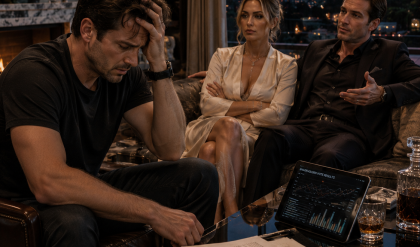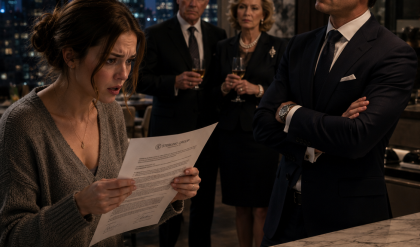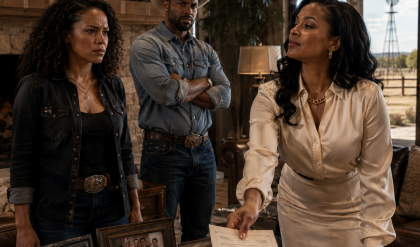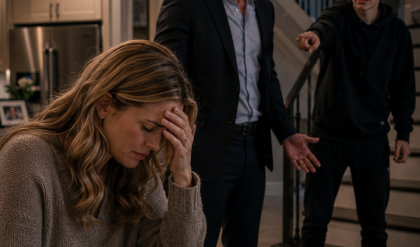
At the federal building downtown, Special Agent Miles Renner pinned the photograph to a board covered in surveillance images and financial charts. Beside Claire’s face, he wrote one word.
Asset.
He had no idea how wrong he was.
The wedding happened quietly at the Cook County courthouse.
No flowers. No orchestra. No fairy-tale vows.
Dante wore a black suit. Claire wore ivory, not white. Elena Brooks, Claire’s best friend from the university, stood beside her with the expression of a woman watching someone step into fire and refusing to look away.
After the ceremony, Elena pulled Claire aside.
“Tell me this was your choice.”
“It was.”
“Tell me he didn’t find you broken and use that.”
Claire looked through the courthouse window at Dante, who was speaking quietly to his attorney.
“He came to me because I was useful.”
Elena’s face softened with worry.
“Claire, Preston spent six years making you feel useless. Be careful with the first man who tells you otherwise.”
Claire wanted to dismiss it.
She could not.
Because somewhere beneath the contract, beneath the money, beneath the revenge, Dante Marino had looked at her as if she mattered before she had done anything to prove it.
And that was dangerous.
Preston called four days later.
Not her cell. She had blocked him. He called her office at Lakeview University.
“This is insane,” he snapped. “Do you understand what you’ve done? Dante Marino is a federal target.”
“Good morning, Preston.”
“Don’t do that.”
“You prepared a statement questioning my mental health two weeks before the gala,” Claire said calmly.
Silence.
“I don’t know what you—”
“Don’t,” she said. “I know. Withdraw it. If you don’t, people will start asking why your campaign payments in September went through three consulting firms that share one mailbox in Evanston.”
His breathing changed.
“Are you threatening me?”
“No. I’m describing reality accurately. That’s what I do.”
Then she hung up.
For the first time in six years, her hands did not shake after speaking to him.
At Dante’s estate, people watched Claire as if she were a temporary problem.
Salvatore Rizzo, Dante’s oldest lieutenant, called her “the professor” with just enough contempt to make the room hear it. Others treated her like decoration, useful only because cameras liked a respectable wife.
Claire let them.
For ten days.
Then came the dinner.
Twelve men sat at Dante’s long dining table, men who controlled money, routes, warehouses, and silence. Across from Claire sat Frank Bellini, a broad, smug man with a wine collection he spoke of like royalty.
“So what do you contribute?” Bellini asked loudly. “Besides the image?”
The table went still.
Dante’s eyes lifted.
Claire set down her fork.
“Your Bordeaux collection,” she said.
Bellini blinked.
“The 1947 cases used as collateral in the Meridian property deal. The documents trace back to a Paris auction house dissolved after a fraud investigation. There’s a fourteen-month gap in the chain of custody. If a forensic accountant reviews it, the valuation collapses, and the loan becomes evidence.”
No one breathed.
Claire picked up her glass of water.
“That’s what I contribute.”
Bellini turned red.
Dante looked at him. “She just saved you from a wire fraud charge. Thank her.”
The apology tasted like blood in Bellini’s mouth.
Later that night, Dante found Claire in the library.
“How long did it take you to find that?” he asked.
“Forty minutes.”
“You could have told me.”
“I needed to know if I was useful here as myself.”
Something shifted in his face.
“You were never just useful.”
Claire looked away first.
Because contracts were simple.
That sentence was not.
The first attack came two weeks later.
A shot shattered the east window of Dante’s study and buried itself in the wall three inches from where he had been standing.
Security locked the estate down.
Within hours, Salvatore discovered the truth.
The shooter had used an interior corridor. Only nine people had access.
One of them was missing.
Dante’s head of security.
A man named Victor Kane.
“He didn’t move alone,” Claire said.
Every man in the room turned toward her.
She looked at the timeline, the access records, the accounts Victor had monitored, the dinner guest list.
“Bellini,” she said. “He realized I could expose him. But he wouldn’t risk killing me directly, because Dante would burn his world down. So he aimed at Dante and hoped the chaos swallowed me too.”
Dante’s voice was low.
“Can you prove it?”
Claire looked at the scattered papers.
“Give me one night.”
She did not sleep.
By dawn, she had mapped shell companies, insurance filings, auction records, property transfers, and one payment routed through a foundation supposedly funding youth arts programs in Milwaukee.
The money led from Bellini to Victor Kane.
But the final transfer led somewhere else.
Preston Vale.
Claire stared at the name for a long time.
It made no sense.
Then it made perfect sense.
Preston had not only wanted Dante destroyed. He had wanted Claire ruined by association. If Dante died, Claire became the suspicious new wife of a murdered mafia boss. If she survived, she became a federal target. Either way, Preston’s humiliation of her would be forgotten under a larger scandal.
He had not moved on.
He had escalated.
Dante found her in the study at sunrise.
“Claire?”
She handed him the file.
His face hardened as he read.
“I want to kill him,” he said quietly.
“No.”
Dante looked up.
“No?” he repeated.
“No,” Claire said. “That’s what he expects from you. Violence makes him look right about both of us.”
“He tried to have me killed.”
“He tried to use your reputation to hide his cowardice.” Her voice broke for the first time. “So we use the truth.”
Agent Miles Renner approached Claire two days later outside the university archive.
He offered protection. Immunity. A clean exit from Dante Marino.
“You’re an intelligent woman,” Renner said. “Don’t throw your life away for him.”
Claire looked at the federal agent who thought she was trapped.
“I’m not here because I was deceived.”
“Then why are you here?”
She thought of Preston’s laugh, Dante’s silence, Elena’s warning, the library fire, the way her own name had begun to feel like hers again.
“Because for once,” Claire said, “I chose my own life.”
Then she handed him a copy of the file.
Not to betray Dante.
To expose Preston.
The press conference happened on a Monday morning.
Preston Vale arrived expecting to announce new campaign endorsements. Instead, reporters began shouting questions about illegal payments, fraudulent consulting firms, and a conspiracy connected to an attempted murder investigation.
Bianca Carrington left through a side door.
Her father withdrew support by noon.
By evening, Preston’s campaign was over.
By Friday, he was indicted.
Chicago went silent.
The same people who had laughed at Claire at the gala now pretended they had always admired her dignity. Invitations arrived. Apologies appeared. Women who had whispered about her sent flowers with handwritten notes.
Claire threw most of them away.
Three months later, she stood again beneath the chandelier at the Ashford Grand Ballroom.
This time, she was not Preston Vale’s discarded fiancée.
She was Dr. Claire Hartley-Marino, newly appointed director of a foundation that used seized criminal assets and private donations to fund legal aid, domestic abuse shelters, and arts education for children who had been taught that survival was the same as silence.
Dante stood beside her, still dangerous, still complicated, but quieter now in ways only she noticed.
Their two-year contract sat unsigned in a drawer.
Not canceled.
Not renewed.
Simply no longer the most important document between them.
At the edge of the ballroom, Elena touched Claire’s arm.
“Are you safe?” she asked.
Claire looked across the room.
Preston was gone. Bianca was gone. The laughter was gone.
But more importantly, the old Claire—the woman who counted chandelier crystals to keep from breaking—was gone too.
“No,” Claire said honestly. “Not completely.”
Elena frowned.
Claire smiled.
“But I’m free.”
Across the room, Dante watched her with the same still attention he had given her in the rain.
This time, Claire walked toward him by choice.
And for the first time in her life, Chicago did not feel like a city deciding her worth.
It felt like a city learning her name.