Part 3
By dawn, Philadelphia had begun pretending it was just another morning.
Buses sighed at curbs. Coffee shops unlocked their doors. Office workers crossed Market Street carrying iced coffees and private worries. The city did not stop for horror. It absorbed it, renamed it news, and kept moving.
Vincent sat in a federal conference room across from Detective Eliza Martinez while Thomas Hargrove began giving up names.
Martinez was in her early forties, sharp-eyed, exhausted, and entirely uninterested in being impressed by him.
She placed three photographs on the table.
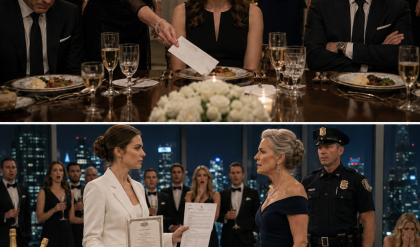
“Federal Judge Alan Whitmore,” she said. “City Councilman Raymond Cross. Katherine Bryce, general counsel for a private equity firm with offices in six countries. Hargrove built operations. Bryce built the money.”
Vincent looked at the faces.
Respectable faces. Donor dinner faces. Faces that smiled beside mayors and shook hands at charity galas while women vanished through loading docks.
“How many?” he asked.
“Across all branches? We don’t know yet.”
It was the first honest answer anyone had given him all night.
“The women from tonight?”
“Twenty-seven recovered from three locations. One location was cleared before teams arrived. We’re tracking the transfer route.”
Avery had counted thirty-one.
Four missing.
Vincent closed his eyes for one second.
Martinez noticed but did not comment.
“There’s a specific victim,” he said. “The one who helped identify Hargrove. Her current name is Avery Quinn. I want it protected. No press. No forced public testimony.”
“I can consider that. I can’t promise it yet.”
“Consider it seriously.”
Martinez held his gaze. “I will.”
Frank Caruso sat against the wall with coffee gone cold in his hand.
“And Paul Sheridan?” Frank asked quietly.
Martinez did not soften. “He’ll be charged. Cooperation will be considered.”
Frank nodded as if he had expected nothing else and still hated hearing it.
Vincent left the building as the sky turned gray-gold.
He did not go to Eclipse. He drove first to the burned Locust Street apartment and parked outside. He thought of Avery sitting behind cleaning supplies, saying I’m sorry before anyone accused her of anything.
Then he drove to Fairmount, to the backup building Roman had found with cash from his own account.
Avery opened the door after the second knock.
She had slept, but not peacefully. Her hair was loose around her face. She wore the same gray shirt from Eclipse. When she saw Vincent, she read him quickly.
“It’s done?” she asked.
“For tonight.”
She stepped aside.
He came in and sat at the small kitchen table. She sat across from him.
“Hargrove is in custody,” Vincent said. “Derek is too. Franklin will be before the day ends. The federal case will take a long time, but the operation is exposed.”
“The women?”
“Twenty-seven out. Four unaccounted for from the location they moved before we got there.”
Avery looked down at her hands.
For a moment, she was back somewhere else, counting faces in locked rooms.
“Daria?” she asked.
“I’m checking.”
Avery nodded, but her throat moved like she had swallowed something sharp.
Vincent waited.
When she looked up again, her eyes were wet but steady.
“I don’t want to be in the papers.”
“You won’t be if I can stop it.”
“And if you can’t?”
“Then Martinez will hear from me every day until she remembers why she should.”
That almost made Avery smile. Almost.
Vincent leaned back. “You have a choice now. Federal victim services can place you somewhere completely separate from me. It may be safer. Cleaner.”
“Cleaner,” she repeated.
He did not pretend not to hear the edge in it.
“I know what I am,” he said.
Avery studied him.
“When I ran,” she said, “I went to a police station first.”
Vincent went still.
She had not told him that before.
“I stood across the street for twenty minutes. There was a man outside smoking. A uniform. I watched him laugh with another officer, and all I could think was, what if they ask for my real name? What if they call someone? What if they don’t believe me? What if they do believe me and still can’t stop it?”
Her voice trembled once, then steadied.
“So I went to the shelter instead. The system didn’t find me. You did.”
“That doesn’t make me good.”
“No,” Avery said. “But it makes you here.”
There was nothing sentimental in the room. No music. No sunrise miracle. Just two people sitting at a cheap table in a borrowed apartment, with a city waking outside and the truth between them.
Vincent nodded.
“I have another place. Pine Street. Two bedrooms. No one from this week knows it. You can stay there until you choose otherwise. Same terms. You pay what you can. You work if you want. You leave when you’re ready.”
“And Daria?”
“I’ll find her.”
Three days later, Katherine Bryce was arrested in New York.
By the end of the week, Judge Whitmore resigned before the indictment became public. Councilman Cross held a press conference on his front steps and called the allegations politically motivated. His wife stood beside him wearing sunglasses though the sky was cloudy.
The sunglasses did not help.
Franklin Holloway tried to leave through a private airfield outside Trenton. Martinez’s people were waiting before the plane’s engines warmed.
Paul Sheridan pled guilty months later. His cooperation reduced his sentence but did not erase what he had done. Vincent made sure Paul’s wife and children had money they could not trace back to him. He never told anyone. Not even Frank.
Eclipse closed for six weeks.
People said Vincent Maro was restructuring. They said he was cutting ties, punishing traitors, preparing for war. Some of that was true.
But the part nobody saw was quieter.
Vincent spent those weeks dismantling every route, account, favor, and handshake that had touched Holloway money. Men who thought they were untouchable discovered that Vincent had a long memory and no remaining patience for respectable monsters.
When Eclipse reopened, the staff noticed the rules had changed.
No private rooms without cameras in the halls. No security subcontractors Vincent had not approved personally. No “special arrangements.” No guest entered through the service corridor unless Marcus knew their name and Roman knew their face.
Avery came back on a Thursday.
She wore new jeans, a black T-shirt, and her hair cut just below her shoulders. She still watched exits. Some habits did not vanish because a door opened. But she no longer moved like she was apologizing to the floor.
Marcus handed her a clipboard.
“You’re not cleaning tonight,” he said.
Avery frowned. “What?”
“Inventory assistant. Better pay. Less bleach.”
She looked toward the upstairs booth.
Vincent was there, looking at paperwork.
He did not wave.
She did not smile.
But she took the clipboard.
Two weeks later, Roman found Daria.
She had been recovered from a location in Camden under a different name and placed in federal care. Her daughter was alive in Romania. Martinez’s office was working on reunification.
When Vincent told Avery, she sat down hard on the Pine Street apartment sofa and covered her mouth.
For the first time since he had known her, she cried without trying to stop herself.
Vincent stood in the kitchen and looked out the window until she was done, giving her the dignity of not being watched while grief and relief finally found the same door.
A year later, the first trial began.
The headlines called it one of the largest trafficking cases in federal history. They used words like network, conspiracy, corruption, and institutional failure. They showed pictures of Hargrove, Bryce, Holloway, Whitmore, Cross.
They did not show Avery.
She testified behind closed doors. Her name in the public record was sealed. She spoke for ninety-one minutes. When she came out, Vincent was waiting in the hallway because she had asked him to be there, and because no one in the building had been brave enough to tell him he couldn’t.
“How’d I do?” she asked.
Vincent looked at her.
At nineteen, she still looked too young for what she carried. But she was standing straight. Her hands were not shaking. Her eyes were clear.
“You told the truth,” he said. “That’s harder than most people know.”
Avery nodded.
Outside the courthouse, reporters shouted questions at lawyers and officials. Cameras flashed. The city wanted a clean story. A villain. A hero. A survivor. A rescue.
Real life had not been that clean.
Derek Holloway was guilty and still had once been a scared twenty-three-year-old recruited by a worse man. Paul Sheridan loved his family and still sold his soul in monthly payments. Vincent Maro had saved women from a criminal machine while remaining a criminal himself.
And Avery Quinn was not proof that pain made people stronger.
Pain had hurt her. It had taken things. Some of those things would not come back.
But on the courthouse steps, with autumn wind moving down Market Street and the city loud around her, Avery understood something she had not believed for a long time.
She was not only the girl who ran in the rain.
She was the girl who lived.
Months after the verdicts, she moved out of the Pine Street apartment into a small studio in Queen Village with three locks, too many plants, and sunlight that came through the windows every morning like a promise that did not need to announce itself.
She still worked at Eclipse twice a week, but she also enrolled in community college for social work.
On her last night before classes started, she found Vincent alone upstairs.
“I won’t be here as much,” she said.
“I know.”
“You’re not going to give me advice?”
“I try not to do things I’m bad at.”
This time, she smiled.
Then she placed an envelope on the table.
Inside was six months of rent payments. Not all she owed. More than he had ever expected her to pay.
Vincent looked at it, then at her.
“It was a transaction,” Avery said.
“So it was.”
She turned to leave, then stopped.
“Thank you,” she said.
Vincent did not answer right away.
For once, the silence between them did not feel like danger. It felt like respect.
“You got yourself out of the window,” he said. “Don’t forget that part.”
Avery nodded.
Then she walked down the stairs, across the club floor, and out through the front door.
Not the service entrance.
The front.
THE END