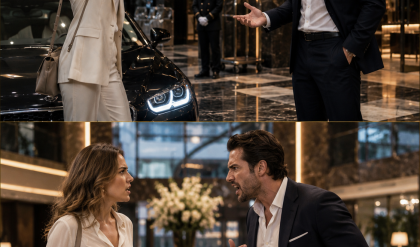
This time, he did smile faintly. “And your name?”
June hesitated. “June Avery.”
Something flickered in his eyes. Not recognition exactly. More like a door opening somewhere in his memory and then closing before he could step through.
“June,” he repeated.
Before he could say more, Madison rose from her seat.
She did it gracefully, with the practiced elegance of a woman who knew cameras loved her. Her bridesmaids quieted at once. Graham looked up, confused but smiling, still not understanding that his new wife was about to reveal herself in public.
Madison lifted her champagne glass. “Everyone, before dinner is served, I just want to say how overwhelmed I am by all this love.”
Applause filled the ballroom.
June sat very still.
Madison thanked her parents. She thanked Graham’s parents. She thanked guests for flying in from New York, Palm Beach, Los Angeles, Aspen. She thanked the florist by name, the dress designer by name, the photographer by name. Then her eyes drifted toward June.
“And of course,” Madison said, smile widening, “we must thank the hardworking staff. Especially those who are enjoying the VIP experience tonight.”
Laughter scattered across the room.
June felt it hit, not because the joke was clever, but because humiliation always carried a familiar weight. She looked down at her hands and reminded herself to breathe.
Cole did not laugh.
Neither did Graham’s grandmother, Martha, who narrowed her eyes from table four.
Madison tilted her glass toward June. “Confidence is important. Even when it appears in unexpected places.”
More laughter.
June lifted her water glass and took a slow sip because it gave her hands something to do.
Cole watched Madison over the rim of his own untouched glass. His expression remained calm, but something behind his eyes had gone cold.
Graham leaned toward Madison when she sat down. “Was that necessary?”
Madison smiled without looking at him. “Don’t be dramatic. It was harmless.”
June heard enough to know Graham had heard it too. That made his silence worse.
A young waiter arrived carrying a tray too heavy for him. His wrist buckled slightly as he approached the head table. Without thinking, June stood and caught the edge of the tray before the champagne flutes tipped.
“I’ve got it,” she murmured.
The waiter’s face flushed with gratitude. “Thank you. I’m sorry.”
“Don’t be. Grip from underneath, not the side. These trays are liars.”
He gave a shaky laugh and adjusted his hold.
June sat back down.
Cole watched the exchange carefully. “You train people?”
“I help when I can.”
“Even when they’re not helping you?”
June looked at him then, uncertain whether he was mocking her. He wasn’t.
“Especially then,” she said.
Again, that strange flicker crossed his face.
Across the ballroom, Madison saw Cole watching June and misread it in the worst possible way. Her expression tightened. This was not how the joke was supposed to work. June was supposed to shrink. Guests were supposed to laugh and move on. Cole Blackwood was not supposed to look interested. Graham’s grandmother was not supposed to look sympathetic. The staff was not supposed to look at June like she was their captain in a storm.
Madison leaned toward Piper. “Get her out of that chair.”
Piper blinked. “How?”
“I don’t care. Spill something. Move her. Do something.”
Piper looked uneasy. “Madison, maybe let it go.”
Madison’s eyes cut toward her. “Do you want to be useful or decorative?”
Piper shut her mouth.
Before anything else could happen, Tessa rushed back to the head table, breathless. “June, I’m so sorry. It’s fixed.”
June stood at once. Relief moved through her so fast her knees almost softened. “Great.”
Tessa whispered, “I don’t know who changed it, but—”
“I do,” June said quietly.
Tessa looked toward Madison and went pale.
June touched her arm. “Don’t. You still have a wedding to run.”
As she stepped away, Cole stood as well.
June looked surprised. “You don’t have to—”
“I know.”
He did not finish the sentence. He simply watched her return to the service floor, where she tied her apron back around her waist and resumed working as though nothing had happened.
That, more than anything, unsettled him.
Cole had seen people beg under pressure, boast under pressure, break under pressure. June Avery did none of those things. She returned to work with her dignity bruised but intact, and somehow the room looked smaller because of it.
Dinner service began. June moved through tables with plates of sea bass, filet, roasted vegetables, and risotto shaped into perfect little towers. She smiled politely. She answered questions. She ignored whispers. She helped the younger waiter again when he nearly dropped a sauce boat.
Then Madison called her name.
“June.”
The voice carried farther than necessary.
June closed her eyes briefly before turning. “Yes, ma’am?”
Madison stood near the dance floor, surrounded by bridesmaids and half a dozen guests eager for entertainment. She held out an empty champagne flute.
“Oh good,” Madison said. “You’re back where you belong.”
The bridesmaids laughed.
A few guests joined in because laughter was safer than disapproval when the person being cruel was rich.
June walked forward and took the glass. “Would you like the same champagne or sparkling water?”
Madison tilted her head. “You’re very composed. I admire that. Most people would be embarrassed after accidentally sitting with actual guests.”
June kept her voice steady. “It wasn’t an accident.”
Madison’s smile twitched.
Piper stopped laughing.
June immediately regretted saying it, not because it wasn’t true, but because the room felt the shift. Madison’s eyes sharpened with warning.
“Excuse me?” Madison asked.
June looked at her and saw, for one strange second, something she could not place. Not just cruelty. Fear. A thin slice of panic hidden under makeup and diamonds.
Then June noticed the bracelet.
It was delicate, platinum, with a sapphire charm shaped like a tiny blue eye. It hung from Madison’s wrist beside her bouquet ribbon, catching the chandelier light.
June’s fingers went cold.
Rain. Metal. Broken glass. A girl in a white coat stumbling backward from a smoking SUV. That same blue charm swinging from her wrist as she whispered, “Please, don’t tell them I was driving.”
June felt the ballroom tilt.
Madison was still talking, but her voice moved far away.
Seven years earlier, on a November night outside Long Island, June had been driving home from a double shift at a nursing facility when an SUV ran a red light and slammed into a small silver sedan. The sound had been terrible, not like in movies. Not clean. Not dramatic. It was a crushing, tearing noise that seemed to split the night open.
June had pulled over before she understood she was moving.
The SUV’s driver-side door hung open. A young woman in a white coat staggered from it, blood at her hairline, diamonds at her ears, that sapphire charm flashing on her wrist. She looked at June with wide, terrified eyes.
“Help me,” she whispered.
June had stepped toward her.
Then the girl in the silver sedan screamed.
June turned and saw the sedan folded around its driver like a fist. Smoke curled from the engine. Gasoline spread across the wet pavement. The driver, a young woman with dark hair and blood on her cheek, was trapped, crying, and fading fast.
June ran to her instead.
The girl from the SUV grabbed her sleeve. “No, wait. Listen. Don’t tell anyone I was driving.”
June stared at her. “Call 911.”
“I can’t. My father—”
“Call 911!”
June had crawled through broken glass into the sedan, cut her own arm open on twisted metal, and held the trapped woman’s face between her hands.
“Stay with me,” June had begged. “Look at me. What’s your name?”
“Lila,” the woman whispered.
“Okay, Lila. I’m June. You’re going to keep talking to me.”
“My chest hurts.”
“I know. Talk anyway. Tell me something you love.”
“My brother.”
“What’s his name?”
“Cole.”
June had kept her talking until sirens finally appeared. By then, the girl from the SUV was gone. A black car had taken her away. A young man, later named in the police report as the drunk driver, was found unconscious in the passenger seat and died before trial. June gave a statement about the girl in the white coat, but the detective wrote it down with the bored face of a man already under pressure from someone powerful.
“No female driver was found at the scene,” he told her weeks later.
“I saw her.”
“You saw a crash in the rain after working sixteen hours. Trauma confuses people.”
“She had a bracelet. Blue sapphire charm. She said not to tell anyone she was driving.”
The detective had closed his notebook. “Go home, Miss Avery.”
So June did. She was twenty-three, broke, scared, caring for a mother with kidney failure, and smart enough to know when power had decided truth was inconvenient. She never forgot Lila’s face. She never forgot the bracelet. She never knew whether Lila lived.
Now the bracelet hung from Madison Vale’s wrist.
Madison noticed June staring at it.
The bride’s face changed.
It was subtle, but June saw it. Recognition. Not of June’s name. Of June’s eyes. Of the person who had looked at her through rain and smoke while she ran from the worst thing she had ever done.
Madison lowered her wrist behind her bouquet. “Is there a problem?”
June’s mouth had gone dry. “No.”
Madison leaned closer, voice soft enough that only June heard. “Then remember your place.”
June looked at her for a long second.
There were moments in life when anger arrived clean and hot, demanding action. But June’s anger had to pass through seven years of exhaustion, fear, and doubt. She thought of Lila trapped in that car. She thought of the dead young man blamed for a crime he may not have committed. She thought of the detective closing his notebook.
Then she thought of rent, her job, the room full of powerful people, and the fact that nobody had believed her then.
Why would they believe her now?
June stepped back. “I’ll get your champagne.”
She turned before Madison could see her hands shaking.
In the service corridor, June set the empty glass down and leaned against the wall. Her breath came unevenly. The noise of the wedding blurred behind the door. She pressed one hand to her chest, trying to slow her heart.
“Hey,” someone said.
It was the young waiter, Ben, still pale from the earlier tray incident. “Are you okay?”
June nodded too quickly. “Fine.”
“You don’t look fine.”
She laughed once, without humor. “That’s because I’m not a good liar.”
Ben glanced toward the ballroom. “They’re awful.”
“Some of them.”
“She’s awful.”
June looked at the door. “Cruel people usually are scared of something.”
Ben frowned. “You’re defending her?”
“No. I’m reminding myself not to become her.”
He stared at her.
June rubbed her eyes carefully so she wouldn’t smear her makeup. “If you let cruel people decide what kind of person you become, then they win twice.”
She didn’t know Cole Blackwood had stepped into the corridor for quiet and heard every word.
He remained just beyond the service door, half hidden by shadow. He had followed because something about June’s face after Madison raised her wrist had struck him. Not hurt this time. Recognition. Fear. The kind of expression people wore when the past stepped into a room wearing perfume.
June returned to work before he could speak.
Cole stayed where he was, staring at the wall.
“If you let cruel people decide what kind of person you become, then they win twice.”
He had heard priests say less useful things.
His phone vibrated.
A message from his sister, Lila.
Running late. Baby spit up on my dress. Save me cake.
Cole’s expression softened despite himself. Lila was one of the few people on earth who could still make him feel like the older brother he had been before power hardened everything else. She had survived the crash, though the accident left a scar along her ribs and a fear of rain she pretended not to have. She had married a pediatric surgeon, had a six-month-old daughter, and still called the unknown woman from the crash “my angel” every year on the anniversary.
Cole opened the attached photo: Lila in a navy dress, holding her baby, smiling tiredly.
The memory hit him with unexpected force.
Hospital lights. Blood on his shirt. Doctors saying the next twelve hours mattered. Lila waking briefly, whispering, “A woman stayed with me. She told me not to sleep. Did you find her?”
They had tried. Cole’s people had searched. The police report mentioned “unidentified female civilian assistance,” but the official record was thin. The woman had refused interviews, refused follow-up, and disappeared. Eventually, Lila recovered. Life moved on. But Cole never forgot that someone had saved his sister and vanished before he could repay the debt.
June Avery.
The name moved through him slowly.
He had heard it tonight and felt something.
Cole turned and walked back into the ballroom, not toward the head table but toward the side exit, where his security chief, Ray Mercer, stood near the terrace doors pretending to admire the ocean.
“Ray.”
The older man straightened. “Boss.”
“I need the staffing file on June Avery.”
Ray blinked once. He knew better than to ask unnecessary questions, but this one escaped him. “The waitress?”
“Yes.”
“How fast?”
“Now.”
Ray disappeared.
Cole stepped out onto the terrace. The Atlantic wind moved cold against his face. Behind him, music resumed. Laughter rose. The wedding pretended it was still a wedding.
Five minutes later, Ray returned with a tablet and a scanned file from the staffing company.
“June Avery,” Ray said. “Thirty. Lives in Queens. No record. Works events, elder care, part-time coursework in social work. Volunteer hours at a women’s shelter, food pantry, animal rescue. Civilian commendation from Nassau County, seven years ago.”
Cole’s eyes lifted. “For what?”
Ray looked at the screen. “Emergency assistance at a motor vehicle accident on Ocean Parkway. November 14. Same night as Lila’s crash.”
The terrace seemed to go still around him.
Cole took the tablet.
The commendation was brief, bureaucratic, and almost insulting in how little it captured. Civilian remained with injured driver until emergency services arrived. Civilian sustained minor lacerations. Civilian declined public ceremony.
Cole read the date again.
November 14.
The location.
Ocean Parkway.
The injured driver.
Lila Blackwood.
For a moment, he was no longer the Harbor King. He was twenty-nine again, standing in a hospital hallway with blood on his hands, bargaining with God despite not being sure God would take his call.
“It’s her,” he said.
Ray’s jaw tightened. “Lila’s woman?”
Cole handed the tablet back. “Yes.”
The terrace door opened.
Lila Blackwood stepped outside holding the edge of her navy dress above her heels. She was thirty now, elegant in a softer way than the women inside, with dark hair, tired eyes, and the guarded grace of someone who had survived something people liked to call a miracle because they didn’t know how much pain came afterward.
“Why do you look like you’re about to ruin someone?” she asked.
Cole turned.
Lila saw his face and stopped smiling. “What happened?”
He took the tablet from Ray and handed it to her.
She read. At first, she looked confused. Then her eyes stopped moving. Her hand rose slowly to her mouth.
“No,” she whispered.
Cole said nothing.
Lila looked through the terrace doors into the ballroom. June was near the dessert station, arranging plates with careful hands, her face composed again.
Lila made a sound that was almost a sob. “That’s her?”
“Yes.”
“I would know her eyes anywhere.” Tears filled Lila’s eyes. “Cole, that’s her.”
Inside, Madison laughed too loudly at something one of her bridesmaids said. The sound reached the terrace like glass breaking.
Lila wiped her cheek. “Why is she serving here?”
“Because the world is very good at rewarding the wrong people.”
Lila watched June for several seconds. “I need to thank her.”
“You will.”
Lila turned toward him. “Why do you look like there’s more?”
Cole hesitated.
He thought of June staring at Madison’s bracelet. He thought of the old police report that had always bothered him, the dead young man blamed as the drunk driver, the missing minutes, the witness statement that disappeared into vague language. He thought of Madison Vale’s father, Charles Vale, who had been powerful enough seven years ago to make uncomfortable details dissolve.
“Maybe there is,” Cole said.
Before Lila could ask, Madison’s voice rang through the ballroom.
“June? Could you come here for a moment?”
Every head turned.
June stood beside the dessert station with a stack of plates in her hands. For a second, she did not move. Then she set the plates down carefully, as if the smallest sound might break whatever strength she had left.
Cole and Lila stepped back inside.
Madison stood in the center of the dance floor with a microphone. Her veil fell over one shoulder. Her diamonds flashed. She looked radiant to anyone not paying attention and vicious to anyone who was.
“Everyone,” Madison said brightly, “I think we should give a little appreciation to the person who has become, unexpectedly, one of the most memorable parts of our evening.”
Some guests laughed. Others looked uncomfortable. Graham stepped toward her. “Madison.”
She ignored him. “Come on, June. Don’t be shy.”
June walked forward.
Each step felt longer than the last. She could feel Madison’s bracelet in the room like a second heartbeat. She could feel Cole watching, though she did not yet know why. She could feel the old fear telling her to survive quietly.
Madison extended the microphone toward her. “Tell us, June. What was it like sitting at the head table with people whose names are on buildings?”
A few guests laughed.
June looked at the microphone but did not take it.
Madison’s smile sharpened. “No thoughts? You seemed comfortable enough in the chair.”
Graham’s grandmother Martha said loudly from table four, “For heaven’s sake, Madison.”
The room went still.
Madison’s face flickered with irritation before she recovered. “I’m only teasing.”
June lifted her chin. “No, you’re not.”
A hush fell.
Madison froze.
June’s voice remained calm, though her hands were cold. “Teasing is when both people are allowed to laugh.”
The silence deepened.
Someone near the bar muttered, “Damn.”
Madison’s cheeks flushed beneath her makeup. “That’s very poetic. Did you learn that carrying shrimp trays?”
Graham stepped closer. “Madison, stop.”
But Madison had passed the point where pride allows retreat. She had wanted June embarrassed. Instead, June had made the room look at her, really look at her, and Madison could not bear it.
“No, Graham,” she said, laughing tightly. “I’m curious. Confidence like this fascinates me. June, what exactly makes you think you belong in a room like this?”
June looked at Madison, and for one brief moment she saw the girl in the rain again. Not the bride, not the socialite, not the charity princess. A drunk, terrified young woman climbing out of an SUV while another woman died by inches in the car she had hit.
June took the microphone.
Her voice was soft when she answered. “I don’t think belonging has much to do with rooms.”
Madison blinked.
June looked around at the guests. “I think it has to do with what you do when nobody can reward you. How you treat people who can’t help you. Whether you tell the truth when lying would be easier.”
Madison’s face went pale at the last line.
Cole noticed.
So did Lila.
June handed the microphone back. “I’m here to work. That’s all.”
Madison gripped the microphone too tightly. “How noble. Unfortunately, kindness and little speeches don’t buy a seat at this table.”
“Actually,” Cole said.
One word.
That was all it took.
The entire ballroom turned.
Cole Blackwood walked onto the dance floor with Lila beside him and Ray a few steps behind. He did not hurry. Men like Cole never had to. Space opened because people moved without being asked.
He stopped beside June.
She looked up at him, startled.
Cole’s gaze stayed on Madison. “Kindness is exactly what earns a seat at my table.”
Madison forced a laugh. “Cole, surely this is being blown out of proportion.”
“No.”
The word landed flat and final.
Graham looked from Cole to June. “What is going on?”
Cole turned slightly toward the room. “Seven years ago, my sister was nearly killed in a crash on Ocean Parkway.”
Lila’s face tightened, but she stood tall.
A murmur moved through the guests. Many knew the story. Lila Blackwood’s accident had made quiet headlines, though the family had kept details private.
Cole continued. “She survived because a stranger crawled into a crushed car, held her hand, kept her awake, and refused to leave while gasoline leaked under both of them.”
June’s eyes widened.
Lila stepped forward, tears already falling. “It was you.”
June shook her head faintly. “I didn’t know you survived.”
Lila made a broken sound. “I did because of you.”
The room changed in an instant.
The waitress they had mocked was no longer a joke. She was the woman who had risked her life for someone she did not know. She had served champagne to people who were not half as brave as she had been on the worst night of another family’s life.
Several guests looked down at their plates. Piper covered her mouth. Martha Whitmore wiped her eyes openly.
June looked overwhelmed. “I just did what anyone would do.”
Cole almost smiled. “No. You did what everyone likes to imagine they would do.”
Lila reached for June’s hands. “I asked about you for years. I called you my angel because nobody knew your name.”
June’s composure cracked. “I’m not an angel. I was scared the whole time.”
“You stayed scared,” Lila whispered. “That’s braver.”
For a moment, the ballroom seemed to forget the bride entirely.
Madison could feel it happening. The room slipping from her. Sympathy moving toward June. Respect moving toward June. The night meant to immortalize Madison’s perfection becoming the story of another woman’s character.
She made the worst choice possible.
“Well,” Madison said, voice brittle, “that’s touching. Truly. But it doesn’t change the fact that this is my wedding, and she is still staff.”
The sentence hung there.
Even Madison’s own mother closed her eyes.
Cole turned toward her slowly. “You say that like work is shameful.”
Madison’s lips parted. “That’s not what I meant.”
“It is exactly what you meant.”
Graham stared at his bride. “Madison, stop talking.”
But June was no longer looking at Cole. She was looking at Madison’s wrist.
The sapphire charm had slipped from behind the bouquet again.
Lila noticed June’s stare. “June?”
June swallowed. “I need to ask you something.”
Lila nodded.
June’s voice lowered, but the microphone in Madison’s hand caught enough of it for the nearest speakers to carry her words. “The night of the crash, did the police ever tell you there was a woman driving the SUV?”
The ballroom went silent in a different way.
Cole’s head turned.
Lila’s face went still. “No. They said a man was driving. He died.”
June closed her eyes briefly.
Madison took one step back.
Cole saw it.
“June,” he said carefully, “what woman?”
June looked at Madison. “A young woman in a white coat. Blond. Bleeding at the hairline. She had a sapphire charm bracelet. She climbed out of the driver’s side before the SUV caught fire.”
Madison whispered, “Don’t.”
It was so quiet most people might have missed it.
Cole did not.
Neither did Graham.
June’s eyes filled, but her voice stayed steady. “She grabbed my sleeve and begged me not to tell anyone she was driving. I told the police. They said trauma confused me.”
Madison shook her head. “This is insane.”
Graham stared at her wrist. “Madison.”
“It’s insane,” Madison repeated, louder. “She’s lying.”
June looked more tired than angry. “I didn’t know your name then.”
Madison’s father, Charles Vale, stood abruptly from a front table. “That is enough. This woman is clearly trying to exploit an emotional situation.”
Cole’s eyes moved to him. “Sit down, Charles.”
Charles Vale did not sit. He was a man used to money acting as armor. He had silver hair, a politician’s smile, and the soft hands of someone who had never carried anything heavier than influence.
“I will not allow my daughter to be slandered by hired help at her own wedding.”
Graham’s face hardened. “Mr. Vale, did Madison have an accident seven years ago?”
Charles looked at him. “This is not the time.”
“That sounds like yes.”
Madison began to cry. “Graham, please.”
Graham looked at her, and something in him visibly broke. “Were you driving?”
She shook her head too quickly. “No.”
June spoke softly. “You said your father would fix it.”
Madison went white.
The room heard that.
Charles pointed at June. “You have no proof.”
Ray Mercer stepped forward and handed Cole his phone. Cole glanced at the screen, then looked toward Charles. “My people found the archived insurance photographs from that night. The SUV was registered to Vale Holdings. Your daughter’s medical records show treatment at a private clinic two hours after the crash for a head laceration and fractured wrist.”
Charles’s face drained of color.
Madison whispered, “Daddy.”
Cole’s voice turned colder. “The dead man blamed as the driver was a twenty-two-year-old bartender named Nick Rowan. His mother wrote letters for years insisting he was in the passenger seat. Nobody listened.”
An older woman at the back of the room let out a sob.
Everyone turned.
She was small, gray-haired, wearing a simple black dress that did not belong among the couture. June recognized her from table nineteen. She had asked earlier for hot tea and apologized for being a bother.
The woman stood with one hand pressed to her mouth. “Nick was my son.”
A terrible silence fell.
Graham looked as though someone had punched him.
Madison stared at the woman, horror and resentment battling across her face, as if the dead had committed an offense by arriving at her reception.
The woman’s voice shook. “They told me he killed that girl. They told me he killed himself with drinking. I buried my boy under that shame.”
June’s eyes filled. “I’m so sorry.”
The woman looked at her. “You told them?”
“I tried.”
Charles Vale pushed back his chair. “This is a private family event. I’m calling my attorney.”
Cole looked at him. “Good. Call several.”
Ray moved toward the exit, already speaking into his phone.
Cole stepped closer to Madison, but not threateningly. Somehow that made it worse. “You let a dead man carry your crime.”
Madison’s tears spilled now. “I was twenty-two. I was scared.”
Lila’s voice cut through the room. “I was twenty-three and dying.”
Madison flinched.
Lila stepped forward, shaking. “I spent months learning to walk without screaming. I woke up every night smelling smoke. My brother blamed a dead man. Nick’s mother buried her son believing he was a killer. And you were scared?”
Madison covered her mouth. “I didn’t mean for anyone to get hurt.”
June looked at her. “But after they were hurt, you still chose yourself.”
Those words did what Cole’s anger could not. They stripped the moment down to its simplest truth.
Madison had not caused only a crash. She had made a decision afterward. Then another. Then years of decisions. She had smiled at charity galas, posed beside hospital donors, built a reputation on compassion while letting other people live inside the wreckage she had escaped.
Graham slowly removed his wedding ring.
Madison saw the movement and made a wounded sound. “No. Graham, don’t.”
He looked at the ring in his palm as if unsure how something so small could feel so heavy. “I kept waiting tonight for one moment where you cared that you hurt her.”
“I was embarrassed.”
“You were cruel.”
“She ruined everything.”
“No,” Graham said, voice breaking. “She revealed everything.”
Madison stepped toward him. “I love you.”
Graham looked at her for a long time. “Maybe you do. But you love being protected more. You love being admired more. You love winning more.”
He placed the ring on the edge of the cake table.
The gesture was quiet.
The impact was devastating.
Madison stared at it as if it were a body.
Around the ballroom, guests began rising. Some left quickly, eager to escape scandal before cameras appeared. Others lingered, stunned into decency. Madison’s bridesmaids clustered together, no longer laughing. Piper cried silently. Martha Whitmore walked straight to June and took her hands.
“I owe you an apology,” the older woman said. “Not because I mocked you. I didn’t. But because I watched others do it and stayed comfortable.”
June’s throat tightened. “Thank you.”
Martha looked toward Madison. “Comfort can be cowardice with better manners.”
One by one, apologies came. Some sincere. Some embarrassed. Some too late. June accepted them with a grace that made people feel worse, not better, because she did not punish them and therefore left them alone with their own shame.
Nick Rowan’s mother approached last.
“My name is Ellen,” she said.
June held both her hands. “Ellen, I tried. I’m sorry I couldn’t make them listen.”
Ellen’s face crumpled. “You remembered him.”
“I remembered the truth.”
Ellen hugged her, and June held on.
Across the room, police sirens became faintly audible beyond the ocean wind. Whether Cole had called them, Ray had, or one of the guests had finally discovered courage, June didn’t know. Charles Vale sat with his lawyers on speakerphone, his face gray. Madison stood alone in her ruined circle of white flowers, no longer a bride in a fairy tale but a woman surrounded by consequences.
Cole did not look pleased. He looked tired.
June noticed that. It surprised her.
For a man feared by half of New York, he did not seem to enjoy the destruction in front of him. Maybe because some debts could not be paid by exposing the guilty. Maybe because justice did not undo scars, revive the dead, or give back seven years of peace to a grieving mother.
Lila stayed beside June.
“I don’t know how to thank you,” she said.
June gave a small, exhausted smile. “You already did.”
“No. I mean for tonight too.”
“I didn’t do anything tonight.”
Lila looked at Madison. “You told the truth.”
June shook her head. “The truth was already there. It just needed the room to stop laughing long enough to hear it.”
Later, people would tell the story differently depending on what they needed to believe about themselves. Some would say Cole Blackwood ruined the wedding. Some would say Madison ruined it. Some would say June Avery walked in as a waitress and walked out a legend. The truth was less polished. June walked out tired, shaken, with sore feet and a stain of champagne on her sleeve from a guest who had bumped her while fleeing the scandal.
Near midnight, after statements had begun and the ballroom had emptied into clusters of police, lawyers, family members, and crying guests, June found her coat in the staff room.
Ben stood by the lockers. “You okay?”
June laughed softly. “I think that question is too big for tonight.”
“Fair.” He hesitated. “You were amazing.”
“I was terrified.”
“Still amazing.”
She touched his shoulder. “Learn to carry trays from underneath.”
He smiled through wet eyes. “Yes, ma’am.”
June stepped outside into the cold coastal air.
The estate driveway curved past hedges lit with small white lights. Beyond them, the ocean moved in darkness. She breathed deeply. For the first time in hours, nobody was staring at her.
“June.”
She turned.
Cole Blackwood stood a few feet away, coat open against the wind, his tie loosened. Without the ballroom around him, he looked less like a legend and more like a man carrying too many ghosts.
Lila waited near a black SUV farther down the drive, giving them space.
June folded her arms against the cold. “Mr. Blackwood.”
“Cole.”
She nodded once. “Cole.”
A faint smile touched his mouth. “I owe you more than I can repay.”
“You don’t owe me anything.”
“That seems to be your answer to everyone.”
“It’s still true.”
“No,” he said quietly. “It isn’t. You gave my sister a life. A husband. A daughter. Years she almost didn’t get. You gave me my sister back. That is not nothing.”
June looked away toward the ocean because his voice made the night suddenly harder to survive.
“I didn’t know she lived,” she said. “For years, I wondered.”
“You could have come forward.”
“I did.”
His jaw tightened. “I know.”
“No, I mean after. I could have kept trying. I could have shouted louder. But my mom was sick, and I was scared, and men in suits came to my apartment building asking neighbors questions about me. I decided surviving quietly was all I could handle.”
Cole’s face darkened. “Vale’s men.”
“Probably.” She looked back at him. “I used to hate myself for going quiet.”
“You were twenty-three.”
“So was Lila.”
“She had a family with power behind her,” Cole said. “You had people using power against you.”
June’s eyes burned. “That’s a generous way to put it.”
“It’s the true one.”
For a while, they listened to the ocean.
Then Cole said, “Lila wants you in her life, if you’ll allow it. Not as a debt. As family, if that word doesn’t scare you.”
June laughed weakly. “It does a little.”
“It should. Family is terrifying.”
That surprised a real smile out of her.
Cole seemed to take courage from it. “And I would like to take you to dinner.”
June blinked. “Dinner?”
“Yes.”
“After all this?”
“Especially after all this.”
She studied him. “You’re aware I’m not a charity case, right?”
His expression shifted, almost offended. “I don’t do charity at dinner.”
“What do you do?”
“Listen. Usually poorly, but I’m willing to improve.”
June laughed before she could stop herself.
Cole’s eyes softened. “There it is.”
“What?”
“The first honest laugh I’ve heard from you tonight.”
She shook her head. “You barely know me.”
“I know you stayed in a burning car with my sister. I know you helped a waiter who was embarrassed. I know you accepted apologies from people who didn’t deserve your grace. I know you were afraid and told the truth anyway.” He paused. “I know enough to ask for dinner. Not enough to deserve yes.”
June looked toward the manor. Through the windows, she could see Madison seated now, speaking to officers, her veil removed, her perfect hair coming loose. Graham stood with his grandmother. Ellen Rowan sat beside Lila, both women crying quietly over a truth that had arrived late but not never.
June had entered that house as staff.
She was leaving as a witness, a survivor, a woman finally believed.
The strange thing was, she did not feel triumphant. She felt sad, relieved, and very tired. She thought of all the years she had measured her worth against rooms that refused to make space for her. She thought of Madison asking what made her think she belonged among people like them.
June looked at Cole. “Nothing fancy.”
His brows lifted. “Dinner?”
“If I say yes. Nothing with twelve forks. Nothing where the waiter has to explain foam.”
“Agreed.”
“And you don’t get to intimidate the staff.”
“I never intimidate staff.”
She gave him a look.
He corrected himself. “I will be mindful of my face.”
June smiled. “Then yes. Dinner.”
Lila, watching from near the SUV, clapped both hands over her mouth and pretended not to cry harder.
Cole offered June his arm, not as ownership, not as rescue, but as a question.
After a moment, she took it.
They walked down the driveway together, past the white roses, past the photographers packing away unused equipment, past the cake that would never be served. Behind them, Crescent Harbor Manor glowed like a beautiful lie finally exposed. Ahead of them, the ocean wind smelled clean and cold.
June did not know what would happen next. She did not know how the case would unfold, whether Charles Vale’s lawyers would delay, deny, and fight, or whether Madison would finally discover that consequences could not be bullied into silence. She did not know whether dinner with Cole Blackwood would become a story, a mistake, a friendship, or something softer she was not ready to name.
But she knew this.
For years, she had believed the world rarely noticed quiet goodness. It noticed beauty, money, cruelty, confidence, and power. It noticed people who demanded rooms and punished anyone who stood in their light. It noticed brides in designer gowns before waitresses in tight black jackets. It noticed the loud before the loyal.
But sometimes, truth waited patiently.
Sometimes, the person everyone laughed at was carrying the one story that could bring the whole room to its knees.
And sometimes, the seat you were given as a joke became the place where everyone finally learned who belonged.
THE END