Jason paused, then inclined his head with the bare minimum of courtesy. “Then you understand this is not romantic. It is legal.”
“It sounds insulting.”
“It’s honest.”
“Honesty without kindness is just cruelty wearing a clean shirt.”
For the second time that afternoon, Jason had no immediate answer. He looked toward Harris, irritated by the older man’s silence. Harris was studying Lena with quiet approval, which only made Jason more annoyed.
Lena folded her hands on the kitchen table. “Your father came here once, years after my mother saved him. I remember him. He brought flowers, not money. He sat on that porch and cried when she told him she didn’t want anything. My mom said sometimes the hardest thing for rich people to accept is that not everyone is for sale.”
Jason’s face hardened. “And yet here we are, discussing your price.”
Lena rose so quickly her chair scraped the floor. “You can leave now.”
Harris stepped forward. “Miss Hart, please. Mr. Cole is gravely ill. He asked for this because he trusted your mother’s judgment and, I believe, yours.”
Lena looked at the photograph on the shelf. For a moment her anger trembled into grief. Martha Hart had died two years earlier after a long illness, and Lena had spent her savings keeping her comfortable, then stayed in Cedar Hollow to teach part-time at the elementary school and care for the older neighbors her mother had loved. She had been accepted years earlier into a graduate accounting program in Pittsburgh, but life had dragged her home and dared her to call duty a prison.
“Why me?” Lena asked quietly.
Harris answered before Jason could ruin it. “Because your mother once told Mr. Cole that a powerful man is only safe when someone near him is brave enough to tell him the truth.”
Jason gave a humorless smile. “Wonderful. My father wants me married to a moral compass.”
Lena looked at him. “You could use one.”
The marriage was arranged faster than anything sacred should have been. Richard’s attorneys handled the paperwork. Jason’s public relations team turned the story into a strange fairy tale about legacy, gratitude, and love found across social lines. No one mentioned the inheritance condition. No one mentioned Jason’s contempt. No one mentioned that Lena signed a prenuptial agreement after reading every line twice and quietly crossing out the clause that offered her a private settlement in exchange for silence if the marriage ended.
Jason noticed. “Most women would have negotiated for more.”
“Most women you know probably need lawyers because they trust men like you,” Lena said.
“You don’t trust me?”
“I trust patterns.”
He almost smiled despite himself, but pride stopped him.
Their wedding took place in a glass-walled chapel overlooking Lake Michigan. Chicago society came hungry for spectacle. Real estate kings, tech founders, senators, influencers, and charity-board wives filled the pews. They whispered about Lena’s accent, her simple pearl earrings, the fact that no famous designer had claimed her dress. Vanessa Vail arrived in ivory, which was almost white enough to be an insult, and kissed Jason’s cheek before the ceremony as if marking territory.
“You’re really doing this,” she murmured.
Jason adjusted his cufflinks. “For now.”
Lena heard him. She said nothing.
During the vows, Jason’s voice was steady and empty. Lena’s voice was quiet but human. When she promised to honor him, she looked less like a blushing bride than a witness taking an oath. Richard, watching from a wheelchair in the front row, wept silently. Jason did not look at him.
Afterward, at the reception, Vanessa cornered Lena near the balcony. “I have to admire you,” she said, swirling champagne. “Most girls from nowhere only dream of marrying money. You actually pulled it off.”
Lena smiled politely. “Most women with money only dream of having class. I hope you pull it off someday.”
Vanessa’s smile died. Jason, watching from a distance, felt the first reluctant spark of amusement. Then he crushed it. Amusement was dangerous. It made people seem real.
After the wedding, Lena moved into Jason’s penthouse in Chicago, a steel-and-glass palace above the river. The elevators opened directly into a foyer larger than her childhood home. The windows looked down on the city like the apartment belonged to someone who had conquered gravity. Staff came and went with respectful efficiency, but the place felt less like a home than a museum dedicated to money.
Jason showed her the guest suite.
“My room is at the other end of the hall,” he said. “My schedule is demanding. You’ll have a driver, a stylist if you need one, and access to a household account. Public appearances will be coordinated by my office.”
Lena set her suitcase on the bed. “Do you coordinate breathing too, or is that still personal?”
He stared at her. “You agreed to this.”
“I agreed to a marriage. You’re describing a press release with furniture.”
His eyes cooled. “Let’s not pretend we married for love.”
“No,” she said. “Let’s not pretend you know what love is.”
He left without answering.
Weeks passed. Jason worked late, traveled often, and spoke to Lena only when necessary. When he did take her to events, he introduced her as if explaining an unusual acquisition. “My wife, Lena.” Nothing more. Never a hand at her back. Never a defense when people smiled too sweetly and asked whether Cedar Hollow had internet or if she was “adjusting to civilization.”
Lena endured it with a restraint that irritated him more than tears would have. She studied the people around him. She learned names, alliances, resentments. She noticed Vanessa still had access to private company gatherings. She noticed Jason’s cousin, Brent Cole, the chief financial officer, always touched Jason’s shoulder before delivering bad news, as though affection could soften manipulation. She noticed board members who praised Richard in public but looked relieved that the old man was dying.
Most of all, she noticed Jason was not as heartless as he worked so hard to appear. He tipped service workers absurdly and pretended not to care. He remembered Harris’s blood pressure medication schedule. He visited Richard when he thought no one knew, stood at the foot of the bed, and looked like a boy locked outside a room where his mother still lived.
One night, Lena found him in the penthouse kitchen at two in the morning, staring at a glass of whiskey he had not touched.
“Can’t sleep?” she asked.
He looked up, annoyed. “Do you always wander around silently?”
“I grew up in a trailer with thin walls. You learn not to wake people.”
He looked away. Rain streaked the windows behind him. “My mother used to make tea when it stormed.”
It was the first personal thing he had ever offered her. Lena moved carefully, sensing the fragility beneath the words. “What was her name?”
“Elaine.” His voice changed around it. “She died when I was twelve. Car accident.”
“I’m sorry.”
“Everyone is sorry. It changes nothing.”
“No, but sometimes it makes the room less empty.”
Jason laughed quietly, but there was no mockery in it. “You talk like a church sign.”
“And you talk like a locked door.”
He looked at her then, really looked, and for a second the kitchen felt warmer than marble had any right to feel. Then his phone buzzed. Brent’s name flashed on the screen. Jason picked it up like a shield.
The moment passed.
The gala came a week later, and with it the humiliation that went viral before dessert was served. After Jason’s “mistake” comment echoed through the ballroom, Lena’s response about paperwork sent a ripple through the guests. Some thought it was a clever comeback. Others sensed a threat. Vanessa understood enough to stop smiling.
Jason pulled Lena aside as soon as he could. “What did you mean by that?”
Lena’s eyes were bright, but not with tears. “I meant you should start reading what you sign.”
“I read everything.”
“No, you trust Brent to summarize what you’re too busy to read.”
His face tightened. “Be careful.”
“I have been careful. That’s why I’m still standing.”
Before he could answer, Vanessa appeared with a phone in her hand. “Jason, darling, you’re trending. I’d say congratulations, but your bride seems to have stolen the show.”
Lena turned to her. “It must be exhausting, Vanessa.”
“What?”
“Standing close enough to someone else’s life to feel important.”
Vanessa’s eyes narrowed. “At least I belong in this room.”
“No,” Lena said gently. “You’re just better dressed for it.”
Jason should have defended his wife then. Years later, he would remember that moment with shame so deep it felt physical. Instead, he said, “Lena, go home. I’ll handle this.”
She looked at him, and the disappointment in her face struck harder than anger. “That’s exactly the problem, Jason. You keep handling things by handing them to the people destroying you.”
Then she walked out of the ballroom alone, past the donors, cameras, and whispers, with her shoulders straight and her dignity intact.
By morning, Cole Meridian’s stock had slipped, gossip sites had crowned Lena the “Appalachian Cinderella with a Spine,” and Jason’s board demanded an emergency meeting about reputational risk. Brent arrived early with coffee and concern.
“This can be contained,” Brent said, shutting Jason’s office door. He was forty-one, handsome in a polished, forgettable way, with the practiced warmth of a man who had learned sincerity from investor calls. “Vanessa knows people at two networks. We can reframe the marriage as complicated but private. Maybe have Lena issue a statement.”
Jason rubbed his temples. “She won’t.”
“Then make her.”
Something in Jason recoiled. “She’s my wife, not an employee.”
Brent lifted his eyebrows. “Since when?”
Jason looked up.
Brent smiled quickly. “I only mean the arrangement is unusual. We all know why you did it.”
Jason’s humiliation sharpened into suspicion for half a second, then exhaustion dulled it. “What else?”
Brent placed a folder on his desk. “The Lake Erie data center acquisition needs your signature today. We delay again, we lose the tax incentive.”
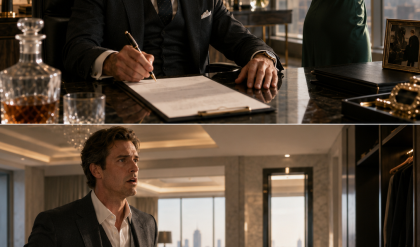
Jason opened the folder. Numbers, summaries, environmental reports, municipal approvals. He skimmed them, then reached for a pen.
At the doorway, Lena’s voice stopped him.
“Don’t sign that.”
Both men turned. She stood there in a gray coat, damp from rain, holding a stack of photocopies and a flash drive.
Jason’s expression darkened. “How did you get into my office?”
“I’m your wife. Security assumed that meant something.”
Brent’s smile vanished for less than a second. “Lena, this is company business.”
“I know. That’s why I’m here.”
Jason stood. “Not now.”
“Yes, now.” She stepped forward and placed the photocopies on his desk. “The environmental report in that folder is not the report filed with the county. The real one shows groundwater contamination risks on the south parcel. The shell company selling you that land is connected to a trust registered in Delaware. That trust paid consulting fees to a firm owned by Vanessa’s brother. Three payments went out the same week your father changed his will.”
The office went silent.
Brent laughed softly. “That’s quite a story. Did you find it on a conspiracy forum?”
“No,” Lena said. “County records, state filings, campaign disclosures, and one careless invoice your assistant left in a scanned attachment.”
Jason stared at the papers. “You went through company files?”
“I went through documents sent to the household account because someone thought the poor girl wouldn’t know a balance sheet from a grocery receipt.”
Brent’s tone hardened. “Jason, this is absurd.”
Lena looked only at her husband. “Ask him who owns Northstar Civic Advisors.”
Jason’s eyes shifted to Brent. “Who owns it?”
Brent sighed. “This is a waste of time. Northstar is one of dozens of consultants.”
“Who owns it?” Jason repeated.
Brent’s face changed. Not much, but enough.
Before he could answer, Jason’s assistant burst in, pale and shaking. “Mr. Cole, federal agents are downstairs with a warrant.”
For the first time since Lena had met him, Jason Cole looked completely unprepared.
The next forty-eight hours stripped him of every illusion wealth had polished. Federal investigators seized servers. Financial news networks reported possible fraud connected to Cole Meridian acquisitions. The board suspended Jason’s signing authority pending review. Brent resigned “to avoid distraction” and disappeared behind attorneys. Vanessa gave an interview implying Jason had been unstable since his “strange forced marriage.” Investors panicked. Protesters gathered outside company headquarters after leaked documents suggested Cole Meridian had knowingly pursued contaminated land near residential communities.
Jason stood in the storm of it, furious and stunned, insisting he had known nothing. But ignorance, he discovered, was not innocence when your signature sat at the bottom of too many pages.
Richard suffered another cardiac episode the night the warrants were executed. Jason raced to the medical suite at the Lake Forest estate and found Lena already there, sitting beside the bed, reading aloud from an old Louis L’Amour novel because Harris said Richard liked westerns when he was too tired to talk.
Jason stopped in the doorway.
Lena looked up. “He asked for you.”
Richard’s eyes opened. “Jason.”
Jason came closer, his suit wrinkled, his face gray with sleeplessness. “Did you know?”
Richard’s mouth trembled. “About Brent? I suspected. Not enough to prove.”
“So you pushed me into marriage instead of warning me?”
“I warned you for years. You called it criticism.”
Jason flinched.
Richard turned his eyes toward Lena. “Martha used to say truth has to enter a proud man’s house through the door he refuses to open.”
Jason laughed bitterly. “So Lena was a trap.”
“No,” Lena said before Richard could answer. “I’m a person. That may be hard for both of you to remember.”
Richard closed his eyes as if accepting the rebuke. “You’re right.”
Jason looked at her, shame and anger fighting in his face. “Why are you helping me?”
Lena stood. “I’m not helping you because you deserve it. I’m helping because thousands of employees didn’t insult me in a ballroom. Because families near that site didn’t forge those reports. Because your father’s company may have done damage, and someone has to care more about fixing it than surviving the headline.”
Jason had no defense. “And us?”
Her expression softened only enough to hurt him. “There is no us right now. There is a legal marriage and a moral emergency. Don’t confuse them.”
Richard died before dawn.
His funeral brought half of Chicago, though not all came to mourn. Some came to measure Jason’s weakness. Some came to see whether Lena would cry. She did, quietly, when Harris placed a white rose on the casket. Jason did not cry until later, alone in his father’s study, where he found a letter addressed in Richard’s shaking hand.
Son,
I taught you strength because I feared the world would break you. Instead, I helped you build armor so heavy you mistook it for a body. I cannot undo that now. I can only leave you near someone who understands the difference between pride and courage.
Martha Hart saved my life once. Her daughter may save more than yours. Let her tell you the truth, even when it costs you the version of yourself you prefer.
Your mother loved your tenderness most. I am sorry I made you bury it.
Dad
Jason read the letter twice. Then he pressed it against his mouth and made a sound that would have embarrassed him if anyone had heard it.
Someone did.
Lena stood in the doorway, not entering, not retreating. “I’m sorry.”
He wiped his face quickly. “Don’t.”
“I won’t mention it.”
“You already saw.”
“Yes,” she said. “And nothing terrible happened.”
He almost laughed, but it broke apart. “I humiliated you.”
“Yes.”
“I let them treat you like a joke.”
“Yes.”
“I thought you wanted my money.”
“I know.”
His voice lowered. “What do you want?”
Lena looked around the study, at the leather chairs, the old photographs, the shelves of awards, all the evidence of a family that had built something impressive and called it the same thing as goodness. “I want the truth cleaned up. I want Cedar Hollow’s water tested by independent scientists. I want the employees protected if this company goes down. I want you to stop acting like decency is charity you perform when cameras are nearby.”
Jason nodded slowly. “And after that?”
“After that, I want a divorce if all you can offer is guilt.”
The word landed harder than he expected. “Lena.”
She lifted one hand. “Don’t say my name like you just discovered it belongs to me.”
Then she left him with his father’s letter and the first honest silence he had known in years.
The investigation deepened. Lena became the person Jason’s attorneys did not know how to categorize. She was not an executive, but she understood the paper trail. She was not a publicist, but the public trusted her more than anyone with the Cole name. She was not a board member, but employees began sending anonymous tips to an encrypted inbox she set up with the help of a cybersecurity professor who had once tried to recruit her back to graduate school.
Jason learned pieces of her history the way a humbled man learns anything: slowly, with embarrassment. Lena had graduated at the top of her state college class in accounting. She had won a scholarship to Carnegie Mellon for forensic analytics but deferred when Martha got sick. During the day, she taught schoolchildren in Cedar Hollow. At night, she helped local families challenge medical bills, predatory loans, and mineral-rights contracts designed to rob them politely. She had not been waiting for rescue. She had been busy rescuing others with almost nothing.
One evening, Jason found her in Richard’s study surrounded by documents. “You should sleep.”
“So should you.”
“I don’t sleep much.”
“I noticed. You walk around at night like a ghost with a credit score.”
He smiled before he could stop himself. She saw it and looked back down, but not before he caught the smallest curve at the corner of her mouth.
He placed a mug of tea beside her. “No whiskey?”
“My mother used to make tea during storms,” he said.
Lena’s hands stilled.
Jason sat across from her, careful not to crowd. “I need to say something without asking you to forgive me afterward.”
“That would be new.”
“I was cruel because it was easier than being afraid. My father’s condition made me feel trapped, and I punished you because you were the face of it. That was cowardly. You did not deserve any of it.”
Lena studied him for a long moment. “No, I didn’t.”
“I know.”
“Do you?” Her voice was quiet, not sharp. “Because apologies from men like you often mean, ‘Please stop making me feel guilty.’”
Jason accepted the blow. “Then I’ll keep feeling guilty. But I’ll still do what needs to be done.”
She leaned back. “That’s the first useful thing you’ve said.”
The turning point came from a box Martha Hart had hidden beneath the loose floorboard of her trailer.
Lena had returned to Cedar Hollow with Jason, Harris, and an independent environmental team. The visit drew reporters, angry residents, and former Cole contractors who insisted they had warned management about runoff years earlier. Jason walked the town without sunglasses for once. People stared at him with open distrust. Some shouted. He listened. Lena watched him absorb the anger without hiding behind security, and though it did not erase anything, it mattered.
At the trailer, Lena searched for her mother’s old property documents, hoping to prove that Northstar’s land options had been obtained through intimidation. Instead, she found the metal box wrapped in a quilt. Inside were letters, photographs, a cassette tape, and a notarized statement dated twenty-seven years earlier.
Martha’s handwriting covered the first envelope.
For Lena, when the truth becomes more useful than peace.
Lena sat on the floor and read until her face went pale.
Jason knelt beside her. “What is it?”
She handed him a photograph. It showed a younger Richard Cole standing beside Martha Hart on the porch of the trailer. His arm was in a sling. Beside them was another man Jason recognized from old family albums: Martin Cole, Richard’s younger brother, Brent’s father.
Jason looked up slowly. “Why is Martin here?”
Lena’s voice shook. “Because your father’s accident wasn’t an accident.”
The cassette tape, converted later by investigators, captured Martha’s conversation with Richard in the days after she saved him. Richard, groggy but lucid, said he had discovered Martin selling company land through illegal side agreements and taking kickbacks from developers. He had been driving to meet a federal prosecutor when his brakes failed on the mountain road. Men arrived at the wreck looking not for survivors, but for documents.
Martha had hidden both Richard and the folder he carried.
Richard survived. The case, somehow, never went forward. Martin died years later in what the family called a hunting accident, and Richard, fearing scandal and perhaps blaming himself for his brother’s death, buried the truth. But he kept supporting Martha quietly. Martha, mistrusting rich men’s promises, kept copies.
There was more. Martin’s old network had not vanished. Brent had inherited it, refined it, and built a modern version through shell companies, environmental fraud, political donations, and acquisition schemes. Vanessa’s family had helped launder influence through charities and media connections. The Lake Erie deal was not an isolated fraud. It was the latest move in a decades-old pattern.
Jason sat on the trailer floor with the photograph in his hand, feeling his family history rearrange itself into something monstrous.
“My father knew,” he whispered.
“He knew some of it,” Lena said. “Maybe not all.”
“He let Brent into the company.”
“Guilt makes people stupid.”
Jason looked at her. “You sound like you’re speaking from experience.”
“My mother saved a man who brought danger to our door. Those men came back later. They threatened her. She moved twice before coming back here. She never told me the whole story because she wanted me to have a childhood that wasn’t built around fear.” Lena’s eyes filled, but she kept her voice steady. “Your family didn’t just owe mine gratitude, Jason. It owed us the truth.”
The evidence went public three days later, but not through a leak. Lena insisted on a formal press conference in Cedar Hollow, not Chicago. She stood on the steps of the elementary school where she had taught and faced the cameras with Jason beside her. He had wanted his attorneys to speak. She said no.
“People with power often hide behind complexity,” she said into the microphones. “They use shell companies, legal language, and expensive suits to make harm look like business. But harm is not complicated when your water is unsafe, when your land is stolen, or when your community is treated as disposable.”
Jason stepped forward after her. His prepared statement shook in his hands. He looked at the residents of Cedar Hollow, at the reporters, at Lena, and folded the paper.
“My name is Jason Cole,” he said. “I inherited a company I thought represented success. I also inherited lies. Some of those lies were told before I was born. Some continued because I was arrogant enough to trust convenience over truth. I did not create every wrong being uncovered, but I benefited from a system that made those wrongs profitable, and I signed documents I should have questioned.”
Cameras clicked. His attorneys looked ready to faint.
He continued. “Cole Meridian Group will fund independent water testing, medical screening, and land restitution in every affected community before it pays executive bonuses, dividends, or my compensation. I am stepping back from day-to-day control until an independent ethics board, including community representatives, completes its review. And I owe my wife, Lena Hart Cole, a public apology.”
Lena’s head turned sharply.
Jason faced her, not the cameras. “I married you for inheritance. I treated you as less than me because you came from a place my world mocks. But you had more courage in rooms built to humiliate you than I had in rooms built to obey me. I am sorry for the things I said, the things I allowed, and the man I chose to be when you deserved better.”
The silence afterward felt vast.
A reporter shouted, “Mrs. Cole, do you accept his apology?”
Lena looked at Jason for a long moment. “An apology is not a receipt. You don’t hand it over and walk away with forgiveness. He can start by doing what he just promised.”
It was not romantic. It was better. It was true.
Brent was arrested two weeks later after attempting to board a private flight to the Cayman Islands. Vanessa was indicted for conspiracy, securities fraud, and obstruction after investigators found messages proving she had helped engineer the gala humiliation to weaken Jason’s public standing before the board vote. Her final text to Brent became a headline of its own: If the hillbilly wife breaks, Jason breaks with her.
Lena read it once and set the phone down.
Jason watched her carefully. “Are you all right?”
“No,” she said. “But I’m not broken.”
The board tried to force a quiet settlement. Jason refused. For the first time in company history, Cole Meridian opened its archives to investigators and community attorneys. The financial cost was brutal. The reputational damage was worse. Investors called Jason reckless. Commentators called Lena manipulative. Former friends stopped inviting them to dinners, which Lena considered one of the investigation’s few immediate benefits.
The penthouse changed too. Not all at once. The museum became a place where people occasionally laughed. Jason learned to cook three meals badly and one meal well. Lena placed her mother’s quilt over the white designer sofa, and when a decorator objected, Jason asked whether the decorator planned to sleep outside. Harris moved through the rooms with the quiet satisfaction of a man watching winter loosen its grip.
But healing did not follow the shape of a fairy tale. Lena did not fall into Jason’s arms because he became decent under pressure. Trust returned like spring in the mountains, slow and muddy, with storms still interrupting the light.
Some nights she still slept in the guest suite. Some mornings Jason woke from dreams of his father’s letter and his mother’s accident and walked the halls until Lena found him. They talked more. They argued better. He learned that listening was not waiting for his turn to speak. She learned that his coldness had been taught to him so early he sometimes mistook tenderness for danger.
One afternoon, months after the press conference, they returned to Cedar Hollow for the opening of the Martha Hart Community Clinic, funded not as charity but as part of a restitution agreement negotiated with residents. The clinic stood where an abandoned payday loan office had once trapped half the town in debt. Its waiting room had wide windows facing the mountains and a children’s corner painted by local students.
Jason watched Lena cut the ribbon with a pair of oversized scissors. The crowd applauded, and for once he did not look like a man calculating optics. He looked proud in a way that had nothing to do with ownership.
After the ceremony, they walked to the old trailer. The garden was full again. Sunflowers leaned toward the road. Lena had decided not to sell the place. Jason understood now that not everything valuable needed to be converted into money.
She sat on the porch steps. “When your father asked for this marriage, I thought honoring my mother meant keeping her promise.”
Jason sat beside her, leaving space between them. “And now?”
“Now I think honoring her means knowing which promises should change when the truth does.”
His chest tightened. “Are you leaving?”
Lena looked at the mountains for a long time. “I was going to.”
He nodded, though the words clearly hurt. “I know.”
“I spoke to a lawyer in May. Before Brent was arrested. Before the clinic. Before you started making tea instead of declarations.”
A small, sad smile touched his mouth. “Tea is safer.”
“Usually.” She turned to him. “I don’t love what you did to me, Jason. I don’t love the way this began. I don’t love that my mother’s kindness became part of your father’s plan.”
“I don’t either.”
“But I have watched what you did after the truth cost you something.” Her eyes searched his face. “That matters to me.”
He barely breathed. “What are you saying?”
“I’m saying I don’t want a marriage built on inheritance.” She reached into her bag and pulled out a folded document. For one awful second, Jason thought it was the divorce petition. Instead, she handed him a new agreement drafted in plain language.
He read the first page. It dissolved the inheritance condition as a basis for their marriage, separated her finances from his, and placed a significant portion of his voting shares into a public-interest trust for affected communities and employee protections. At the bottom, beneath the legal text, Lena had written one sentence by hand.
If we stay, we stay freely.
Jason’s vision blurred.
“You’d give up the leverage?” he asked.
“I never wanted leverage. I wanted a choice.”
He looked at the document, then at her. “And what do you choose?”
Lena’s voice softened. “I choose not to decide because the world is watching. I choose not to stay because you apologized well in public. I choose one year. No inheritance condition. No separate bedrooms unless I want one. No pretending. We build something honest for one year, and at the end of it, if either of us wants to leave, we leave with respect.”
Jason exhaled slowly, the way a man might breathe after being released from a sentence he deserved. “And if I want longer than a year?”
“Then you spend the year becoming the kind of man who can ask.”
He laughed, and this time it was unguarded. Lena smiled because the sound surprised them both.
He signed the agreement on the porch railing with a pen Harris had given him. No cameras. No board members. No chandeliers. Just mountains, late sunlight, a woman who had refused to be purchased, and a man learning that love could not be inherited.
A year later, Chicago society received invitations to a small ceremony at the Martha Hart Community Clinic. The gossip blogs speculated wildly. Some said Jason and Lena were renewing vows. Others said they were announcing a divorce. Vanessa, awaiting trial, reportedly screamed when a guard refused to let her see the livestream.
The ceremony was neither glamorous nor dramatic. There were folding chairs, wildflowers in mason jars, children running across the lawn, and Harris crying openly into a handkerchief. Jason wore a navy suit. Lena wore a simple white dress her neighbors had helped alter. No one gave her away. She walked herself down the aisle because, as she told Jason, “I’ve been getting myself places my whole life.”
Their vows were different this time.
Jason did not promise to protect her as though she were fragile. He promised to tell the truth before fear turned it into cruelty. He promised to measure success by the people who could live better because he had power, not by the rooms that applauded him for having it. He promised, with a smile that made Lena’s eyes shine, to read every document before signing and to listen when she said, “Don’t sign that.”
Lena promised not to shrink herself to make him comfortable. She promised to challenge him without contempt and stand beside him only when standing beside him did not require standing against herself. She promised to remember that people can change, but only when their actions keep changing after the applause ends.
When Jason kissed her, the crowd cheered in a way no ballroom ever had.
Later, as the sun lowered behind the mountains, Jason found Harris standing near Martha’s garden.
“You look satisfied,” Jason said.
Harris smiled. “Your father would have been difficult about it, but yes, he would have been pleased.”
Jason looked toward Lena, who was laughing with children near the clinic steps. “He thought she would save my life.”
“No,” Harris said gently. “He hoped she would help you find it.”
Jason let the words settle. For most of his life, he had believed money could buy loyalty, silence, beauty, access, comfort, and escape. He had been right about some of that. Money could buy many things. It could build towers, hide crimes, polish reputations, and surround a lonely man with people who called obedience love.
But it could not buy the look in Lena’s eyes when she chose to stay. It could not buy the courage of Martha Hart opening her door to a wounded stranger. It could not buy back the years Richard lost to guilt or the innocence Jason lost to grief. It could not buy forgiveness, because forgiveness given for a price was only another transaction.
What money could do, when finally placed in humbled hands, was repair a roof, test a well, fund a clinic, protect a worker, and return stolen land. It could become useful. It could become accountable. It could become less like a throne and more like a tool.
Lena came up beside him and slipped her hand into his.
“You’re quiet,” she said.
“I was thinking.”
“That sounds expensive.”
He laughed. “It used to be.”
She leaned her head briefly against his shoulder. “And now?”
Jason looked at the clinic, the garden, the mountains, and the woman he had once mistaken for a condition in a will. “Now it feels like something I should have learned a long time ago.”
Lena squeezed his hand. “Some men take longer to educate.”
“Yes,” he said. “But I had a very strict teacher.”
She smiled. “You’re welcome.”
Across the lawn, Harris raised a glass of sweet tea. The children shouted for Lena to come cut the cake. Jason watched her go, her dress brushing the grass, her laughter carrying through the warm evening, and he understood at last that his father’s empire had never been the real inheritance.
The real inheritance was the chance to become human before it was too late.
And the woman everyone mocked as a poor girl from nowhere had not changed Jason Cole by begging for his love, chasing his money, or proving she belonged in his world.
She changed him by refusing to let his world remain as small as his pride.
THE END