Part 3
The first rule of loving a dangerous man is this: never confuse honesty with innocence.
Killian was honest.
He was not innocent.
He still vanished at midnight for meetings he would not discuss. He still took phone calls in languages I didn’t speak. He still said things like “resolved” and “handled” with enough ambiguity to make my moral compass spin.
But he stopped lying.
And I stopped pretending I was only staying because of passion, curiosity, or poor judgment.
I stayed because he saw me.
All of me.
The polished consultant. The lonely woman. The control freak. The coward. The person beneath the armor who wanted, desperately, to be chosen without being softened into someone else.
Killian never asked me to be gentle.
I never asked him to be harmless.
But the world did not let us exist quietly.
Three weeks after the warehouse, I attended another gala.
This one was not for charity.
It was a private dinner at an old estate outside Lake Forest, where men arrived in black cars without license plates and women wore diamonds large enough to have histories.
Killian warned me in the car.
“Stay beside me.”
“I was planning to wander into the woods with strangers.”
“Sloan.”
“I know. Stay beside you. Smile. Forget names. Don’t ask about businesses.”
“And if I tell you to leave?”
“I leave.”
His hand found mine. “Thank you.”
Inside, people watched me like I was either a prize or a liability.
Maybe both.
An older man named Vincent Moretti kissed my hand and said, “So this is the woman who made Gray reckless.”
Killian’s voice sharpened. “Careful, Vincent.”
I smiled. “I made him organized. You should be grateful.”
For one stunned second, no one breathed.
Then Vincent laughed.
Killian looked at me like I had just set a fire and called it interior design.
Later, on the terrace, he said, “You cannot insult men like Vincent.”
“I didn’t insult him. I corrected him.”
“That’s worse.”
“You said to be polite. You didn’t say to be boring.”
He stared at me.
Then he laughed.
Actually laughed.
The sound startled two guards near the door.
That was when I understood something no warning had fully explained.
Men feared Killian because of what he could do.
But they watched me because of what I could make him feel.
That made me dangerous too.
The threat came two nights later.
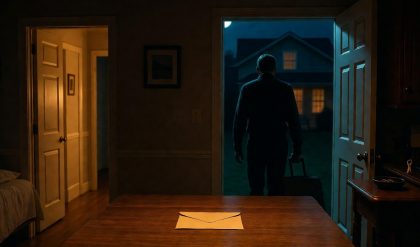
A white envelope slid under my apartment door.
Inside was a photograph of me leaving work.
On the back, written in black ink:
Pretty girls should not stand too close to monsters.
I called Killian.
He arrived in eleven minutes.
Not alone.
The hallway filled with men.
For once, I did not argue when he moved me to his penthouse.
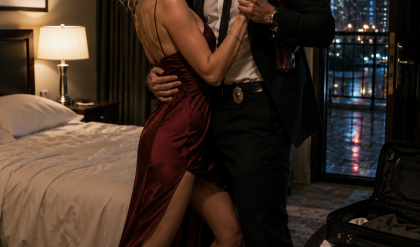
But at three in the morning, when I found him standing by the window with a gun on the table beside him, rage replaced fear.
“You said I wouldn’t be a prisoner.”
“You’re not.”
“I’m in your apartment because someone took my picture like a warning.”
“That is temporary.”
“Everything is temporary when you control the clock.”
He turned.
The exhaustion in his face almost broke me.
“I don’t know how to protect you without containing you,” he said.
“That’s not protection. That’s fear wearing a suit.”
His jaw flexed.
“I can lose territory. I can lose money. I can lose men who knew the risks when they joined me. I cannot lose you.”
“You don’t get to make love another word for ownership.”
The room went silent.
Then he nodded, slowly.
“You’re right.”
I had expected a fight.
The absence of one hurt worse.
“What are we going to do?” I asked.
“We end this threat. Then we build rules that protect you without erasing you.”
“We?”
His eyes met mine.
“We. Unless you’ve changed your mind.”
I looked at the man before me. Ruthless. Tired. Terrified in a way only powerful people were terrified, because they knew exactly how much the world could take.
“No,” I said. “I haven’t.”
The man behind the photograph was not a rival boss.
He was worse.
A lawyer.
A partner at my own firm.
Daniel Cross had discovered Killian’s connection to me and decided it could be useful. He had been quietly selling client information to one of Killian’s enemies and planned to use me as leverage if anyone got suspicious.
When Killian told me, I went very still.
“He works down the hall from me.”
“Yes.”
“He smiled at me yesterday.”
“Yes.”
“I want to handle him.”
Killian blinked. “Absolutely not.”
“I don’t mean with guns.”
“I assumed.”
“I mean my way.”
His expression shifted. “Sloan.”
“He used my life as a bargaining chip. He used my firm. My clients. My reputation. You can scare him after I destroy him.”
Killian stared at me for a long moment.
Then he smiled.
It was not soft.
It was proud.
The next morning, I walked into Sterling & Associates wearing a navy suit, nude heels, and the calm expression that had made senior partners hand me impossible cases for years.
By noon, I had found the leak.
By two, I had documentation.
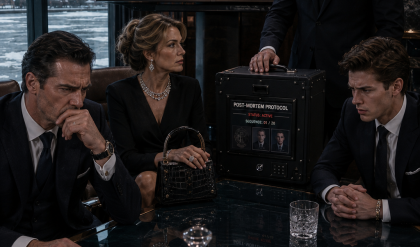
By four, Daniel Cross was sitting in the main conference room with the managing partners, sweating through his expensive shirt while I presented evidence clean enough to ruin him in civil court, criminal court, and every private room in Chicago that mattered.
He tried to interrupt twice.
I let him.
Then I said, “Daniel, I would advise silence. You’re already bad at crime. Don’t also be bad at strategy.”
Tessa coughed into her hand.
By five, Daniel was fired.
By six, federal investigators had copies of everything.
By seven, Killian’s people made sure Daniel’s other employers understood he was no longer useful.
At eight, Killian picked me up outside the office.
“You look happy,” he said.
“I look professionally satisfied.”
“You look terrifying.”
“Thank you.”
He opened the car door.
Inside, on the seat, was a single white rose.
I stared at it.
“That is suspiciously romantic.”
“I’m branching out.”
“Is anyone hospitalized?”
“Not by me.”
“Progress.”
He laughed again, and this time I did not feel like I had cracked something in him.
I felt like I had returned something.
Eight months later, my life was still ridiculous.
I still worked at Sterling, though now as a partner, partly because my work was excellent and partly because no one wanted to explain why they had underestimated the woman dating Killian Gray.
Tessa still asked if I was alive every Monday morning.
Marcus still appeared at inconvenient times with phrases like, “Change of route, Miss Hart,” as if my commute were a military operation.
Killian still took calls at midnight.
But he came home.
That mattered.
One Friday evening, he kept a promise.
No emergency. No territory dispute. No blood on his sleeves.
Just dinner at home, candles on the table, pasta he had absolutely ordered from a restaurant and transferred into serving bowls like a criminal trying to impersonate a husband.
“This is not homemade,” I said.
“I never claimed it was.”
“You put flour on the counter.”
“For atmosphere.”
“You’re insane.”
“You like that about me.”
“I tolerate it because you’re attractive.”
“Efficient.”
“Exactly.”
After dinner, we stood by the window overlooking the city.
Chicago glittered below us, beautiful and corrupt and alive.
Killian slipped his hand into mine.
“No regrets?” he asked quietly.
I thought about the woman I had been in that hotel suite, dressed in black, terrified of appearing lonely, willing to rent the illusion of being loved because the real thing seemed too dangerous.
I thought about all the safe years that had left me empty.
Then I looked at him.
Dangerous man.
Honest man.
Monster to some.
Home to me.
“Constant regrets,” I said.
His mouth curved sadly.
I squeezed his hand.
“But never about choosing you.”
He pulled me close, and for once, the city did not feel like something I needed to conquer or survive.
It felt like something I could live inside.
Messy.
Uncertain.
Real.
And maybe that was the most shocking part of all.
I had hired a man to pretend he loved me for one night.
Instead, I found the one person who refused to let me keep pretending I didn’t need love at all.
THE END