At Christmas, Brooke sat beside me on my parents’ sofa and helped carve the turkey because my father’s arthritis was acting up. She bumped my shoulder and whispered, “Remember when we used to fight over the wishbone?”
I smiled and said, “You always cheated.”
She laughed.
I wanted to turn to everyone in that room and show them the hotel photographs. I wanted to ask my mother whether raising daughters had meant teaching one to steal from the other. I wanted to ask Preston whether he had ever looked at me across our bed and felt even a pinprick of shame.
Instead, I kept quiet.
Not because I was weak.
Because Miles kept finding things.
A bracelet charged to Preston’s private card. A condo outside Brentwood rented under one of Hartwell Properties’ subsidiaries. Text messages retrieved from an old synced laptop Preston had forgotten I knew the password to. Photos of Brooke entering the building through a service garage. Photos of Preston leaving ninety minutes later.
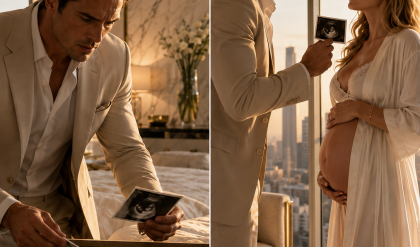
Then, three weeks before the anniversary party, Miles discovered the pregnancy.
Not from gossip. Not from following Brooke to a drugstore.
From Calvin Price.
Calvin worked with Brooke at an event-planning firm in Nashville, a quiet, broad-shouldered man with a young daughter from a previous marriage and a habit of looking at Brooke as if he was waiting for instructions. Miles found him because his truck had been parked outside Brooke’s apartment on nights Preston was not there. At first, I thought that meant Brooke was cheating on Preston, too, which would have been ugly but simple.
Nothing was simple.
Calvin had believed he was the father. Brooke had let him believe it until Preston’s money became more useful than Calvin’s devotion. When she began pushing Calvin away, he demanded proof. Brooke, trying to control both men, ordered a noninvasive prenatal paternity test using Calvin’s cheek swab and her blood. The report confirmed Calvin was the biological father with a probability so high only a fool would argue.
Then Brooke changed her plan.
She told Preston the baby was his.
Preston believed her because believing her allowed him to imagine his betrayal had a purpose. Men like Preston loved purpose. It polished selfishness until it shone like destiny.
Calvin, humiliated and frightened, gave Miles the report after Miles showed him enough evidence to make him understand that Brooke was preparing to ruin several lives, including his child’s. He did not ask for money. He asked only that his daughter not see his name dragged through the news.
That was why, when Preston suggested a tenth-anniversary party to “start fresh,” I agreed.
He thought he was being cruel in a refined way. He had been distant for months, then suddenly attentive, suddenly sentimental. He wanted the ballroom. He wanted the string quartet. He wanted the three-tier almond cake with raspberry filling because that had been our wedding cake. He wanted photographs of us laughing so the public version of our marriage would survive long enough for him to decide how to leave me without losing board seats, investors, and the respectability his family name required.
I gave him everything he wanted.
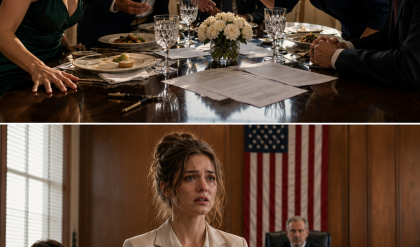
I chose the ballroom at the Belle Meade Grand Hotel, a renovated landmark Preston had once tried and failed to buy. I selected ivory roses, gold-rimmed plates, and embroidered napkins with our initials. I invited his investors, my parents’ friends, Brooke’s coworkers, Hartwell executives, old Army contacts, church ladies, bankers, and the mayor’s wife.
Then I invited Miles Reddick.
He arrived alone, sat at the back, and wore a gray suit.
By the time Brooke took the microphone, I knew every possible direction the night could go.
Still, knowledge did not make it painless.
“Get off the stage, Brooke,” I said.
My voice sounded calm, even to me.
She tilted her head, the way she had when we were children and she had broken something but wanted me blamed for it. Her red dress caught the chandelier light like spilled wine. She pressed one hand to her stomach.
“No, Natalie,” she said. “I’m tired of hiding. Preston and I are tired of pretending. We love each other, and we’re going to be a family.”
A sound moved through the room, low and hungry. People hated scandal until they were close enough to feed on it.
Preston stood then, finally, but too late.
“Brooke,” he said, his voice rough. “Stop.”
She turned on him with theatrical softness. “No. She deserves the truth.”
I almost laughed at that.
“The truth,” I repeated.
Brooke looked back at me. “I know this hurts. But you had ten years. Ten years, Natalie. You never gave him a child. You built your whole life around being strong, being untouchable, being the woman everybody admires. But marriage isn’t a medal ceremony. Preston needed warmth. He needed a home. He needed a family.”
My mother made a small wounded sound.
My father said my name, but I did not turn.
Brooke lifted her chin, and the smile returned. “This time, big sister, I win.”
That was when I looked toward the back of the room and nodded.
Miles rose.
He did not hurry. He did not perform. He simply picked up a thick red folder from the chair beside him and walked along the edge of the ballroom as three hundred heads turned to follow him. The string quartet sat frozen with their bows hovering above the strings. One waiter backed into a column and nearly dropped a tray of champagne.
Brooke’s smile weakened.
“Who is that?” she asked.
I reached for the microphone.
She tried to hold it. For one brief second, we stood like children fighting over a toy, except the toy was her public execution and mine. Then she let go.
I looked at the guests.
“This man,” I said, “has spent four months collecting the truth my sister claims to respect.”
Miles placed the red folder on the cake table. The silver knife glinted beside it. He opened the folder and handed me one page in a plastic sleeve.
I did not show the crowd first.
I showed Brooke.
Her eyes moved across the laboratory seal, the date, the initials, the probability line. I watched the blood leave her face so completely that, for one strange second, she looked twelve years old again, standing in our childhood kitchen after lying about the broken window.
“Brooke,” I said softly enough that the front tables leaned in to hear, “that baby is not Preston’s.”
The room erupted, but I raised the microphone.
“And the real father is not a mystery. He is sitting in this ballroom, three tables away from you, wearing a gray tie and wishing he had never met you.”
Every head turned.
Calvin Price stood so abruptly his chair toppled backward. His face was ashen. He looked at Brooke, and Brooke looked at him, and in that look the entire ballroom understood what no speech could have explained.
Preston sat down as if his bones had been cut.
For ten years, he had been my husband. For four months, he had been my enemy. And in that final humiliation, he was not even the father of the child he had used to justify destroying me.
It should have felt like victory.
For a moment, it did.
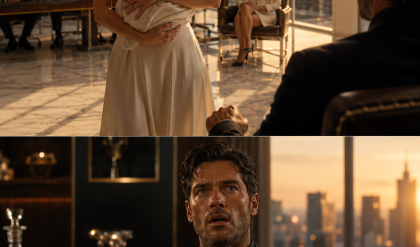
Brooke dropped the microphone. It struck the stage with a crack that made several people flinch. She whispered something I could not hear. My mother sobbed into her napkin. My father stared at me with a stunned expression that was part grief, part pride, part terror at the daughter he had underestimated.
Preston tried to approach me after the room began to break apart into whispers and movement.
“Natalie,” he said. “Please. I can explain.”
I looked at him for a long time.
He had the handsome face that had once made me feel chosen in crowded rooms. He had the expensive watch I had given him on our fifth anniversary, when I still thought time belonged to us. He had tears in his eyes, though I could not tell whether they were for me, Brooke, his reputation, or himself.
“No,” I said. “You can’t.”
Then I left my own anniversary party through the side entrance, with Miles walking two steps behind me like a guard assigned to a dignitary after an assassination attempt.
Outside, Nashville was cold and clear. The hotel’s valet stand glowed under yellow lamps. Somewhere down Broadway, music spilled from a bar, bright and careless, as if my life had not just cracked open under chandeliers.
Miles asked if I wanted him to drive.
“I can drive.”
“I believe you can,” he said. “That wasn’t my question.”
That was when my hands started shaking.
I let him take the keys.
He drove me home in silence. I sat in the passenger seat and watched the city lights smear across the window. I should have been thinking about divorce lawyers, bank accounts, property, statements, the footage that would inevitably appear online before midnight. Instead, I thought about Brooke’s smile.
Not the smile on the stage.
The smile at every birthday dinner. Every Christmas. Every time she had said, “Love you, Nat,” while sleeping with my husband and letting her son call me aunt.
If Brooke had lied for years about that, what else had she lied about?
The question followed me into the house.
It followed me up the stairs, past the wedding portrait in the hallway, past the guest room where Brooke had cried after her divorce, past the office where Preston kept the framed magazine cover calling him “Nashville’s Restoration King.”
I did not sleep.
At three in the morning, I opened the cedar chest at the foot of my bed and removed the old quilt my grandmother had made. Beneath it, wrapped in tissue and tucked inside a faded Wonder Bread bag because grief makes ordinary objects sacred, was a tiny blue knit cap.
I had made it myself twelve years earlier.
No one in that ballroom knew I had once had a son.
Preston knew only pieces. I had told him before we married that I had been pregnant in my twenties, that the baby had died, that I did not want to discuss it in detail. He had accepted the story because men accept pain more easily when it arrives prepackaged and quiet. He knew not to ask why I avoided baby showers or why I sometimes stopped breathing when a newborn cried in a grocery store.
The truth was this.
Before Preston, before Hartwell Properties, before the stone house and the embroidered napkins and the public life, there had been a soldier named Ryan Kline.
Ryan was from Iowa, a farm boy with steady hands and a laugh that always began reluctantly, as if happiness had to persuade him first. We met at Fort Campbell, where I was twenty-five and convinced that discipline could protect me from everything. He loved me without drama. I trusted him without fear.
When I became pregnant, we were not married yet, but he bought a cheap ring from a pawnshop and proposed outside a gas station because he said waiting for a perfect moment was how cowards lost their lives.
Three months before the baby was born, Ryan died in a training accident.
After the funeral, I became a person moving through instructions. Sign here. Sit there. Drink water. Let your mother drive. Brooke slept beside me for a week because I woke up reaching for my phone to call him before remembering there would never be another answer.
I went into labor early during a thunderstorm.
The hospital near base was full from a highway pileup, so they sent me to a small private maternity clinic that had a contract with military families. I remember fluorescent lights. I remember my mother’s voice on the phone saying she was coming. I remember Brooke’s face above me, pale and frightened. I remember pain, then pressure, then a cry.
A real cry.
For years, I told myself I had invented that cry because grief wanted something to torture me with.
I hemorrhaged. Everything became noise and white light. When I woke the next morning, I was in a different room with an IV in my arm and Brooke sitting beside the bed holding my hand.
“Where is he?” I asked.
Her face crumpled.
“Oh, Nat,” she said. “He didn’t make it.”
I tried to sit up. Machines complained. Pain tore through me.
“No. I heard him.”
“You wanted to,” she whispered. “The doctor said he never breathed on his own.”
“Let me see him.”
Brooke cried harder. “Mom said it would only hurt you more. She took care of everything. We all did. You don’t need that image in your head forever.”
I was young. I was widowed. I had lost too much blood. And the two women I trusted most in the world told me my baby was gone.
So I believed them.
There was no funeral. My mother said the clinic had arranged a private cremation because the baby had been stillborn and I was too unstable to handle decisions. There was no grave. No certificate I could bear to read. No photograph. Just the blue cap I had knitted while Ryan was alive, the one thing I had made for a child I was told had never worn it.
For twelve years, I kept it in a bread bag because I could not bear to buy a proper memory box for a son no one else seemed to mourn.
After the anniversary party, I held that cap under the bedroom lamp and saw something I had refused to see for more than a decade.
Brooke’s son, Logan, was born the same week my baby died.
Brooke had been pregnant then, too. At least that was what the family had believed. She had married Caleb Monroe in a courthouse ceremony at six months along, after months of complaining that pregnancy had ruined her body and her life. But I had been swallowed by my own grief, and no one expected me to track due dates or ask why Brooke never let me visit her in the hospital.
Logan had my father’s chin.
He had Ryan’s gray eyes.
He had the same small crescent-shaped birthmark beneath his left shoulder blade that I had, the one my mother always called “our little moon.”
I had seen it when Logan was five and running through my parents’ sprinkler in swim trunks. I had laughed and said, “He got the moon mark.”
Brooke had looked up too fast.
My mother had gone into the house.
I sat on the bedroom floor until dawn with the cap in my lap, and every memory rearranged itself into a shape I did not want to recognize.
When Logan was a baby, Brooke never let me babysit overnight. She said I was too fragile. When he was a toddler and called me Mama by accident after I picked him up from daycare, Brooke snatched him from my arms and did not speak to me for a week. When he was seven and asked why he looked more like Grandpa than his own dad, my mother said, “Families are funny that way,” and changed the subject so sharply the child apologized.
At six in the morning, I called Miles.
He answered on the second ring.
“You didn’t sleep,” he said.
“Neither did you.”
“No.”
“I need to know something, and it’s going to sound insane.”
“Most true things do at first.”
I told him about the baby. The clinic. The cap. The timing. Logan’s birth.
Miles did not interrupt. When I finished, he was quiet for so long I thought the line had dropped.
Then he said, “Do not confront anyone yet.”
“I need a DNA test.”
“You need a legally useful DNA test eventually. But first you need information. Records. Birth certificates. Hospital logs if they still exist. Chain of events. And Natalie?”
“What?”
“If you’re right, the affair was only the door. Whatever is behind it will hurt worse.”
He was right.
But the next day, I drove to my parents’ house anyway.
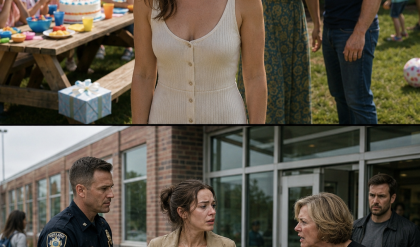
Logan spent most Saturdays there. My mother liked to say he kept the house young. I found him in the living room, half buried under a blanket, eating cereal from a mixing bowl while watching basketball highlights.
“Aunt Nat?” he said, surprised. “Mom said you were sick.”
Of course she had.
“I’m fine,” I managed.
He studied me with the blunt concern of children who have not yet learned to hide it. “You don’t look fine.”
“I’ve had better weeks.”
“Mom’s mad at you.”
“I know.”
He shrugged. “She’s mad at everybody.”
I almost smiled.
My mother came from the kitchen, wiping her hands on a towel. The moment she saw me, her face tightened.
“Natalie,” she said. “This isn’t a good time.”
“I’m not here for you.”
Logan looked between us.
The house smelled like coffee and bacon grease. My father’s recliner sat empty by the window; he was probably in the garage pretending to organize tools so he could avoid whatever storm my mother had brought home from the anniversary party.
I looked at Logan.
“Have you eaten anything besides cereal?”
He glanced down at the bowl. “This counts.”
“No, it doesn’t. Come on.”
My mother stepped forward. “Natalie.”
I did not look at her. “I’m making my nephew breakfast.”
The word nephew nearly choked me.
In the kitchen, Logan sat at the counter while I made scrambled eggs, toast, and sausage the way he liked, with too much pepper and grape jelly on the side. He talked about a video game, then baseball tryouts, then how his mother had cried the night before and told him adults were liars.
“Are they?” he asked.
I kept my eyes on the pan. “Sometimes.”
“Are you?”
I turned off the burner.
That question landed deeper than he knew.
“I’ve tried not to be,” I said. “But sometimes adults stay quiet because they think silence protects kids. It usually doesn’t.”
He considered that while chewing toast.
When he went upstairs to find his charger, I walked into the downstairs bathroom and took his hairbrush from the drawer. My hands shook as I removed several strands of dark hair and sealed them in a plastic bag I had brought in my coat pocket.
It felt like theft.
Maybe it was.
But twelve years earlier, someone had stolen more than hair from me.
The private lab was in Brentwood, tucked between a dental office and a physical therapy clinic. The woman at the counter asked for the relationship between the tested parties.
I stared at the form.
Aunt was the lie.
Mother was the hope.
“I’m trying to find out,” I said.
She had probably heard stranger answers. She nodded without expression and slid the paperwork toward me.
The waiting was worse than the party.
Preston moved into a downtown condo after my attorney sent him formal notice. His lawyers requested discretion. Mine requested documents. The anniversary video leaked anyway, of course. For two days, Nashville feasted on the downfall of the handsome developer, his decorated veteran wife, and the red-dressed sister who had misidentified the father of her own baby in front of half the city’s donor class.
Brooke vanished from social media.
My mother left voicemails I did not return.
My father sent one text: I love you. I don’t know what to say yet.
That one I answered.
Me neither.
Three weeks later, the DNA envelope arrived.
I did not open it immediately. I placed it on the kitchen island and stood over it as afternoon light slid across the marble. My house was too quiet without Preston’s footsteps, without his calls, without the hum of a marriage pretending to be alive. The silence should have comforted me. Instead, it made room for every possibility.
If I was wrong, I would be a grieving woman who had tried to turn a nephew into a dead son because betrayal had made her reckless.
If I was right, then my son had been alive for twelve years, growing up two miles from me, calling another woman Mom while I lit candles for him on birthdays no one else remembered.
I opened the envelope with a steak knife because my fingers would not work.
The report was clinical. Clean. Cruel in its certainty.
Probability of maternity: 99.99%.
I read it once.
Then again.
Then I sank to the kitchen floor with the paper in my hand and made a sound that did not seem human.
My son had not died.
My son had eaten birthday cake at my table and called me Aunt Nat.
My son had fallen asleep in my car after Little League games.
My son had asked me once, at eight years old, whether I thought heaven had dogs, and I had answered while believing his dead brother was somewhere in that same heaven, waiting for a mother who had failed to hold him.
I had not failed.
He had been taken.
The first person I told was my father.
Not my mother. Not Brooke. Not my lawyer.
My father.
He came to my house that evening after I called and said, “Dad, I need you alone.”
He looked older when he arrived, as if the anniversary scandal had aged him in public and the drive had finished the work in private. Robert Avery had spent forty years selling farm equipment before retiring with a bad knee and a stubborn belief that family problems should be solved around kitchen tables. He hugged me at the door, and I held on longer than I meant to.
“What is it, baby?” he asked.
I handed him the report.
He read slowly. His lips moved around words he did not want to understand. When he reached the probability line, he lowered himself into a chair.
“The chin,” he whispered.
I covered my mouth.
“I always said that boy had my chin.”
“Dad.”
He looked up, and his eyes were wet.
“I thought it was just God being kind,” he said. “Letting something of us show up in Brooke’s boy because you had lost yours. I never thought—” His voice broke. “Natalie, I never thought they would do this.”
“They?”
He closed his eyes.
That was when I knew.
Not the whole truth. Not yet.
But enough to understand my mother had known more than grief allowed.
I went to my parents’ house the next morning.
My mother opened the door before I knocked twice. She looked tired, frightened, and smaller than a mother should look to a daughter who has come demanding the truth.
“Where’s Dad?” I asked.
“In the garage.”
“Good.”
I walked past her into the dining room and placed the DNA report on the table where our family had eaten Thanksgiving dinner for twenty years.
“What happened the night my son was born?”
Her eyes dropped to the paper.
She did not pick it up.
“Natalie,” she whispered.
“What happened?”
“You’re upset.”
“I am past upset.”
“You have been through a terrible shock with Preston and Brooke. This is not the time to start making accusations that could destroy a child.”
“A child was already destroyed,” I said. “His mother was told he died.”
She gripped the back of a chair.
For twelve years, I had thought my mother’s greatest flaw was her need to keep peace at any cost. She forgave too quickly, explained away too much, believed that family unity mattered more than truth. But standing there in that dining room, I finally saw that peace had not been her weakness.
It had been her disguise.
“Tell me,” I said. “Or I call a lawyer from your driveway.”
She sat down.
At first, she spoke so softly I had to lean forward to hear.
Brooke had lost her baby two weeks before I went into labor.
A stillbirth. Late term. A girl.
I had never been told because, in my mother’s words, I was already drowning. Ryan was dead. My pregnancy was high risk. Brooke was hysterical. The family decided I did not need another grief laid at my feet.
Brooke had stopped eating. Stopped bathing. She held the dead baby’s blanket for hours and whispered that God had stolen from the wrong daughter. Caleb, her husband then, could not reach her. My mother stayed with her every day.
Then I went into labor during the storm.
My mother arrived late at the clinic because a wreck had shut down part of the interstate. By the time she got there, I had hemorrhaged and been taken into emergency care.
Brooke was in a side room.
Holding my son.
“She said he was hers,” my mother whispered. “She was rocking him and saying God had brought her baby back. The nurse was confused. The clinic was overwhelmed. Records were still being entered. Caleb had come and gone. Everything was chaos.”
“And you corrected her,” I said.
My mother covered her face.
No.
She had not corrected her.
She had looked at Brooke, broken and desperate, holding a living baby after burying her own. She had looked at me, unconscious and widowed, with no husband, no stable home beyond the Army, and a career that might send me away again. She had convinced herself the baby would be safer with Brooke and Caleb. Safer in a house with two parents. Safer with a mother who, in my mother’s mind, needed him more.
“I told myself you were strong,” she said, sobbing now. “I told myself you would survive. Brooke wouldn’t have.”
I stared at her.
There are sentences so cruel they do not sound dramatic. They sound ordinary. That is what makes them unbearable.
“You chose the daughter who screamed,” I said. “Because the one who stayed quiet looked easier to sacrifice.”
“Natalie, I thought—”
“No. You didn’t think. You stole my son and called it mercy.”
She reached for me, and I stepped back so sharply the chair behind me scraped the floor.
“Did Dad know?”
She shook her head hard. “No. I swear to God, no. He believed what I told him. Caleb believed Logan was his. Everyone did.”
“Brooke knew.”
My mother closed her eyes.
“Brooke knew.”
I left without another word.
Brooke was packing when I arrived at her apartment.
She had not answered my calls, so I used the spare key she had given me years before when she said, laughing, “In case I die surrounded by laundry.” The apartment smelled of cardboard boxes and the same amber perfume that had started unraveling my life. Her belly was visible now beneath an oversized sweatshirt. Six months pregnant. Calvin’s baby. Another child entering the world through a doorway built from lies.
She looked up from a suitcase and froze.
“You can’t just come in here,” she said.
“I can do a lot of things today.”
Her eyes flicked to my hand, where I held the DNA report.
For a second, something like fear moved across her face. Then it hardened into resentment.
“So Mom told you.”
“She told me enough.”
Brooke laughed once, dry and ugly. “Of course she did. She always folds when you use that soldier voice.”
I stepped inside and closed the door.
“You let me believe my baby died.”
“You were going to leave him.”
The words struck like a slap.
“What?”
“You were Army, Natalie. You were already talking about staying in after maternity leave. You would have handed him to daycare, nannies, whoever fit between your career and your grief. I gave him a real home.”
“You stole him.”
“I raised him.”
“You stole him.”
She zipped the suitcase with both hands, jerking it hard when the fabric caught.
“I was his mother when he had croup at two in the morning. I was his mother when Caleb left. I was his mother when he cried on the first day of kindergarten. Where were you?”
“Mourning him.”
Her mouth trembled, but not with guilt. With fury.
“You always get to be the noble one,” she said. “The strong one. The brave soldier. The good daughter. The wife everyone respects. Do you know what it was like growing up next to you? Mom bragged about your grades, Dad bragged about your service, teachers asked why I couldn’t be more like Natalie. Then my baby died, and yours lived, and for once something good was in my arms instead of yours.”
I stared at my sister and understood that she had not acted from one night of madness. She had carried a ledger of envy for years, and my son had become the payment she believed the world owed her.
“You slept with my husband,” I said, “and still thought I had too much.”
Her eyes flashed.
“Preston came to me. Don’t rewrite that.”
“I’m not here for Preston.”
“No. You’re here for Logan.” She stepped closer. “Listen to me carefully. If you go after me, I will tell him you are trying to take him from his mother because you hate me. He will believe me. Why wouldn’t he? I packed his lunches. I signed his field trip forms. I know what scares him. I know what song calmed him down when he was little. You have a lab report and a sad story. I have twelve years.”
That was the worst part.
She was right.
Not morally. Not legally. But emotionally, in the brutal court where children live, she had twelve years and I had a knitted cap.
I wanted to hurt her then. Not with my hands, but with truth sharp enough to leave marks. I wanted to tell her she had turned motherhood into a hostage situation. I wanted to tell her every bedtime story she had ever read him was stolen property.
Instead, I took one breath.
Then another.
“I am going to get my son back,” I said. “Not to punish you. For him. So when he is old enough to ask why his birth mother disappeared, he will know she never did. He will know she was lied to. He will know she wanted him every day of his life.”
Brooke’s face twisted.
“He’ll hate you.”
“Maybe.”
“He’ll choose me.”
“Maybe.”
“You’ll ruin him.”
“No,” I said. “You already built his life on a lie. I’m going to give him the truth carefully, even if it costs me everything.”
It did cost me.
The legal battle lasted seven months, though time inside it did not move like time outside. It moved in filings, hearings, continuances, expert reports, phone calls, and nights when I sat at the kitchen table reading the same paragraph of a custody evaluation until the words turned meaningless.
My attorney, Patricia Bell, was a family-law specialist with silver hair, calm eyes, and a voice that made even judges sit straighter. She did not promise me victory.
“The DNA helps,” she said. “The birth circumstances matter. Your lack of consent matters. But Logan is twelve. The court will consider his emotional reality. We are not moving a couch from one house to another. We are disrupting a child’s identity.”
“He’s my son.”
“Yes,” Patricia said gently. “And he does not know what that means yet.”
The court ordered its own DNA test.
Brooke fought it. Her attorney claimed I had become unstable after Preston’s affair and was targeting Brooke out of revenge. They argued that I had always been overly attached to Logan. They produced family photos of me holding him at birthdays, texting him about baseball, taking him to museums. Evidence of love became evidence of obsession when placed in the wrong mouth.
My mother testified.
That day nearly broke me.
She sat in court wearing a gray cardigan and no lipstick, hands folded like a woman at church. Patricia questioned her first.
“Mrs. Avery, did your daughter Natalie ever sign adoption papers regarding the child now known as Logan Monroe?”
“No.”
“Did she ever consent to Brooke Monroe raising him as her biological son?”
“No.”
“Was Natalie told her baby had died?”
My mother’s mouth trembled. “Yes.”
“Who told her that?”
“I did.”
A sound left me before I could stop it.
Across the aisle, Brooke stared straight ahead.
Then Brooke’s attorney stood and turned my mother’s guilt into a weapon.
“Mrs. Avery, would you describe Natalie after Ryan Kline’s death as emotionally stable?”
“She was grieving.”
“Was she prepared to raise a child alone?”
“She wanted her baby.”
“That was not my question.”
My mother looked at me. For one terrible second, I saw the old instinct rise in her, the need to justify the unforgivable by making me look fragile enough to sacrifice.
Then my father, seated behind me, leaned forward.
My mother closed her eyes.
“She would have been a good mother,” she said.
It did not fix what she had done.
But it was the first truth she had given me in twelve years.
Logan did not attend the early hearings, but he knew enough. Brooke made sure of that. She told him I was trying to steal him. She told him grief had confused me. She told him adults sometimes used courts to hurt people. When he finally had to speak privately with the custody evaluator, he refused to look at me in the waiting room.
“Logan,” I said softly.
He stared at the vending machine.
Brooke placed a hand on his shoulder. “You don’t have to talk to her.”
I wanted to say, I sang to you before you were born. I wanted to say, I heard you cry. I wanted to say, I kept your cap in a bag because it hurt too much to touch and too much to throw away.
But a courthouse hallway was not a place to hand a child a life.
So I said only, “I’m sorry this is hurting you.”
He turned then, and the anger in his face was almost more than I could bear.
“If you’re sorry, stop.”
For three days after that, I considered it.
I sat in my car outside Patricia’s office with the engine off and my forehead against the steering wheel. I imagined dropping the petition, letting Logan keep the only mother he knew, becoming the aunt who sent birthday gifts from a distance and never again asked why he had my eyes. I told myself love was supposed to be selfless. I told myself maybe Brooke had won because possession becomes truth when enough years pass.
Then my father called.
“I know what you’re thinking,” he said.
“No, you don’t.”
“You’re thinking maybe letting him hate you is worse than letting him live the lie.”
I closed my eyes.
My father’s voice softened.
“If you quit now, he grows up believing his first mother abandoned him or never wanted him. Maybe not today. Maybe not next year. But one day he’ll ask why no one fought for him. Don’t leave him that wound just because this wound hurts.”
That kept me alive through the rest.
The court DNA test came back the same as mine.
Maternal relationship confirmed.
Patricia found a retired nurse from the clinic, a woman named Sandra Willis, living in Alabama. She remembered the storm. She remembered the hemorrhage. She remembered confusion with two Avery sisters, two infants listed in the system, one deceased and one living, and an older woman insisting paperwork would be handled because “the mother is too unstable to sign anything right now.” Sandra had been young then, overworked, and afraid of losing her job. Her testimony was not perfect, but it was enough to support the records Patricia had subpoenaed: corrected logs, missing discharge signatures, inconsistencies in birth times, and a handwritten notation no one had meant to preserve.
Infant male transferred to family care per grandmother.
No consent form attached.
The judge was a Black woman in her sixties named Miriam Hollis, with reading glasses she wore low on her nose and a patience that never felt soft. On the final day, she spoke for nearly twenty minutes. She said the court could not restore twelve years. She said Logan’s emotional bond with Brooke was real, regardless of the deception that created it. She said biology alone did not make a parent, but fraud could not be allowed to erase a mother who had never relinquished her child.
Then she corrected the birth certificate.
My name replaced Brooke’s.
Ryan Kline was listed as Logan’s father.
The room blurred.
For twelve years, I had carried a guilt I could not name: that I had not held my son, not protected him, not somehow willed his lungs to work. That day, the court said what no one in my family had ever said clearly.
My baby had lived.
I had not given him away.
I had not failed him.
But there were no movie embraces.
Logan did not run into my arms. He did not call me Mom. He sat between my father and the court-appointed counselor with his jaw clenched and tears slipping down his face in furious silence. When the judge ordered a gradual transition plan, beginning with therapeutic visitation and moving toward primary custody, he whispered something to Brooke.
She sobbed.
He held her hand.
I stood across the aisle, legally restored and emotionally exiled.
Outside the courthouse, reporters waited because Preston Hartwell’s name had made our pain useful to strangers. Patricia shielded me with her body while Miles walked ahead to clear a path. My father brought Logan through another exit.
I saw my son only once before he got into my father’s truck.
He looked back at me, and his face said, You did this.
Maybe I had.
Maybe truth, arriving late, always looks like violence to the people raised inside the lie.
I could have pursued criminal charges against Brooke.
Patricia had the complaint ready. Kidnapping, fraud, falsified records, conspiracy depending on what prosecutors could prove. My mother could have faced consequences, too. Maybe she should have. People online, once the story leaked in pieces, certainly thought so. They wanted punishment neat and televised. They wanted Brooke in handcuffs, my mother disgraced, Preston ruined, Calvin exposed, every villain labeled and removed from the board.
Life is rarely that clean.
The first time Logan came to my house for a supervised visit, he sat on the far end of the couch and answered questions with one word.
The counselor, Dr. Harris, asked him what he wanted to call me.
“Natalie,” he said.
“That’s fine,” I replied before anyone could correct him.
He looked surprised.
I had set out snacks I knew he liked: pretzels, apple slices, peanut butter, the ginger ale Brooke never bought because she said soda made boys hyper. He did not touch any of it.
His eyes moved around the living room, landing on the wedding portrait I had not yet removed from the hallway.
“Where’s Preston?” he asked.
“Gone.”
“Because of my mom?”
“Because of his choices.”
He looked down.
“She says you hate her.”
“I don’t know what I feel about her that can fit into one word.”
“Do you want her in jail?”
The counselor glanced at me, warning and sympathy mingled in her expression.
I answered carefully.
“I want you safe. I want the truth known. I want what happened never to happen to anyone again. Jail is a separate question.”
“If you send her to jail,” Logan said, still looking at the floor, “I’ll never forgive you.”
There it was.
Not a threat. A boundary built by a child whose world had been split by adults and paperwork.
That night, I sat with the criminal complaint on my kitchen table. Patricia had marked the signature line with a yellow tab. Miles told me no one would blame me for signing. My father said he would support whatever I chose. My mother did not get a vote.
I thought of Brooke in the red dress. Brooke at the clinic. Brooke telling my son I wanted to steal him. Brooke using pregnancy, grief, beauty, lies, and motherhood as tools.
Then I thought of Logan’s face.
I did not sign.
Some people will say that was weakness.
Maybe it was.
Or maybe it was the first decision in twelve years that put my son’s heart above my pain.
Brooke left Nashville before the transition plan ended. Not illegally; the court restricted Logan’s residence, not hers. She moved to Louisville with Calvin’s baby after Calvin made it clear he would support his child but not marry her, lie for her, or become the next man she used as shelter. She named the baby Mason. My mother drove up once to help and came home crying because Brooke blamed everyone but herself.
“If Natalie hadn’t needed to be perfect,” Brooke said, according to my mother, “none of this would have happened.”
I refused delivery of that guilt.
Preston and I divorced quietly compared with everything else. He tried apologies first, then explanations, then settlement offers dressed as remorse. He admitted the affair, admitted he had believed Brooke’s pregnancy claim, admitted he had been ready to leave me after the anniversary party if Brooke’s announcement had gone differently. He cried once in my attorney’s office and said Brooke had manipulated him when he was lonely.
I looked at the man who had slept in my bed, smiled in my family photos, and held my hand at charity galas while building a second life with my sister.
“Lonely is not a medical condition,” I said. “It does not make you helpless.”
He gave me the house because he could afford three more and because fighting me after the DNA story became public would have made him look monstrous. Hartwell Properties survived. Wealth protects men from consequences the way marble protects floors from spilled wine: not completely, but enough that the stain rarely reaches the foundation.
My mother was harder.
For months, I could not stand to hear her voice. She wrote letters I did not open. She left casseroles on my porch until I texted my father and told him food was not penance. When I finally agreed to see her, it was in a therapist’s office, not a kitchen. She apologized in pieces because the whole truth was too large for either of us to hold at once.
“I thought I was saving everyone,” she said.
“You saved yourself from Brooke’s grief,” I replied. “You handed me both.”
She nodded.
That mattered.
It did not heal everything.
Forgiveness, I learned, is not a door you walk through once. It is a road with washed-out bridges. Some days you cross. Some days you turn back.
Logan moved in with me at the end of summer.
Not because he wanted to. Because the court, the counselor, and eventually even my father agreed that the truth needed a life, not just a document. We kept him in the same school. My father drove him to baseball practice twice a week. He video-called Brooke under supervision at first, then regularly once the counselor believed he could handle it. I did not listen. I did not make faces. I did not correct him when he called her Mom.
To me, he said Natalie.
The first month was brutal in quiet ways.
He closed his bedroom door. He ate dinner without tasting it. He answered kindness as if it were a trick. When I bought his favorite cereal, he accused me of spying. When I did not buy it the next week, he said I did not care what he liked. Once, after a bad call with Brooke, he shouted that I had ruined his life and wished I had never found out.
I went to the laundry room and cried into a towel so he would not have to carry that, too.
Then I came back and asked if he wanted grilled cheese.
He said no.
Ten minutes later, he came into the kitchen and asked if there was tomato soup.
There was.
That became our language at first. Food. Rides. Clean uniforms. Permission slips signed without speeches. A bedroom painted dark blue because he said the guest-room beige looked like “old people’s oatmeal.” A new desk assembled badly by me and corrected silently by him after he watched me put one shelf upside down.
“You’re not good at this,” he muttered.
“No,” I said, handing him the screwdriver. “But I’m persistent.”
He almost smiled.
The first time he asked about Ryan, it was raining.
He stood in the hallway outside my office, holding a framed photo he had taken from the shelf. Ryan in uniform, younger than I remembered him now, squinting into sunlight with one hand raised against the glare.
“Is this him?”
I turned from my desk.
“Yes.”
“Did he know about me?”
My throat tightened.
“Yes. He bought you a terrible stuffed bear from a gas station because he said every baby needed a first ugly toy.”
Logan looked at the photo again.
“Where is it?”
“In the cedar chest.”
“Can I see it?”
I opened the chest with him beside me. The bear was flattened and faded, one eye scratched, a blue ribbon still tied around its neck. Logan picked it up carefully, as if old grief might break if handled wrong.
“He had gray eyes,” I said. “Like yours.”
Logan did not answer, but he took the bear to his room.
Two weeks later, it appeared on his bookshelf.
Not the bed.
Not yet.
But visible.
That was how love returned to me: not like a flood, not like a miracle, but like water finding cracks in stone.
On a Sunday morning in October, nearly a year after the anniversary party, I made breakfast while Logan sat at the counter scrolling through his phone. He had grown an inch since moving in. His hair still refused discipline. The cleft in his chin deepened when he frowned, which was often, because twelve-year-old boys considered frowning a form of privacy.
“Eggs?” I asked.
“With cheese.”
“You hated cheese last week.”
“I evolved.”
“Congratulations.”
He snorted.
I turned back to the stove before he could see what that small sound did to me.
The blue cap was in my robe pocket. I had carried it there for twenty minutes, arguing with myself. Dr. Harris had said children deserved access to their own history, but history could become a burden if delivered like a debt. I did not want Logan to feel responsible for comforting me. I did not want to perform grief at breakfast and call it truth.
Still, the cap belonged to him.
After I put his plate down, I placed the tiny blue knit cap beside it.
He stared.
“What’s that?”
“I made it before you were born.”
He did not touch it.
The kitchen hummed around us: refrigerator, rain against the windows, the soft click of the burner cooling. I kept my hands folded so they would not reach for him.
“Before Brooke?” he asked.
“Before anyone told me you were gone.”
His face changed. Not dramatically. No sudden tears. Just a tightening around the eyes, a boy trying to understand that he had existed in someone else’s love before he had memory.
He picked up the cap.
It fit in his palm.
“You kept it?”
“Every day.”
He rubbed the edge between his fingers.
“Did you hate me?”
The question tore through me so cleanly I could not answer at first.
Logan still looked at the cap.
“When you thought I was hers,” he said. “Did you hate me because you didn’t have a kid?”
I came around the counter slowly, giving him time to move away if he wanted. He did not.
“No,” I said. “Never. Loving you was the only part of that lie that was true.”
His mouth trembled.
He shoved the cap into the pocket of his hoodie, stood, and carried his plate to the sink even though he had only eaten half.
“Can you make those eggs next Sunday?” he asked without looking at me.
“Yes.”
“And maybe pancakes.”
“Cheese eggs and pancakes?”
“I’m evolving.”
I laughed, and this time he did smile.
Not much.
Enough.
He went upstairs. A few minutes later, his door closed, but not all the way.
I stood in the kitchen, one hand on the counter, and breathed through the ache of everything lost and everything still possible.
Women are often taught that silence keeps families intact. Do not embarrass your husband. Do not shame your sister. Do not question your mother. Do not make a scene in front of guests. Smile for the picture. Fold the napkins. Swallow the broken glass and call it dinner.
I had been silent for years because I mistook endurance for peace.
Silence cost me my marriage long before the party exposed it. Silence let my sister perform innocence in my kitchen. Silence let my mother mistake my strength for permission to wound me. Silence almost kept my son buried inside a lie for the rest of his life.
I did not recover everything.
No court could return the first steps, the first words, the fevered nights, the school drawings taped to refrigerators that were not mine. No apology could hand me back twelve birthdays. No punishment could make Brooke understand that raising a stolen child did not make the theft holy. No divorce settlement could buy back the woman I had been before the microphone cracked open my life.
But that Sunday, my son carried the blue cap upstairs.
And the next Sunday, he came down before I called him.
He sat at the counter, hair wild, hoodie wrinkled, Ryan’s old bear tucked casually under one arm as if it had always belonged there.
“Morning, Natalie,” he said.
Then, after a pause so small someone else might have missed it, he added, “Can you show me how to make the eggs?”
I set the skillet on the stove and slid the carton toward him.
“Yeah,” I said, my voice steady because he needed steadiness more than tears. “Come here. I’ll show you.”
He cracked the first egg badly, leaving shell in the bowl. I reached for a spoon and taught him how to fish it out.
Outside, rain softened the windows. Inside, my son stood beside me in the kitchen, learning a breakfast recipe twelve years late.
It was not enough.
It was everything I had.
THE END