Jack looked at the car, then back at her.
“Because I studied every paper Henry Hartwell ever published when I was in college,” he said. “Nobody else built load paths like this.”
For the first time in weeks, Vivian felt something other than grief.
Not hope.
Something smaller.
Something dangerous.
A reason not to let go.
Vivian waited forty-eight hours before making her decision.
In those forty-eight hours, she called three engineers who owed her favors, sent them detailed photos, and asked for honest opinions.
All three said the same thing.
Don’t do it.
Let it go.
Build a replica if you have to.
One of them said, “Vivian, sentiment is expensive in our industry.”
She almost laughed.
As if she did not know.
As if sentiment hadn’t already cost her sleep, patience, and the last soft part of her heart.
During those two days, she asked Tony Russo for Jack Miller’s work history.
What came back was not what she expected.
Jack Miller was not a random grease-stained mechanic with a lucky eye. He had been an automotive engineer with early designs still cited in niche technical papers. He had left the field after his wife’s illness. He had rebuilt engines other garages had written off. He had a file cabinet at Russo’s filled with hand-drawn diagrams and experimental concepts nobody had paid him to make.
Tony, when pressed, admitted what he had never said in front of the other men.
“Jack’s the best mechanic I’ve got,” he said. “Maybe the best I’ve ever had. He just doesn’t make noise about it.”
Vivian returned to the garage Thursday morning.
She found Jack already beside the prototype with a notebook open on the fender.
No panels had been removed. No bolts loosened. He was only measuring, sketching, and studying.
Noah sat nearby on his wooden stool, backpack still on, watching his father as if memorizing him.
Jack looked up.
“Morning,” he said.
Vivian glanced at the notebook. “Have you started?”
“No,” Jack said. “I’m trying to understand it first.”
That answer stayed with her.
Everyone else had wanted to decide quickly.
Jack wanted to understand.
She looked at Noah. The boy gave her a solemn nod, so formal and serious that Vivian almost smiled despite herself.
“How long would you need?” she asked.
Jack considered the question as if honesty mattered more than impressing her.
“Seven months,” he said. “Maybe eight. Full access. No interruptions from people who don’t know what they’re looking at. No committee. No shortcuts.”
Tony made a sound somewhere behind her.
Vivian ignored him.
“What guarantee can you give me?” she asked.
Jack met her eyes.
“None.”
The garage went still again.
Jack continued, “Not the kind you’re asking for. We’re starting from damage most people would never touch. I can’t promise the outcome. But I can promise I’ll treat that car like the most valuable thing I’ve ever had in my hands. And if it can’t be saved, I’ll be able to tell you exactly why.”
Vivian had heard thousands of polished pitches in boardrooms.
That was the first answer in years that felt clean.
They signed the agreement that afternoon.
What followed was not a restoration.
It was an excavation.
Jack did not tear into the car like a man trying to prove something. He dismantled it as if removing pieces of history from ash.
Every part was photographed before being touched. Every bolt was labeled. Every damaged section was drawn by hand and cross-referenced in his notebook. He made cardboard templates, measured flex points, recreated load paths, and built temporary support frames to prevent further distortion during disassembly.
The other mechanics watched at first with amusement.
Then impatience.
Then reluctant interest.
Benny Kowalski, the oldest tech in the garage, had been the loudest the first day.
“Seven months for scrap metal,” Benny muttered during week one. “Must be nice to get paid for daydreaming.”
Jack never answered.
By week three, Benny stopped making jokes.
Not because Jack confronted him.
Because it is hard to mock a man who works with the kind of quiet devotion that makes everyone else feel sloppy.
Noah kept coming after school.
But now he didn’t just do homework.
He brought questions.
“Dad, why is that bracket different from the other one?”
“Because Hartwell wanted this section to flex just a little under side load,” Jack said. “If everything stays rigid, force travels straight to the center frame. But if this bends first, it saves what matters.”
Noah wrote it down.
Jack noticed one evening.
“Why are you taking notes?”
Noah shrugged. “In case I need it someday.”
Jack stood there with a wrench in one hand and no words in his mouth.
Then he ruffled Noah’s hair and went back to work before the boy could see his eyes.
Vivian began visiting the garage more often than her calendar could justify.
At first, it was professional.
Progress checks.
Technical updates.
Budget approvals.
Then she started staying longer.
Russo Auto & Salvage was messy, loud, and deeply unglamorous. The coffee was terrible. The bathroom door stuck. The waiting room smelled faintly of old tires and vending machine crackers.
But it had something Vivian’s Chicago office did not.
Peace.
Not luxury. Not silence.
Peace.
The kind that comes when people are doing work that matters with their whole bodies.
One rainy afternoon, she arrived early and found Jack and Noah sitting cross-legged on the concrete floor beside the half-disassembled prototype, eating peanut butter sandwiches from wax paper. An old radio played soft classic rock from a shelf. Noah had grease on his cheek and no idea.
Vivian stood at the entrance and did not interrupt.
Something about the scene hurt.
Not in a cruel way.
In a human way.
The kind of hurt that reminds you how long it has been since you stood inside a life that didn’t require performance.
After that, she stopped rushing her visits.
Sometimes, when Noah fell asleep on the cracked vinyl couch in the back office, Vivian sat on the empty stool and asked Jack questions that had nothing to do with invoices.
Jack told her about Emily slowly.
Not all at once. Not like a confession. In pieces.
A hospital hallway.
A song Emily used to hum while making pancakes.
The way Noah stopped asking when she was coming home.
The debt.
The interviews that went nowhere.
The first week at Russo’s, when a customer asked him whether he knew how to open a hood.
Vivian listened.
She was not used to listening without trying to fix something.
Jack, in return, listened when she spoke of Henry.
She told him how her father used to wake before dawn to test drive prototypes on empty roads. How he hated corporate slogans. How he believed “luxury” meant nothing if the machine had no soul.
“One night,” Vivian said, staring at the black prototype’s exposed frame, “he told me the car wasn’t what mattered.”
Jack looked over. “What mattered?”
“What I would feel when I saw it running after he was gone.”
She swallowed.
“I think he wanted me to feel like I could still talk to him.”
Jack did not answer quickly.
Then he said, “Maybe that’s what good work does. Keeps answering after the person is gone.”
Vivian looked at him then.
Not at the mechanic.
At the man.
And that frightened her more than the wreck ever had.
By the fifth month, the car had begun to look less like a tragedy and more like a secret being slowly returned.
The central frame was stabilized. The scorched wiring had been removed and replaced with custom routing. The original leather pattern had been recreated by an old upholsterer Jack found in Dearborn. Damaged body panels had been reshaped by hand rather than replaced when possible.
Jack refused shortcuts so often that Tony started calling him “the priest.”
“You’re not fixing a car,” Tony said one evening. “You’re conducting a funeral backward.”
Jack kept measuring. “Maybe.”
Then he found the problem.
It was buried in the power distribution system, deep enough that most modern engineers would have scanned past it as an artifact of older design thinking. Henry Hartwell had built an elegant solution for impact absorption, but the acceleration transfer under high lateral load had a weakness.
Not a flaw exactly.
An unfinished thought.
Under normal conditions, it would never have mattered much. But at the edge of performance—the kind Henry loved—it would eventually cost the car power, balance, and responsiveness.
Jack spent two weeks sleeping badly.
He knew how to fix it.
That was the problem.
Fixing it meant altering something Henry Hartwell had designed.
Not replacing.
Completing.
But who was he to put his hands into the unfinished work of Vivian’s father?
One night after closing, with rain ticking against the garage roof and Noah asleep on the couch under Jack’s old hoodie, Jack laid his notebook across the prototype’s hood.
Vivian stood beside him.
“I found something,” Jack said.
Her expression sharpened. “Something bad?”
“Not bad. Unfinished.”
He turned the notebook toward her. His sketches were dense, precise, full of arrows and numbers.
“Your father saw a power transfer problem here. I’m almost sure of it. He built the beginning of a solution, but he never completed the adjustment. Maybe he ran out of time. Maybe he planned to come back to it.”
Vivian stared at the diagram.
“The car will run if I leave it alone,” Jack said. “It’ll run beautifully. But not as beautifully as he meant it to.”
She understood what he was really asking.
“And you can finish it?”
“Yes.”
“Would you finish it the way he would have?”
Jack took a long breath.
“No,” he said. “Not exactly. I’d use materials and tools he didn’t have then. But I’d be chasing the same answer.”
Vivian looked at the car.
For a moment, she was no longer a CEO, no longer the woman on magazine covers, no longer the daughter who had built an empire in the shadow of a genius.
She was just a girl in a garage, missing her father.
“Finish it,” she said.
Jack was silent.
Vivian turned to him. “He would have wanted it finished right.”
After that night, something changed.
Not publicly.
Not dramatically.
But the air between them shifted.
Jack still called her Ms. Hart.
Vivian still spoke carefully.
Noah still pretended not to notice the way his father stood straighter when Vivian entered the garage.
But children see everything.
One evening, while Vivian was taking a call outside, Noah looked up from his notebook.
“Dad?”
“Yeah?”
“Do you like her?”
Jack nearly dropped a socket.
“Noah.”
“What? I’m just asking.”
“She’s my client.”
Noah pushed his taped glasses up his nose. “That’s not a no.”
Jack stared at him.
Noah returned to his homework with the calm cruelty of a child who knows he has won.
The eighth month arrived cold and wet.
The prototype was ready.
Vivian chose the Hartwell Design Center in downtown Detroit for the unveiling, not Chicago. She wanted it close to where her father had first learned to build engines as a young man with more talent than money.
The guest list spread quietly at first, then exploded.
Executives came.
Journalists came.
Engineers came.
Competitors came.
People who had heard the car was impossible to restore came mostly to see whether Vivian Hart had finally let grief make her foolish.
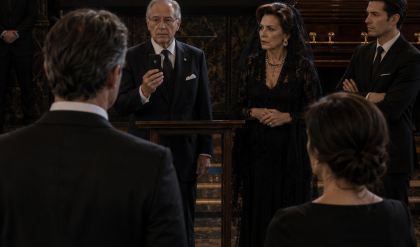
The night of the unveiling, the restored prototype sat beneath a black silk cover under white lights.
Vivian stood beside it in a dark dress with no flashy jewelry, her hair pulled back, her face composed.
Jack stood near the side of the room with Noah, who wore new glasses and a blazer he clearly hated.
Benny and Tony stood in the back, looking uncomfortable among expensive suits.
A journalist whispered too loudly, “Is this the one from the crash?”
Another murmured, “Probably a replica.”
Vivian heard them.
She did not react.
She took the microphone.
“My father believed honest work could outlive the person who made it,” she said. “He believed a car could carry memory, grief, love, and defiance in its frame. Tonight, we find out whether he was right.”
Then she pulled the cover away.
Part 3
For a few seconds, nobody made a sound.
The black prototype stood beneath the lights like it had rolled out of a dream.
Not new.
That would have been easier.
It looked alive.
The body lines were flawless, not because they had been erased and remade, but because they had been understood. The curve of the fenders held Henry Hartwell’s original hand. The restored interior carried every intimate detail Vivian remembered. The center frame, once twisted and dismissed as unsalvageable, now held a quiet authority that made the engineers in the room lean closer without meaning to.
Someone exhaled.
Someone else whispered, “My God.”
An older man in a navy suit stepped forward. Vivian recognized him instantly: Robert Gaines, one of the few engineers still living who had worked with her father in the early years.
He crouched beside the car, ignoring the cameras, and ran his fingers beneath the lower frame.
For a moment, his face changed.
He was no longer a famous consultant.
He was a young engineer again, standing beside Henry Hartwell in a noisy workshop.
Robert stood slowly.
“This is Henry,” he said, voice rough. “This is exactly Henry.”
Then his gaze moved across the room until it found Jack.
“Who are you?”
Every head turned.
Jack looked like he wanted to disappear.
Noah, standing beside him, lifted his chin.
Jack cleared his throat. “I’m a mechanic.”
Benny, from the back, let out a laugh.
Not the cruel kind.
The surrendering kind.
The applause began slowly.
Then it grew.
It filled the design center, rolling over the polished floor and glass walls, over the reporters and rivals and investors, over every person who had come expecting to see a rich woman’s grief fail in public.
Vivian did not look at them.
She looked at Jack.
He stood there with one hand on Noah’s shoulder, wearing his only decent suit, looking more uncomfortable with applause than he had ever looked with failure.
And Vivian realized then that Jack Miller had not just restored her father’s car.
He had restored something in her, too.
After the crowd moved in to examine the prototype, Vivian found Jack beside the side wall. Noah leaned against him, half-asleep, his head on Jack’s arm.
“How’s he holding up?” Vivian asked.
Jack glanced down. “He can sleep anywhere. Hospital chairs, garages, corporate events. It’s his superpower.”
Vivian smiled.
A real smile.
Jack saw it and looked away first.
“Jack,” she said, “I need to talk to you.”
He nodded toward the car. “About the power distribution modification?”
“About that. And more.”
Noah opened one eye.
“I’m awake,” he muttered.
“No, you’re not,” Jack said.
Noah closed his eye again, smiling faintly.
Vivian folded her hands in front of her, suddenly aware that she was more nervous than she had been in front of the entire crowd.
“What you did tonight wasn’t restoration,” she said. “You solved a problem my father didn’t have time to finish. You understood his work better than people who built careers quoting him.”
Jack said nothing.
“I want to open a new division at Hartwell Apex,” she continued. “High-performance restoration and prototype development. Not mass production. Not branding nonsense. Real work. Difficult work. Work that requires someone who understands both the mechanics and the soul of a machine.”
Jack stared at her.
“I want you to run it.”
His face went still.
“Vivian—”
“Full authority,” she said. “You choose the team. You choose the projects. You choose the methodology. You’ll have funding, facilities, and protection from anyone who thinks loud opinions are the same as expertise.”
Jack looked toward the prototype.
Then toward Noah.
His son was awake now. Fully.
Noah looked at him as if he already knew the answer and was just waiting for Jack to catch up.
“I haven’t worked in that world in a long time,” Jack said.
“That world lost the right to define you when it stopped seeing you,” Vivian replied.
The words struck him harder than she expected.
Jack’s jaw tightened.
For a moment, she saw the decade behind his eyes. The hospital bills. The closed doors. The interviews. The customers who looked past him. The years of shrinking his own brilliance so it would fit inside survival.
“What would the division be called?” he asked at last.
Vivian’s chest loosened.
“Hartwell,” she said. “For my father. And whatever name you choose for the other half.”
Jack looked down.
When he spoke, his voice was quiet.
“Miller.”
Vivian nodded. “Hartwell Miller.”
Noah sat up straight.
“Does that mean we don’t have to eat vending machine dinners at the garage anymore?”
Jack laughed.
It came out sudden and deep, from a place that had not been used in years.
Vivian laughed too.
And in a room full of money, cameras, history, and restored metal, the most honest sound of the night was a tired father laughing with his son while a woman who had forgotten how to be soft remembered.
Three months later, Jack Miller walked into Hartwell Apex Motors’ Detroit innovation campus as division director.
He carried the same old backpack.
He wore the same work boots, cleaned but still worn at the edges.
Noah walked beside him with new glasses, a new school schedule, and an expression that suggested he was mentally mapping every hallway for future reference.
People stared.
Some tried not to.
A few recognized him from the unveiling coverage. Others saw only a man who did not look like the executives they were used to following.
Jack noticed.
He had spent years noticing when people decided what he was before he spoke.
This time, he did not lower his eyes.
Vivian met him in the lobby.
“Ready?” she asked.
“No,” Jack said honestly.
“Good. People who are too ready usually haven’t understood the size of the work.”
Noah looked between them. “That sounds like something grown-ups say when they’re terrified.”
Vivian laughed. “He’s going to be dangerous in a boardroom someday.”
“He’s already dangerous at parent-teacher conferences,” Jack said.
The first weeks were not easy.
Respect did not arrive all at once just because Vivian had given him a title.
Some engineers resented him.
Some executives doubted him.
One senior project lead named Grant Keller made the mistake of saying, in a meeting, “With all due respect, garage intuition isn’t exactly a scalable methodology.”
The room went quiet.
Jack looked at him.
He did not get angry.
He walked to the glass board and drew a load-path diagram from memory, then layered three failure scenarios over it, then explained how Keller’s proposed design would fail under extreme side stress at a point no simulation had flagged because the input assumptions were too clean.
By the time Jack finished, Grant’s face had gone pale.
Vivian, seated at the end of the table, said nothing.
She didn’t need to.
After the meeting, Noah, who had been waiting outside with a book, looked up as Jack stepped into the hallway.
“Did you win?”
Jack adjusted his backpack strap.
“It wasn’t a fight.”
Noah gave him a look.
Jack sighed. “Fine. Maybe a little.”
By the end of the first month, Hartwell Miller had its own workspace.
Not a glossy showroom.
A real workshop.
Vivian had offered Jack a polished lab with white floors and fingerprint-proof glass. Jack asked for concrete, ventilation, tool access, old-school drafting tables, and enough room for people to think with their hands.
He hired carefully.
A retired fabricator from Flint.
A young electrical systems designer who had been told she was “too intense” at her last job.
A former military mechanic who could diagnose vibration by sound.
And Benny Kowalski.
When Jack called him, Benny answered with suspicion.
“You calling to brag, Miller?”
“No,” Jack said. “I’m offering you a job.”
A long silence followed.
“Why?”
“Because you know metal,” Jack said. “And because you stopped laughing when it mattered.”
Benny showed up two weeks later with two toolboxes, a bad attitude, and eyes that got wet when he thought no one was looking.
Tony Russo called Jack personally too.
The conversation was awkward.
“I should’ve said it sooner,” Tony admitted. “You were the best man in that shop.”
Jack leaned against his new workbench and looked across the room at Noah doing homework under better lighting than he’d ever had at Russo’s.
“You gave me work when I needed it,” Jack said. “That mattered.”
Tony was quiet.
“You always were too generous,” he muttered.
“No,” Jack said. “I just remember everything.”
Vivian visited the Hartwell Miller workshop nearly every day.
At first, everyone assumed it was oversight.
Then they began to notice that she never hovered. She listened. She asked questions. She sat on a stool near the prototype and watched Jack’s team argue about solutions with the kind of focus she usually reserved for acquisition deals.
One evening, long after most employees had gone, she found Jack alone beside the black car.
The restored prototype had become the division’s silent centerpiece. Not a trophy. A reminder.
Noah was at a robotics club meeting, his first real extracurricular activity in years, and Jack looked strangely incomplete without him nearby.
Vivian stood beside him.
“You’re doing well,” she said.
Jack smiled faintly. “That still sounds strange.”
“What does?”
“Being told I’m doing well by someone who means it.”
Vivian’s expression softened.
For a while, they stood in silence.
Then Jack said, “I used to think if I ever got back here, I’d feel like I’d won.”
“And?”
He looked around the workshop. “Mostly I feel grateful. And scared. And angry sometimes.”
“At what?”
“At how close I came to believing them.”
Vivian understood.
She had built an empire, and still there were days she heard every man who had called her too cold, too emotional, too ambitious, too much like her father, not enough like him.
“The world is very confident when it’s wrong,” she said.
Jack looked at her.
“Yeah,” he said. “It is.”
Their relationship did not become a fairy tale.
Neither of them had room in their lives for pretending.
It became something slower.
Coffee left on a desk.
A text asking whether Noah’s science fair went well.
A late-night argument about whether preserving original design mattered more than improving performance.
A quiet dinner after a long investor meeting, where Vivian admitted she hated eating alone in restaurants because people always watched her.
Jack admitted he still checked grocery prices even when he didn’t have to anymore.
One Saturday, Vivian came to Noah’s robotics competition.
She arrived late, tried to stand in the back unnoticed, and failed completely because CEOs do not blend into middle school gyms.
Noah’s robot malfunctioned in the semifinal round.
His team panicked.
Noah crouched beside it, pushed his glasses up, and listened.
Jack watched from the bleachers.
Vivian leaned toward him. “He listens like you do.”
On the floor, Noah adjusted one wire, reset the drive, and sent the robot forward.
It worked.
The gym erupted.
Noah looked for his father first.
Then, to Jack’s surprise, he looked for Vivian.
She clapped with both hands, smiling like she had forgotten the rest of the world existed.
That night, after pizza with Noah’s team, Jack walked Vivian to her car.
“Thank you for coming,” he said.
“I wanted to.”
“You don’t have to do things just because Noah likes you.”
Vivian paused beside the driver’s door.
“I didn’t come because Noah likes me.”
Jack knew what she was saying.
For a second, fear rose in him—old fear, practical fear, the kind built from loss and debt and hospital rooms.
Vivian saw it.
“I’m not asking you for anything tonight,” she said gently.
Jack nodded.
But he reached for her hand before she got into the car.
Just once.
Just enough.
A year after the ruined prototype first arrived at Russo Auto & Salvage, Hartwell Miller unveiled its first original concept: a performance restoration platform that combined classic design preservation with adaptive modern engineering.
The industry called it groundbreaking.
Magazines called Jack Miller a rediscovered genius.
One headline read: The mechanic who saved Hartwell’s lost masterpiece.
Jack hated that headline.
Noah loved it and taped it inside his locker.
At the launch event, Vivian spoke briefly, as always.
Then she surprised everyone by inviting Jack to the stage.
He froze.
Noah, standing near the front in a suit he had finally stopped complaining about, mouthed, Go.
Jack walked up slowly.
Hundreds of people waited.
Cameras pointed.
Executives, journalists, engineers, investors—an entire room full of people who would once have never looked up from their phones for him.
Jack gripped the microphone.
“I don’t have a speech,” he said.
A soft laugh moved through the room.
He looked at Noah.
Then at Vivian.
Then at the car.
“I spent a lot of years working where no one could see me,” he said. “Some of those years were hard. Some were humiliating. Some were just quiet. And when life gets quiet in that way, you start wondering if maybe the world is right about you.”
The room stilled.
Jack continued.
“But my son watched me when nobody else did. He believed I was still building something, even when all he could see was me coming home tired. And Vivian Hart trusted me with the only machine in the world that still carried her father’s voice.”
Vivian’s eyes shone, but she did not look away.
“So if there’s anything worth saying tonight, it’s this. Don’t measure people only by where they are standing when you meet them. Some people are not stuck. They are surviving. Some people are not ordinary. They are waiting for one honest chance to show you what they’ve been carrying.”
For a long moment, nobody moved.
Then Noah started clapping.
Vivian followed.
Soon the entire room stood.
Jack stepped down from the stage before the applause ended because he did not yet know how to stand inside admiration comfortably.
Maybe he never would.
That was all right.
Later that night, after the guests had gone and the lights had dimmed, Vivian found Jack and Noah in the workshop beside the black prototype.
Noah was half-asleep on a bench, his tie loosened.
Jack stood with his hands in his pockets, looking at Henry Hartwell’s car.
Vivian came to stand beside him.
“You changed my company,” she said.
Jack shook his head. “Your father started it.”
“You finished what he couldn’t.”
“No,” Jack said softly. “We did.”
Vivian leaned her shoulder lightly against his.
For the first time, he did not move away from the tenderness.
Noah opened one eye.
“Are you two finally going to admit you’re dating, or do I have to make a spreadsheet?”
Jack closed his eyes. “Go to sleep.”
Vivian laughed. “A spreadsheet might help.”
Noah smiled, satisfied, and drifted off again.
Jack looked at Vivian.
In the reflection of the black car, he saw them all: a woman who had mistaken control for strength, a boy who had never stopped believing, and a man who had spent years being treated like scrap until someone finally understood he had not been destroyed.
He had only been waiting for the right hands, the right moment, the right reason to come back to life.
The world had called the car impossible.
It had called Jack ordinary.
It had called grief an ending.
But that night, in the quiet heart of the workshop, the restored prototype gleamed under the soft lights, whole and powerful and alive.
And Jack Miller finally understood something his wife had tried to tell him years ago, back when she sat barefoot on the kitchen counter and believed in every impossible sketch he drew.
Some dreams don’t die when life breaks them.
Some dreams wait inside the wreckage until someone brave enough, patient enough, and stubborn enough whispers the words nobody else believes.
I think it can be saved.
THE END