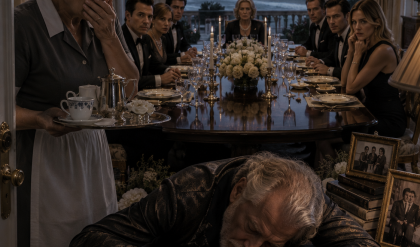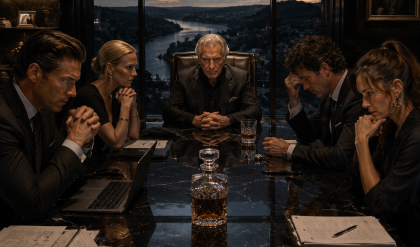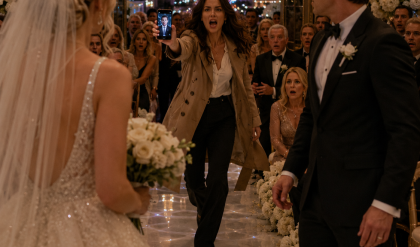
Clara did not smile.
She stared at him with every ounce of urgency she could put into her eyes.
Then she gave one small nod.
Damian’s expression did not change.
That was how Clara knew he understood danger better than any man she had ever met.
He lifted the glass, took a slow sip, and in the same motion swept the note into his palm. Under the tablecloth, his fingers opened it.
Clara turned and walked away, forcing her pace to stay ordinary.
One.
Two.
Three.
Damian read.
His jaw tightened.
Only once.
Then his whole body altered.
It was almost invisible, but Clara saw it. A man having dinner vanished. Something colder took his place.
He reached for his phone and typed with his thumb.
Across the room, Jackal took his first step.
Then Chloe emerged from the restroom hallway.
She walked back with a smile stretched so hard it looked painful.
“Sorry, darling,” she said, sliding into her chair. “My shoe clasp was giving me trouble.”
Damian looked at her.
Clara had never seen a person lose color so quickly.
“Is that right?” he asked.
Chloe lifted her wine. “Why are you looking at me like that?”
“I was just thinking about your brother,” Damian said softly. “Richard, isn’t it?”
The wine trembled in Chloe’s hand.
“What about him?”
“I heard his debt became uncomfortable.”
Chloe swallowed.
Damian leaned forward, his voice lower than the music. “A man can do desperate things when his family owes money to the Irish.”
Chloe’s eyes snapped toward the bar.
Fatal mistake.
Damian moved before the first gun cleared the coat.
He grabbed Chloe by the front of her emerald gown and pulled her across the table, not hard enough to kill, but hard enough to move. The first suppressed shot punched through the space where his chest had been and shattered the bottle of sparkling water behind him.
Clara screamed.
“Get down!”
The restaurant exploded.
Women shrieked. Chairs toppled. Crystal broke like ice under boots.
The two men from booth four rushed forward, but Chloe, thrown off balance, crashed into their path. One stumbled over her legs. The other reached into his jacket.
Damian was already standing.
He drew from beneath the table, fast as a magician and twice as terrifying. Two sharp cracks split the air. The men from booth four dropped screaming, one clutching his shoulder, the other his knee.
Jackal fired again.
The bullet tore through a framed oil painting above table six.
Clara threw herself behind the hostess stand and dragged the young hostess down with her.
“Stay low,” Clara ordered.
“I can’t breathe,” the girl sobbed.
“Yes, you can. Breathe with me. In. Out. Don’t look.”
Clara looked.
Damian crossed the room with impossible calm. Jackal tried to fire again, but Damian slammed a chair into his arm. The gun skidded across the polished floor. Damian kicked the man behind the knee and drove him face-first into the hardwood.
The whole thing lasted less than fifteen seconds.
Then came silence.
Not peace.
Shock.
The kind of silence people make when they have just discovered how thin the wall is between dinner and death.
Chloe lay on the floor, shaking, her emerald gown stained with wine and water and fear.
Damian stood over Jackal, breathing hard but controlled. His eyes moved across the room until they found Clara behind the host stand.
For the first time in her life, Clara Jenkins was not invisible.
Damian raised two fingers to his temple.
A salute.
A promise.
A debt.
And as police sirens began to wail through the rain outside, Clara realized the note had not simply saved a mafia boss.
It had put her name inside his world.
Part 2
Three days after the shooting at Leto, Clara stopped sleeping.
Every sound in her Logan Square apartment became a warning. Pipes knocking in the wall. A car slowing outside. Footsteps on the stairs. A drunk neighbor laughing too loudly at two in the morning.
She kept a kitchen knife beside her bed, even though she knew it was useless.
The restaurant had closed “for renovations,” which was what rich people called bullet holes when they had enough money to repair them quickly. Police had interviewed everyone. Clara had lied exactly the way people expected her to lie.
“I was serving sides,” she told Detective Mark Harrison, wrapping her arms around herself. “I heard popping sounds. I hid. I didn’t see anything.”
He barely looked at her.
That helped.
Men like Detective Harrison had spent their whole lives believing women like Clara were background noise. He wrote down three lines and moved on to people he considered important.
Still, Clara knew the truth would not stay buried forever.
Chloe knew.
Damian knew.
And if any of the wounded hitmen survived long enough to talk, the Irish might know too.
On the fourth night, rain came down hard enough to turn the sidewalks silver. Clara walked home from the corner store with a plastic bag of groceries pressed against her coat. Eggs, bread, coffee, generic cereal, and a can of soup she probably would not eat.
Half a block from her building, a black Cadillac Escalade rolled to the curb.
Clara stopped.
The rear door opened.
A man stepped out holding an umbrella.
He was tall, clean-shaven, and dressed in a navy suit that looked expensive without trying to announce itself. His expression was polite. His posture was not.
“Clara Jenkins?” he asked.
Her fingers tightened around the grocery bag. “Depends who’s asking.”
“My name is Leon. Mr. Rossi would like to speak with you.”
“No.”
Leon blinked once. “No?”
“You heard me. Tell Mr. Rossi thank you for not dying, but I’m not getting into a car with anybody.”
A flicker of amusement crossed Leon’s face. “He said you might say that.”
“Then he’s smarter than he looks.”
“He also said to tell you that if he wanted to hurt you, you would not see the car first.”
Clara’s blood went cold.
Leon sighed, as if he regretted the wording. “That sounded worse than intended.”
“No, I think it sounded exactly like intended.”
The rain hit the umbrella between them.
Leon reached slowly into his inner jacket pocket. Clara stepped back.
He withdrew an envelope and held it out.
“Your lease renewal,” he said. “Your landlord accepted money yesterday from a man named Patrick Doyle. South Side Irish. Doyle asked for access to your building’s basement door. Mr. Rossi bought the building this afternoon.”
Clara stared at the envelope.
Leon’s voice softened. “He is not the only dangerous man in Chicago, Miss Jenkins. He may be the only one currently trying to keep you alive.”
Clara hated that this made sense.
She hated even more that she got into the SUV.
They drove north, leaving behind wet brick buildings and late-night taquerias, moving through neighborhoods with wider streets and quieter money. By the time they passed through iron gates in Lake Forest, Clara’s hands had stopped shaking and gone numb.
Damian Rossi’s house looked less like a home and more like something a senator would deny owning. Stone walls. Tall windows. A view of Lake Michigan black and restless beyond the lawn.
Leon led her inside.
The study smelled like leather, smoke, old books, and expensive bourbon. A fire burned in the hearth. Damian stood by the window, wearing a black turtleneck and dark slacks, not a suit. Without the restaurant lights and the bodyguards, he looked less like a crime lord and more like a man who had survived too many winters by refusing to freeze.
“Clara,” he said.
“Mr. Rossi.”
“Damian.”
“No offense, but I don’t think we’re on a first-name basis.”
A small smile touched his mouth. “You saved my life. That moves things along.”
“I saved everyone’s life.”
His smile faded. “Yes. You did.”
That stopped her.
Damian walked to a side table and poured two glasses of bourbon.
“Do you drink?”
“Only when I’ve been kidnapped politely.”
He handed her a glass. “You were not kidnapped.”
“Your man threatened me with accuracy.”
Damian looked toward the door. “Leon needs charm lessons.”
“Leon needs prison.”
To her surprise, Damian laughed. A real laugh. Quiet, but real.
Clara did not drink.
Damian noticed.
“You think it’s poisoned?”
“I think everything in this house is a decision.”
He lifted his own glass and drank first. “Fair.”
Only then did Clara take a sip. It burned down her throat and settled warm in her chest.
Damian leaned against the edge of his desk. “I had you looked into.”
“Of course you did.”
“Thirty-two. Psychology degree. Mother died six years ago. Father not in the picture. Ten years in hospitality. No criminal history. No debt besides student loans and medical bills. No boyfriend. No husband. No children.”
Clara set the glass down hard. “Anything else? Shoe size? Favorite cereal? How many times I cried in my car this week?”
His face changed.
Not guilt, exactly.
Recognition.
“I apologize,” he said.
That was not what she expected.
Damian Rossi apologizing felt more dangerous than Damian Rossi threatening her.
“I needed to know whether you were working with anyone,” he continued. “You weren’t. You acted alone.”
“I acted because your girlfriend was about to get half the dining room killed.”
“Chloe is not my girlfriend anymore.”
“That breakup must have been awkward.”
His eyes darkened. “Her brother owed the Irish two million dollars. They offered to erase it if she delivered me. She accepted.”
“Where is she?”
“Alive.”
“That’s not an answer.”
“It is the one I can give you.”
Clara looked at him for a long moment. “I don’t want to know more than that.”
“Good.”
The fire cracked between them.
Damian studied her the way she usually studied other people.
“You saw what my security missed,” he said. “The men I pay to keep me alive failed. You did not.”
“I’m a waitress. People talk in front of waitresses.”
“No. People talk in front of people they don’t respect. You learned to turn disrespect into intelligence.”
Clara felt something twist behind her ribs.
No one had ever put it like that.
They called her observant when they wanted her to cover extra tables. They called her sensitive when she noticed cruelty. They called her paranoid when she sensed danger before it had a name.
Damian called it intelligence.
“You weaponized being overlooked,” he said quietly.
Clara looked away first.
“Why did you do it?” Damian asked. “You could have run.”
She should have given a noble answer. Innocent people. Staff. Duty. Survival.
Instead, the truth came out.
“Because you said thank you.”
Damian went still.
“At the table,” Clara said. “You said thank you. You remembered my name. Last year, you helped Tomas when he burned his hand. You never treated me like furniture.” Her voice hardened. “That doesn’t make you good. But it meant I wasn’t going to watch Chloe Vanderwall murder you over her brother’s gambling debt.”
Damian’s face lost its armor for one brief second.
It was not softness.
It was loneliness.
Then he crossed to his desk, opened a drawer, and took out a folder.
“I want to offer you a job.”
“No.”
“You haven’t heard the terms.”
“I heard ‘job’ from a mafia boss. That was enough.”
His mouth twitched. “Officially, you would work for Rossi Freight as a human risk consultant.”
“That sounds fake.”
“It is. Most titles are.”
Clara almost smiled. She stopped herself.
“I don’t want you to carry weapons,” he said. “I don’t want you involved in anything violent. I want you in rooms. Meetings. Dinners. Negotiations. I want you to watch people and tell me who is lying.”
“And if I say no?”
“I keep protecting you until the Irish lose interest.”
“That could be never.”
“Yes.”
Clara stared at the folder.
“How much?”
“Five hundred thousand a year.”
She laughed before she could stop herself.
Not because it was funny.
Because the number was obscene enough to sound fictional.
Damian slid a check across the desk. “Signing bonus. Two hundred fifty thousand.”
Clara stared at it.
That check could erase her mother’s last hospital bills. Her student loans. Her credit cards. Her fear of one broken tooth ruining her life.
That check could buy freedom.
Or chains.
“What’s the catch?” she whispered.
Damian’s eyes held hers. “You will see things you cannot unsee.”
“I already do.”
“You may become a target.”
“I already am.”
“You will be near me.”
There it was.
The most honest warning.
Clara looked at Damian Rossi, at the firelight catching in his dark eyes, at the bloodless calm of a man who could order death and still remember a dishwasher’s rent.
“I have conditions,” she said.
His eyebrows rose. “Name them.”
“I don’t hurt people.”
“Agreed.”
“I don’t help you hurt people.”
A pause.
Then, “Agreed.”
“If I tell you someone is dangerous, you listen.”
“Yes.”
“If I tell you you’re becoming the worst version of yourself, you listen harder.”
For the first time, Damian looked truly surprised.
Then he nodded once.
“Yes.”
Clara picked up the pen.
Her signature looked steady.
Her heart was not.
“When do we start?” she asked.
Damian’s answer was immediate.
“Now.”
Over the next six months, Chicago learned to stop laughing at Clara Jenkins.
At first, Damian’s men treated her like a joke. They saw a plus-size former waitress in tailored blazers sitting silently at the edge of private rooms, and they smirked behind glasses of scotch.
The smirks did not last.
In November, a city councilman named Wallace sweated through a meeting in a room cold enough to chill coffee. Clara noticed his pupils were blown wide, his left foot tapping in a withdrawal rhythm, his answers half a second too rehearsed.
“Don’t give him the money,” she told Damian afterward. “He’s wired or scared. Maybe both.”
Two days later, Wallace was arrested by the FBI.
In December, during a charity auction, Clara watched Damian’s accountant mirror the body language of a rival boss across the room. She checked shipment inconsistencies, found duplicate invoices, and uncovered three million dollars being siphoned offshore.
In January, a nervous warehouse manager lied about missing medical supplies. Damian wanted to punish him. Clara asked three more questions and discovered the man had been stealing insulin shipments to keep a free clinic alive after funding collapsed.
Damian was furious.
Not at the man.
At himself.
The next week, Rossi Freight quietly became the clinic’s biggest donor.
“You’re changing my business,” Damian told Clara one night in his penthouse office.
“No,” she said, flipping through a file. “I’m showing you what your business already is. You decide what to change.”
He watched her from across the desk.
“What?” she asked.
“You don’t flinch when you speak to me.”
“Should I?”
“Most people do.”
“I’m not most people.”
“No,” Damian said softly. “You are not.”
Something changed after that.
Not quickly.
Not safely.
It happened in midnight strategy sessions over cold takeout and untouched wine. It happened when Damian learned Clara took her coffee with cinnamon but hated sweet drinks. It happened when Clara learned Damian could play old Sinatra songs on the piano but only when he thought no one was listening. It happened when he stopped calling her “Miss Jenkins” and started saying “Clara” like her name belonged in his mouth.
One snowy night in February, they sat alone above the city, reviewing warehouse contracts while wind pressed against the glass.
Clara reached for a file.
Damian reached at the same time.
Their hands touched.
Neither moved.
Clara’s breath caught.
Damian looked at their hands, then at her.
“You know,” he said, voice low, “for someone who reads everyone else so well, you are remarkably blind about me.”
Clara tried to pull her hand back. He did not hold it hard, only enough to ask her to stay.
“Damian.”
“Tell me what you see.”
“That’s a bad idea.”
“Tell me.”
She forced herself to meet his eyes. “I see a man who is tired of being feared but doesn’t know who he is without it.”
His expression flickered.
“I see a man who thinks loyalty has to be bought because the last woman beside him sold him for a debt.”
His jaw tightened.
“I see a man who is dangerous,” Clara whispered. “And lonely. And kinder than he wants anyone to know.”
The silence after that felt like standing too close to lightning.
Damian lifted his hand to her face, giving her every chance to step away.
She did not.
“You forgot one thing,” he said.
“What?”
“I see you.”
The words struck deeper than any kiss could have.
Then he kissed her anyway.
It was not gentle at first. Damian Rossi did not seem to know how to want gently. But when Clara’s hand pressed against his chest and she whispered his name, he softened with visible effort, as if tenderness were a language he had once known and lost.
Clara had been desired before, but often wrongly. As a secret. A curiosity. A compromise. A woman men wanted in the dark and ignored in the daylight.
Damian did not kiss her like a secret.
He kissed her like a vow.
When they broke apart, Clara looked up at him, terrified of what she had just allowed herself to feel.
“I won’t be your ornament,” she said.
“No.”
“I won’t be your weakness.”
His thumb brushed her cheek. “Clara, you are the strongest thing in my life.”
For a moment, she believed him.
Then April came.
And with it, the gala.
Part 3
The Continental Children’s Gala was supposed to be Damian Rossi’s return to polite society.
That was what the newspapers called it.
Clara knew better.
Polite society was only criminal society with better lighting.
The gala was held at Leto, newly renovated after the shooting. The bullet-torn painting had been replaced. The shattered glass was gone. The marble floors gleamed again. The restaurant wanted the city to forget that blood had once hit its polished wood.
Clara did not forget.
She stood in Damian’s bedroom while a stylist zipped her into a sapphire gown that had been made for her body, not for the body the world kept telling her to earn. The fabric draped over her curves like water. The neckline framed her shoulders. Her hair fell in glossy waves. Diamonds rested at her throat.
When she looked in the mirror, she did not see a waitress pretending to be important.
She saw a woman who had survived being invisible and had learned the cost of being seen.
Damian appeared behind her in a black tuxedo.
For once, he said nothing.
Clara met his eyes in the mirror. “That bad?”
His voice was rough. “No. That dangerous.”
She smiled despite herself.
Then she saw the worry beneath his expression.
“What is it?”
He adjusted one cufflink. “A lot of people in that room will hate seeing you beside me.”
“Because I used to serve them water?”
“Because you know what they look like when they lie.”
Clara turned. “Damian.”
“Yes?”
“No one gets hurt tonight.”
His face closed slightly.
She stepped closer. “I mean it. No warnings that end with bodies. No back rooms. No men disappearing because they made a joke.”
“If someone threatens you—”
“Then you trust me to see it before they move.”
That landed.
He nodded.
“Okay,” he said. “No one gets hurt tonight unless there is no other choice.”
Clara hated the last part.
But in Damian’s world, it was progress.
When they entered Leto, the room changed.
Not quiet at first.
Stunned.
Then whispering.
Clara recognized faces everywhere. Men who had ignored her. Women who had asked for her manager because their soup was not hot enough. Politicians who had discussed bribes while she refilled wine. Mob wives who had looked at her like upholstery.
Now every eye followed the placement of Damian’s hand at the small of her back.
A rival boss named Vincent Marcone approached with a smile sharp enough to cut ribbon.
“Damian,” he said. “Good to see you alive.”
“Vincent.”
Marcone’s gaze moved to Clara. “And this must be the famous waitress.”
The word was meant to sting.
It did not.
Clara extended her hand. “Clara Jenkins. I remember you prefer Bordeaux but pretend to like Scotch when you’re nervous.”
Marcone’s smile faltered.
Damian made a sound that might have been a cough, if Clara did not know better.
“Enjoy the gala,” Clara said.
They moved on.
For an hour, she played the room like an instrument.
A deputy mayor lying about a zoning favor.
A shipping executive terrified of his own assistant.
A donor couple pretending not to hate each other.
Then Clara saw Chloe.
Her breath stopped.
Chloe Vanderwall stood near the far exit in a silver dress, thinner than before, paler, her platinum hair cut short around her jaw. She should not have been there. She should have been in hiding, or custody, or wherever Damian’s world put people who betrayed kings.
But there she was.
And she was not looking at Damian.
She was looking at Clara.
Clara touched Damian’s wrist once.
He followed her gaze.
The temperature around him seemed to drop.
“I told you,” Clara whispered. “No one gets hurt.”
“She shouldn’t be here.”
“I know.”
Leon appeared beside them as if conjured. “Boss?”
Damian’s eyes stayed on Chloe. “Find out how she got in.”
“No,” Clara said.
Both men looked at her.
Clara watched Chloe’s hands.
Not frantic like last time.
Empty.
Trembling.
“She wants to talk,” Clara said.
“She wants to live,” Damian replied coldly.
“Those can be the same thing.”
Before Damian could stop her, Clara walked across the room.
Chloe’s eyes filled with tears as she approached.
“Clara,” she whispered.
“You have thirty seconds before every armed man in this building remembers breathing is optional.”
Chloe let out a broken laugh. “I deserve that.”
“You deserve worse. Start talking.”
Chloe glanced toward the balcony doors. “The Irish didn’t stop after Leto. They found out you warned him. They’ve been waiting for tonight because all his legitimate partners are here. They’re not trying to kill just Damian.”
Clara’s skin went cold.
“Who?”
Chloe swallowed. “Marcone. He made a deal with them. If Damian dies tonight, Marcone takes the city and the Irish get the west routes back.”
“How?”
Chloe’s eyes flicked upward.
Clara followed the glance.
Above the main dining room, a decorative balcony overlooked the gala floor. A photographer stood there, camera raised. He had been there all night.
But now Clara noticed what she should have seen earlier.
The strap was wrong.
Too thick.
Too heavy.
Not a camera strap.
A harness.
“Bomb,” Chloe whispered. “In the lighting rig. They gave me this.”
She pressed something into Clara’s hand.
A small black drive.
“Insurance,” Chloe said, crying now. “Texts. Bank transfers. Recordings. Richard is dead anyway. They killed him last week. I sold Damian for nothing.”
Clara felt no pity.
Then, despite herself, she felt something worse.
Understanding.
Chloe had done something unforgivable because fear had eaten her alive. Now fear had brought her back with the truth.
Clara closed her fist around the drive.
“Go to the ladies’ room,” she said.
Chloe blinked. “What?”
“Same place you hid last time. Lock yourself in a stall. If you run, Damian will think you’re part of it. If you stay here, Marcone will kill you. Go.”
Chloe went.
Clara turned back.
Across the room, Damian had not moved, but every part of him was watching her.
She crossed to him slowly.
“Do not react,” she said, smiling like he had told a charming joke.
His eyes sharpened.
“There’s a device in the lighting rig. Photographer on the balcony. Marcone is with the Irish. Chloe brought evidence.”
Damian’s hand flexed once.
The old Damian came into his eyes.
The one who solved betrayal with blood.
Clara stepped closer, still smiling for the room.
“No,” she whispered.
“Clara—”
“No. Children’s charity, remember? There are kids in the east dining room. Staff in the kitchen. Donors by the exits. You fire one shot, the room stampedes and people die.”
His jaw worked.
“Then what?”
“You own a logistics empire,” she said. “Move people.”
For one second, he stared at her.
Then he understood.
Damian turned to Leon. “Silent evacuation. Kitchen first. Tell the band to start the auction early in the east room. Move donors in groups. No panic.”
Leon vanished.
Damian touched Clara’s elbow. “And the balcony?”
“Mine.”
“No.”
“Trust me or don’t.”
His eyes burned. “I trust you. I don’t trust gravity, bombs, or men with cameras.”
“Then be ready to catch me.”
Before he could answer, Clara walked toward the staircase.
Every step up felt too loud.
The photographer saw her coming and smiled.
“Ma’am, guests aren’t allowed up here.”
Clara smiled back. “Funny. I used to work here. Guests were allowed to do almost anything if they looked expensive enough.”
His smile faded.
Behind him, tucked into the lighting truss above the chandelier, Clara saw the black casing.
Her mouth went dry.
She kept walking.
“I need you downstairs,” the man said.
His hand moved toward his jacket.
Clara stopped three feet from him. “You know what men like you always get wrong?”
His eyes narrowed.
“You think because a woman is big, she must be slow.”
He lunged.
Clara did not run.
She grabbed the camera strap with both hands and yanked hard, pulling him off balance. His shoulder slammed into the railing. The camera hit the floor. Something metallic skidded out from beneath his jacket.
Below, someone gasped.
The man swung at her.
Clara ducked badly, not elegantly, pain flashing across her cheek as his knuckles grazed her. But she had spent ten years carrying trays heavier than rich men’s egos. She drove her knee upward and shoved him into the wall with all the weight people had spent years mocking.
The railing cracked behind him.
Damian was already moving below.
Leon and two guards rushed up the opposite stairs.
The man reached for a remote clipped inside his sleeve.
Clara saw the red switch.
She grabbed his wrist.
He was stronger.
For one terrible second, his thumb moved toward the button.
Then Damian reached the balcony.
He did not shoot.
He did not kill.
He seized the man’s hand, twisted once, and the remote fell into Clara’s palm.
Leon tackled the man to the floor.
The room below was half-empty now, guests being guided into the east dining room under the cheerful lie of a surprise auction.
Clara looked at Damian.
He looked at her bleeding cheek.
The violence rose in him like a storm.
She touched his chest.
“No.”
His breathing was harsh.
“He hurt you.”
“And if you kill him, you prove every frightened thing they say about you.”
Damian stared at her as if she had put a blade between his ribs.
Then, slowly, he stepped back.
“Call the bomb squad,” he told Leon. “Call Detective Harrison. Tell him he gets Marcone, the Irish, and enough evidence to make captain if he doesn’t trip over his own shoes.”
Leon nodded.
“And Chloe?” Clara asked.
Damian looked toward the restroom hallway.
For a moment, the old law of his world hovered between them.
Betrayal demands blood.
Then Damian exhaled.
“Protective custody,” he said. “If she testifies.”
Clara closed her eyes briefly.
Not because everything was forgiven.
Because something had changed.
By midnight, Leto was surrounded by police, federal agents, bomb technicians, news vans, and rich people pretending they had not just crawled out of a restaurant through a service hallway.
The device was disarmed.
Marcone was arrested trying to leave through the wine cellar.
The photographer gave up two names before sunrise.
Chloe testified.
So did Clara.
And, to the shock of the city, so did Damian Rossi.
Not against himself in the way prosecutors wanted. He was too careful for that, and his lawyers were too expensive. But he gave enough to collapse Marcone’s network, enough to expose the Irish faction behind the Leto hit, enough to hand federal prosecutors a dozen violent men he had once considered useful to keep around.
Then Clara gave him her final condition.
They stood on the balcony of his Lake Forest house three weeks later, watching dawn spread over Lake Michigan.
“You have to leave it,” she said.
Damian did not pretend not to understand.
“The violence,” Clara continued. “The favors that ruin people. The fear. You have enough legitimate money to live ten lifetimes. Make Rossi Freight clean. Keep the clinics. Fund the staff scholarships. Build something that doesn’t require someone’s blood under the floor.”
Damian looked out at the water.
“I don’t know who I am without power.”
Clara stood beside him. “Then find out.”
He turned to her. “And if I fail?”
“Then you fail without me.”
The words hurt them both.
But Clara had learned something since the night she slipped him that note.
Love was not the same thing as surrender.
Damian took her hand.
“I have spent my life making people fear me,” he said. “You are the first person who made me want to be worthy of trust.”
One year later, Leto reopened under new ownership.
Clara Jenkins owned fifty-one percent.
She turned the private dining room, the place where Damian had nearly died, into a hospitality training program for women who had been overlooked, underestimated, mocked, dismissed, or told their bodies made them unworthy of beautiful rooms.
Tomas ran the kitchen apprenticeship.
The hostess Clara had dragged behind the stand became the general manager.
Rossi Freight still existed, but smaller, cleaner, watched by auditors who made Damian miserable and Clara delighted. The clinics stayed funded. The old back channels closed one by one. Men who had once bowed out of terror now shook Damian’s hand with caution and confusion, as if unsure what to do with a powerful man who had stopped collecting fear like rent.
On a clear October evening, exactly one year after the note, Clara stood near table seven in a dark blue dress, watching the dining room fill with laughter.
Damian came up beside her.
“No regrets?” he asked.
Clara looked at the table where she had once placed truffle potatoes with shaking hands.
“I regret the shooting,” she said. “The fear. The damage. The fact that it took danger for people to see me.”
Damian waited.
“But I don’t regret the note.”
He smiled faintly. “Neither do I.”
A young waitress passed carrying sparkling water. She was nervous, full-figured, and trying to make herself smaller as she moved between tables.
Clara stepped into her path gently.
“What’s your name?” Clara asked.
The girl blinked. “Maya.”
“Good to meet you, Maya. Don’t shrink in my dining room. Take up the space you need.”
The girl’s eyes filled with startled gratitude.
Clara watched her walk away taller.
Damian’s hand found Clara’s.
“You saved my life,” he said quietly.
Clara leaned into him, her eyes on the room she had once served from the shadows.
“No,” she said. “I saved mine first.”
And this time, when the crystal glasses clinked and the music rose and the powerful people of Chicago looked her way, Clara Jenkins did not disappear.
She smiled.
She had become impossible to overlook.
THE END