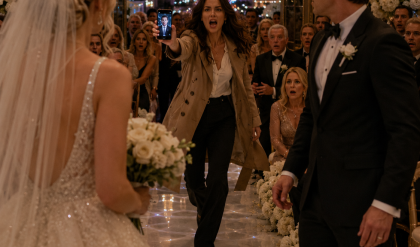
Olivia turned to her.
“No, Vanessa. From whatever my husband becomes when a woman like you convinces him cruelty looks like freedom.”
For the first time all night, Vanessa had no answer.
Grant looked around the ballroom and realized the performance had turned against him. The woman he had brought to make Olivia look replaceable now stood beside him like evidence.
“I want to speak privately,” he said.
Olivia shook her head.
“You made our marriage public tonight,” she said. “You don’t get to demand privacy just because the truth arrived better dressed than your lie.”
A few guests lowered their eyes.
Richard Bennett had already taken out his phone and sent a message.
Emergency board meeting. Tomorrow. Mandatory.
Olivia saw the small movement and knew the first door had opened.
She did not stay to enjoy it.
She was too tired.
Too pregnant.
Too wounded.
And still, strangely, too in love with the man standing in front of her to enjoy watching him fall.
She turned toward the exit.
Grant took two steps after her, but Caleb moved beside her with quiet precision.
Near the doors, Olivia looked back once.
Not at Vanessa.
At Grant.
“Until tonight,” she said, “you were only playing with the image of a hurt wife. From now on, you answer to something bigger than me. You answer to your unborn child. And to the will of a dead man you never truly learned how to defy.”
Then she left.
Outside, Manhattan was cold and bright, alive with headlights and sirens and strangers who knew nothing about the war that had just begun inside a hotel ballroom.
In the car, Olivia sat in the back seat with the folder on her lap and one hand over the baby.
Caleb spoke quietly on the phone, confirming the meeting.
When he ended the call, Olivia asked, “Can he undo anything before morning?”
“No,” Caleb said. “But a desperate man doesn’t need to win legally to hurt you. He only needs to make people doubt you.”
Grant reached the penthouse before she did.
Vanessa came with him, though for the first time that night, her presence irritated him. She poured him bourbon without asking, as if she already lived there.
“Olivia is bluffing,” Vanessa said. “Abandoned wives love documents. It makes them feel powerful.”
Grant loosened his bow tie and stared out over Fifth Avenue.
“My father,” he muttered, “built traps even from the grave.”
Vanessa came behind him and touched his shoulder.
“Then control the story,” she whispered. “Say she’s unstable. Say she’s being manipulated. Say the lawyer has his own interests. People will believe that before they believe a pregnant wife suddenly became a corporate warrior.”
Grant turned slowly.
It was ugly.
It was useful.
And that made it tempting.
When Olivia arrived after midnight, she found Grant standing in the living room and Vanessa sitting barefoot on the cream sofa Olivia had chosen herself.
The sight did not shock her.
The entitlement did.
Vanessa had placed her purse on Olivia’s chair. Her lipstick stained a glass from Olivia’s cabinet. She looked less like a guest than a woman waiting for the wife to leave so she could redecorate.
Grant spoke first.
“Where have you been hiding that lawyer?” he demanded. “How long have you been planning to interfere with my company?”
Olivia sat carefully near the window.
“It’s interesting,” she said, “hearing you talk about interference while your mistress drinks in my living room.”
Vanessa laughed.
“No woman keeps a man just because she’s carrying his baby.”
Olivia looked at her.
“I’m not trying to keep a man. I’m trying to keep a child from being robbed by one.”
Grant moved toward her sharply, but Caleb entered behind her with the same white folder.
“This home is no longer a safe place for Mrs. Whitmore tonight,” Caleb said.
Grant’s face hardened. “You don’t tell me what my home is.”
Olivia stood slowly.
“No,” she said. “I do.”
Grant stared at her.
Vanessa crossed her legs. “Maybe if everything is so clean, Olivia should prove the baby is even yours.”
Silence swallowed the room.
Olivia went still.
Grant did not defend her.
That was the real betrayal.
Not the mistress. Not the gala. Not the bracelet.
The silence.
Olivia looked at the man who had once cried when he heard their baby’s heartbeat for the first time.
“Is that what you want?” she asked. “To cast doubt on your own child so you can leave tonight as the victim?”
Grant swallowed.
“I want the truth.”
Olivia gave a soft, broken laugh.
“No, Grant. You know the truth. You want a more comfortable version.”
She walked to the bedroom, packed a small suitcase, prenatal vitamins, medical records, and a tiny pair of white baby shoes still inside a box.
Grant followed her alone.
“You don’t have to do this,” he said, softer now.
“Yes,” she replied. “I do.”
“Vanessa went too far.”
“You let her.”
He looked away.
“I love you,” he said. “It’s complicated.”
Olivia closed the suitcase.
“Complicated love is a beautiful excuse for simple cruelty.”
He flinched, but he did not change.
Not yet.
Before leaving, Olivia turned to Vanessa.
“You still don’t understand the difference between entering a house,” she said, “and belonging to a story.”
Then she looked at Grant.
“If one false statement appears in the press, you won’t only lose a board fight. You’ll lose the right to ever tell your child you protected him.”
Grant said nothing.
And that silence followed Olivia all the way into the night.
Part 2
By sunrise, Grant Whitmore had not slept.
He stood in the penthouse living room, staring down at New York as if the city owed him an answer. Vanessa was asleep on the sofa, or pretending to be, her phone hidden beneath a cushion.
On the glass coffee table lay a copy of the transfer agreement he had signed two weeks earlier.
The date looked worse in daylight.
Two weeks after Olivia had told him the pregnancy was healthy.
Two weeks after he had pretended to be happy.
Two weeks after he had decided he needed to prove he was not still living under Arthur Whitmore’s hand.
At 7:20 a.m., his phone buzzed.
Richard Bennett.
Emergency board meeting confirmed. 10 a.m. Attendance mandatory.
Below that came another message from an unknown number: a photo of Olivia entering the gala with Caleb, her hand on her belly, her face steady.
The caption had already begun circulating.
Pregnant wife of Whitmore CEO appears with attorney after months away from public events.
Grant’s stomach tightened.
For the first time in years, the story was moving without his permission.
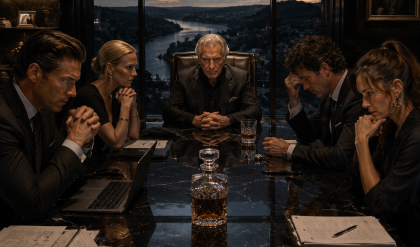
At ten o’clock, the Whitmore Group boardroom in Midtown felt colder than usual.
The long table reflected careful faces. Outside the glass walls, Manhattan looked gray and expensive. Grant arrived first, wearing a navy suit and the controlled expression of a man determined to look innocent by looking offended.
Vanessa had not been invited.
That did not stop her from sending him messages every three minutes.
Don’t let her weaponize pregnancy.
Your father is dead. You run the company.
She stayed because she knew.
Grant did not answer.
Then Olivia entered with Caleb.
Everyone stood.
Grant did not.
That small act said more than any speech.
Olivia wore a pale blue dress and a cream coat. She looked exhausted, but there was something new in her that Grant hated on sight.
She no longer seemed to be asking permission to exist in his world.
Richard Bennett opened the meeting.
“We are here to review the recent transfer of protected shares authorized by Mr. Whitmore under the stated purpose of strategic reorganization.”
Grant cut him off.
“This is absurd. Executive decisions should not be frozen because of marital drama.”
Olivia looked up.
“You made it marital when you used family assets to fund a public lie.”
A throat cleared somewhere down the table.
Caleb placed three folders in front of him.
“This is not about jealousy,” he said. “It is about whether protected trust assets were moved in a way that could harm Mr. Whitmore’s direct heir, currently unborn, whose interests are covered under Arthur Whitmore’s estate provisions.”
Unborn heir.
The phrase changed the temperature of the room.
Grant leaned back.
“My father wrote clauses because he enjoyed controlling people. That doesn’t make them sacred.”
“No,” Richard said. “But it does make them binding.”
Caleb read from the trust documents. Arthur had stated that any direct descendant conceived before certain transfers were finalized would trigger review protections. Until birth and formal trust assignment, the mother could act as legal representative for the unborn child’s interests.
Grant’s mouth twisted.
“So now a fetus runs my company?”
Olivia closed her eyes briefly.
When she opened them, they were wet but steady.
“You may hate me today,” she said. “You may accuse me of embarrassing you. But you will not speak about our child as if he is an accounting problem.”
Grant looked away.
Caleb saw it.
So did Olivia.
And so did every person in that room who knew shame when it tried to disguise itself as anger.
Grant tried another route.
“How do we know she isn’t being coached to use this pregnancy against me?”
The words landed like a slap.
Olivia’s hand moved over her stomach.
Caleb turned toward her silently, asking if he should respond.
She did not let him.
“You know when this baby was conceived,” Olivia said. “You know the doctor’s visits. You know the first heartbeat made you cry in the parking garage because you said maybe you could become better than your father. The doubt you are suggesting did not come from truth. It came from convenience.”
Grant’s face tightened.
Outside the boardroom, the press narrative was already being poisoned.
Vanessa sat in an upscale coffee shop three blocks away, wearing oversized sunglasses and smiling at her phone. She had sent a journalist an old photo of Olivia and Caleb in the hotel lobby with one carefully written line:
The pregnant wife wasn’t as alone as she claimed.
Vanessa did not need to accuse.
Accusations could be challenged.
Suggestions spread faster.
At the same time, she was texting a former junior legal assistant from Whitmore’s archives. He owed favors. Expensive favors. Paid through dinners, gifts, and a corporate card Grant had been careless enough to share.
I need to know where Arthur’s full trust papers are kept, she wrote.
He refused twice.
Then she sent him a screenshot of his own questionable expenses.
One minute later, he replied.
Old Westchester archive. Restricted cabinet. Partial copy accessible.
In the boardroom, Olivia began to struggle for breath.
Not dramatically.
Quietly.
That made it worse.
She was being discussed as a wife, a mother, a risk, a rumor, a legal representative, and a possible liar, all while her son shifted inside her as if reminding her that she was still flesh, not strategy.
Caleb requested a break.
Grant laughed under his breath.
“Maybe Mrs. Whitmore needs rest before continuing her performance.”
Olivia lifted her eyes.
“Rest would have been useful when you left me alone through morning sickness, blood tests, and nights I was too scared to sleep while you were in hotels with Vanessa.”
The room went silent.
For the first time, the affair had been named clearly in a corporate setting.
Grant flushed.
“My private life is not on trial.”
“If your private life had stayed out of company expenses,” Olivia replied, “maybe it wouldn’t be.”
Richard Bennett sat straighter.
Caleb opened a second folder.
“There are related expenses that require review,” he said, “including event costs, jewelry, hospitality, and consultant payments that may indicate improper influence by third parties during the period leading up to the transfer.”
Vanessa’s name entered the meeting not as a mistress.
As a risk.
During the break, Olivia stood in the glass hallway with a cup of water trembling in her hands.
Caleb stood beside her, not touching her, giving her the dignity of space.
“He’s close to making the worst mistake,” Caleb said. “If he turns false doubt into official strategy, the board will have to treat it as intimidation.”
“Will they believe him?” Olivia asked.
“Some may want to. An unstable pregnant wife is easier to dismiss than a CEO violating trust provisions.”
Olivia closed her eyes.
She remembered Grant months earlier in the doctor’s office, pale and speechless, holding her fingers too tightly while the heartbeat filled the room.
She remembered him kissing her forehead in the car.
“I don’t want to be my father,” he had whispered.
Where had that man gone?
Or had he only existed for a few seconds, too weak to survive ambition?
Grant appeared at the end of the hallway.
No board members.
No Vanessa.
For a moment, only husband and wife.
“We can still solve this without destroying everything,” he said.
“What is everything?” Olivia asked. “The company? Your name? Vanessa? Or your chance to pretend you didn’t abandon me?”
Grant’s face cracked just enough to show exhaustion.
“You don’t understand what it was like being Arthur Whitmore’s son. Every clause in that trust is him telling me I’m not enough.”
Olivia listened.
There was truth in that.
But truth was not absolution.
“So to prove you were free of your father,” she said, “you were willing to endanger your son?”
“I didn’t know the clause went that far.”
“You didn’t know because you didn’t ask.”
Then he said the thing that ended the last fragile thread between them.
“Caleb seems to know a lot about you. About the baby. About documents even I haven’t seen.”
Olivia stared at him.
“You can suspect the lawyer. The board. Your dead father. Even me. But if you suspect your own child to save yourself, there will be no marriage to come back to.”
Grant said nothing.
Richard opened the boardroom door.
“We need to resume.”
The break was over.
So was mercy.
The second half of the meeting was worse because it was precise.
Caleb presented timelines. Doctor records. Emails sent to the company’s legal department confirming the pregnancy weeks before the transfer. A record showing that Grant’s office received the notice.
Grant said he never saw it.
The general counsel confirmed it had been forwarded to his executive inbox.
Grant said he delegated document review.
Richard asked who approved the transfer without full legal review of succession restrictions.
Grant said, “I had authority.”
The word sounded smaller than he expected.
Then an assistant entered and handed Richard printed press notes.
Richard read them, his expression hardening.
“Did you authorize any external communication regarding Mrs. Whitmore’s emotional state or conduct?”
Grant hesitated.
Only half a second.
Too long.
“No.”
Caleb asked that the record reflect that such insinuations could materially harm the legal representative of the heir and influence the board process.
Olivia said nothing.
Her silence was no longer submission.
It was testimony.
Meanwhile, Vanessa reached the Westchester archive in a hired car.
The old Whitmore estate office sat behind iron gates and winter-bare trees. It smelled of polished wood, paper, and men who had built wealth like a religion.
The nervous assistant met her in the side parking lot with a brown envelope.
Inside were partial copies of Arthur’s trust notes.
Vanessa scanned them quickly.
Direct descendant.
Unborn child.
Asset protection.
Temporary maternal representation.
Then she found the handwritten note.
Grant should not exercise isolated control over assets intended for his first child until he demonstrates stability in both family and executive conduct.
Vanessa’s mouth tightened.
It was not only the baby.
It was Olivia.
Arthur had made the abandoned wife part of the shield.
Vanessa almost tore the page in half.
Then she stopped.
Destroying it was useful.
Using it was better.
She photographed it and sent it to Grant.
Olivia knew. That’s why she stayed. She needed to look like the perfect wife.
When the meeting ended without a final ruling but with the transfer suspended pending audit, Grant looked like a man who had lost a battle but refused to admit he had been at war.
Olivia rose carefully.
Grant approached her near the door.
“Suspending a signature doesn’t mean you’ve beaten me,” he said quietly.
“I didn’t come to beat you,” Olivia answered. “I came to stop you from becoming unrecognizable to your own child.”
For one second, something human flickered across his face.
Then his phone buzzed.
He looked.
Vanessa’s photo.
Arthur’s note.
Her poisonous caption.
The flicker died.
Grant’s eyes hardened.
“How long have you known,” he asked, “that staying married to me was worth shares?”
Olivia did not understand at first.
Caleb saw the screen and went pale.
“Grant,” Caleb said, “that is not what—”
Grant stepped back from Olivia as if she had become a stranger.
Vanessa’s lie had found the deepest wound in him.
The wound his father had left.
The wound Olivia had never been able to heal.
That night, Olivia did not return home. She sat in a safe apartment arranged by Caleb’s firm, the city shining below her, the trust papers open on her lap.
For the first time, she read Arthur Whitmore’s full words.
He wrote of wealth, yes.
But also of fear.
Fear that Grant would repeat his worst traits.
Fear that a child would become a bargaining chip.
Fear that the woman carrying that child would be discarded the moment she became inconvenient.
Olivia touched her belly.
“I won’t let them turn you into a key,” she whispered. “Or a weapon. Or an excuse.”
Her phone buzzed.
Grant.
Tomorrow, you tell me whether this baby was love or strategy.
Olivia cried then.
Not loudly.
Not dramatically.
Alone, because courage needed room to bleed.
Then she wiped her face and called Caleb.
“Prepare everything,” she said. “If Grant wants the whole truth, he’ll get it. But not the version Vanessa expects.”
Part 3
The next morning, the Whitmore Group building seemed to wake before the city.
Black cars lined the curb. Business reporters lingered near the side entrance pretending not to wait. Employees crossed the lobby with nervous speed, as if every elevator might carry a downfall.
Olivia arrived just before nine.
This time she wore a deep blue dress beneath a soft white coat. She did not hide her pregnancy. She did not display it either.
It was not evidence.
It was her child.
The boardroom was fuller than the day before. Along with the directors, there were internal lawyers, an independent auditor named Sylvia Price, and a silence so tight even the chairs seemed afraid to move.
Grant sat at the head of the table.
But the chair no longer seemed to belong to him.
Caleb placed three folders on the table.
White.
Blue.
Gray.
“Before any discussion of morality, image, or rumor,” Caleb said, “we need a line of facts.”
Grant gave a dry laugh.
“Facts can be arranged by lawyers.”
Olivia remained standing.
“And lies can be arranged by mistresses as gossip.”
Several eyes dropped.
Grant lifted his chin.
“Do you deny knowing my father’s note about you?”
“No,” Olivia said.
The answer stunned him.
His anger sharpened. “So you admit it. You stayed because you knew being my legal wife gave you power.”
Olivia looked at him with sadness, not surprise.
“That is your tragedy, Grant. When a woman stayed because she loved you, you could only imagine strategy.”
Caleb opened the white folder and projected the full trust document onto the screen.
Not the cropped photo Vanessa had sent.
Not the torn note.
The entire provision.
Arthur Whitmore’s instructions were clear: Olivia gained no personal ownership of Grant’s shares. She could not enrich herself. She could not sell, transfer, or control company assets for her own benefit. Her temporary role existed only to force review when actions might harm the unborn heir.
Sylvia Price confirmed it.
“The transfer Mr. Whitmore authorized affected precisely the protected block of shares,” she said. “The suspension was required.”
Grant tried to interrupt.
“If it was legitimate,” Caleb said, “it will survive review.”
Then came the blue folder.
Expenses.
Hotels.
Jewelry.
Private dinners.
Consulting payments.
Event costs.
Vanessa Hale’s name appeared again and again, hidden beneath corporate labels vague enough to fool lazy eyes but not an audit.
Olivia felt sick seeing betrayal turned into spreadsheets.
The pain had invoices.
Vanessa had dressed herself as Olivia’s replacement using money tied to the company Grant claimed to protect.
Grant’s fist hit the table.
“This is irrelevant. The question is whether Olivia used the pregnancy to gain power.”
Olivia stood.
“If power had been my goal,” she said, “I would have gone to the press the first month you disappeared. I would have released hotel receipts. Photos. Messages. I stayed quiet because I thought the man who cried at our baby’s heartbeat might find his way home.”
Grant stared at her.
“I knew about Arthur’s note,” she continued. “Because Caleb told me after you signed the transfer. Not before. I did not get pregnant to trap you. I got pregnant with my husband, in a marriage I still believed could be saved.”
Vanessa entered the building twenty minutes later.
She had no invitation, but she had learned to walk through doors with confidence and another person’s last name.
Security stopped her outside the executive floor.
She raised her voice.
“I’m here for Grant.”
The hallway heard.
So did the boardroom through the glass.
Grant turned his head.
Richard Bennett looked at him.
“Perhaps,” Richard said coldly, “we should hear from the third party whose name appears throughout these expenses.”
Grant’s face changed.
“No.”
But the room had already shifted.
Vanessa was brought in under escort, furious beneath her perfect makeup.
She looked at Olivia first.
“Still playing fragile?” she asked.
Olivia did not answer.
Sylvia placed printed records in front of Vanessa.
“Did you contact a Whitmore archive employee yesterday to obtain restricted trust documents?”
Vanessa smiled.
“I have no idea what you mean.”
Caleb slid a phone record across the table.
“Did you send Mr. Whitmore a photo of a partial handwritten note with commentary implying Mrs. Whitmore had manipulated her pregnancy?”
Vanessa’s smile thinned.
Grant looked at her.
For the first time, not as an escape.
As a risk.
“Vanessa,” he said slowly, “answer the question.”
She turned on him.
“Don’t look at me like that. I was helping you.”
“By stealing trust documents?”
“By showing you what she is.”
Olivia finally spoke.
“No. You showed him what he feared. That was easier.”
Vanessa’s face hardened.
“You think you’re better than me because you have a ring and a baby?”
“No,” Olivia said. “I think I’m responsible for a child. That makes me less interested in winning a room.”
Vanessa looked at Grant.
“She knew how to use your father against you. I just made sure you saw it.”
Grant’s voice dropped.
“You leaked the photos?”
Vanessa said nothing.
Grant’s expression cracked.
The boardroom watched the collapse of a man realizing the woman he had used to humiliate his wife had used him even better.
Caleb opened the gray folder.
It contained the archive employee’s statement, text messages, and proof that Vanessa had threatened exposure over personal expenses to obtain restricted documents.
Sylvia added the final blow.
“Preliminary review indicates corporate funds were used to provide benefits to Ms. Hale while the protected transfer was being prepared. Whether or not Mr. Whitmore intended direct misconduct, the conflict is severe.”
Richard removed his glasses.
“Grant, the board has enough to act.”
Grant stood.
“No. You don’t remove me because my marriage is ugly.”
Richard’s voice was calm.
“No. We suspend your executive authority because you moved protected assets without full review, allowed company money to blur with personal misconduct, and permitted a public narrative attacking the legal representative of the protected heir.”
Grant looked around the room.
No one came to save him.
Not Vanessa.
Not the board.
Not his father’s name.
His authority was suspended pending formal investigation. The transfer was frozen. A temporary oversight committee would manage the protected assets. Olivia’s role would remain limited to safeguarding the child’s legal interests, not controlling the company.
It was not revenge.
That was what made it hurt more.
It was consequence.
Vanessa lost control as security came for her.
“You’ll regret this,” she hissed at Olivia. “He’ll never forgive you.”
Olivia looked at her with tired eyes.
“I’m not asking him to.”
Grant did not move until Vanessa was gone.
When the door closed, the room felt emptier but not lighter.
The meeting ended with signatures, statements, and quiet instructions. Reporters outside would receive a formal notice about governance review, no mention of Olivia’s emotional state, no insinuations about the baby, no private smear dressed as concern.
Olivia stepped into the hallway, one hand pressed to her side.
Then pain tightened across her belly.
She stopped.
Caleb noticed first.
“Olivia?”
Grant turned.
Another wave came, sharper.
Her face drained of color.
“I think something’s wrong,” she whispered.
For one terrible second, all the money in the building became useless.
Grant ran.
Not as CEO.
Not as Arthur Whitmore’s son.
As a man who had just realized power could not command a heartbeat to stay.
At the hospital, everything became fluorescent light, rushing nurses, monitors, questions, signatures, waiting.
Grant stood outside the exam room with bloodless hands.
Caleb remained nearby, silent.
When the doctor finally came out, Grant could barely speak.
“Is she okay? Is the baby—”
“They’re stable,” the doctor said. “But she needs rest. Real rest. No more stress.”
Grant sat down hard.
For the first time in years, he looked small.
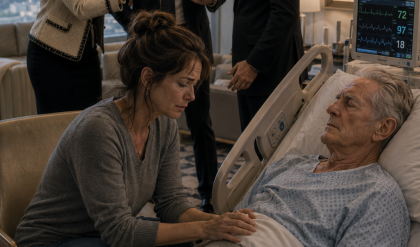
Olivia was awake when he entered.
The hospital room was quiet. A monitor traced the baby’s heartbeat in steady waves. That sound broke Grant more effectively than any board vote.
He stood near the door.
“I’m sorry,” he said.
Olivia looked at him.
She had imagined that sentence a hundred times.
It did not fix anything.
But it mattered that he finally said it without an audience.
“I let her speak about our child,” he said. “I let myself believe whatever hurt you most because it protected me from seeing what I’d become.”
Olivia’s eyes filled.
“You didn’t just hurt me, Grant. You made our baby stand trial before he was born.”
He covered his face with one hand.
“I know.”
“No,” she said softly. “You are only starting to know.”
He nodded.
The old Grant would have argued.
This one did not.
“I won’t ask you to come home,” he said. “I won’t ask you to forgive me today. I’ll sign whatever is needed to protect the baby. I’ll cooperate with the board. I’ll step down if they require it.”
Olivia studied him.
“And Vanessa?”
“It’s over. Legally, personally, completely.”
“That should have been true before she sat on my sofa.”
“I know.”
Silence settled between them.
Not warm.
Not healed.
But honest.
Weeks passed.
Grant’s suspension became a formal leave. The audit exposed enough misconduct to cost him control of daily operations, though not his entire stake. Vanessa disappeared from Manhattan society almost as quickly as she had entered it. The archive employee cooperated. The press tried to make Olivia into a scandal, then a victim, then a heroine, but she refused interviews.
She moved to a quiet townhouse in Brooklyn Heights with a nursery full of soft gray blankets and morning light.
Grant visited only when invited.
The first time he came, he brought no flowers, no jewelry, no grand speech.
Just a folder.
A corrected trust structure.
Signed.
Reviewed.
Unbreakable.
Olivia read it at the kitchen table while he stood near the window.
“You gave up more authority than the board required,” she said.
“Yes.”
“Why?”
Grant looked toward the nursery door.
“Because my father spent his life forcing me to be controlled. I don’t want my son to spend his life needing protection from me.”
Olivia closed the folder.
“That’s a beginning,” she said. “Not redemption.”
“I know.”
Two months later, their son was born during a rainstorm.
Olivia held him first.
A small, furious boy with dark hair, a strong cry, and fingers that curled around hers like a promise.
Grant stood beside the bed, crying openly.
“What’s his name?” the nurse asked.
Olivia looked at Grant.
They had once considered Arthur.
Grant shook his head gently.
“No,” he said. “He shouldn’t carry the weight of men who couldn’t love without control.”
Olivia looked down at her son.
“Elliot,” she said. “Elliot James Whitmore.”
Grant smiled through tears.
“Hi, Elliot,” he whispered. “I’m your dad. And I’m going to spend the rest of my life earning what that means.”
Olivia did not take him back that day.
Love was not a switch.
Trust was not a headline.
But when Grant asked if he could sit beside her while the baby slept, she moved her hand slightly, making room for a chair.
That was all.
And for once, Grant understood it was enough.
A year later, at a small charity luncheon far from the grand ballroom where everything had broken, Olivia stood at the podium as founder of the Elliot Trust, a fund supporting mothers navigating pregnancy, legal abuse, and financial control.
Grant sat in the back row.
Not beside her.
Not claiming her.
Just present.
When she finished speaking, the room rose in applause.
Grant waited until everyone else had greeted her.
Then he approached quietly.
“You were incredible,” he said.
Olivia smiled faintly.
“I know.”
He laughed softly, and the sound carried no arrogance.
Elliot toddled between them, clutching a toy truck, his dark curls falling over his forehead.
Grant crouched.
“Hey, buddy.”
Elliot placed the truck in his father’s hand, then turned and reached for Olivia.
Both of them.
Not as a perfect family.
Not yet.
Maybe not ever in the old way.
But as three people standing in the truth after surviving the lie.
Olivia looked at Grant.
“I don’t know what we become,” she said.
Grant nodded.
“I don’t need to decide that today.”
“For once.”
“For once,” he agreed.
Outside, New York moved fast and bright around them.
Inside, their son laughed.
And Olivia, who had once walked into a ballroom with trembling knees and a white folder, finally understood that the night Grant tried to replace her had not ended her story.
It had returned it to her.
THE END