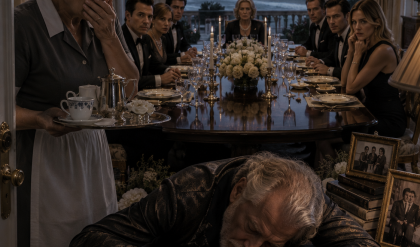
“This food is wearing her perfume, but it isn’t hers.” Vincent pushed the plate away as though it had insulted the dead. “Who cooked it?”
The question traveled to the kitchen like a match dropped on dry paper. By midnight, half the staff knew. By morning, Pierce Whitman knew the most dangerous regular in New York had sent back food for the first time in seven years. What Pierce did not yet understand was that he had not lost a chef that night.
He had lost the only reason certain people crossed Manhattan to sit under his chandeliers.
Whitman House had not always been a famous address. Nine years earlier, it had been an expensive mistake in SoHo with marble bathrooms, empty tables, and a landlord sharpening his patience into eviction papers. Pierce had inherited it from a father who knew wine, linen, and money, but not kitchens. Pierce knew even less. He could choose a suit, flatter a critic, and describe “culinary intention” for twelve minutes without mentioning food. He could not roast a chicken.
Nora had been thirty-one when she answered his advertisement, a line cook from a neighborhood supper club in Hoboken where firefighters, nurses, schoolteachers, and off-duty cops ate chicken pot pie like communion. She had no television credits, no famous mentor, no diploma from a gleaming culinary institute. What she had was a palate so precise that her old chef used to say she could hear salt. She could taste a stock and tell which bone had cracked too early. She could smell when butter was fifteen seconds away from browning into bitterness. She understood food as memory, hunger, weather, history, and promise. In an honest world, that would have been enough.
“You cook,” he told her in the interview, leaning across a desk he had not paid for yet, “and I sell the dream. Turn this place around, Nora, and your name goes on the menu. Executive chef, then partner. I don’t forget loyalty.”
Nora had known men like Pierce forgot loyalty the way rich boys forgot umbrellas. But she had also known the size of the chance in front of her. A real kitchen. A free hand. A restaurant that was dying enough to let her try anything. She took the job because sometimes the cage is also the only open door.
Then she built Whitman House from the bones outward.
She threw out the brittle tasting menu Pierce had copied from magazines and wrote food that tasted like America after midnight: cider-glazed pork with black pepper apples, salt-roasted carrots over buttermilk, crab cakes sharpened with preserved lemon, cornmeal spoonbread with smoked honey, and the short rib that would become the soul of the house. It was braised with bourbon, coffee, onion, and time, laid over slow grits enriched with aged cheddar and finished with a peppery jus that tasted like Sunday dinner dressed for a funeral.
She trained cooks to listen before they moved. She taught them that a plate could be beautiful without being vain. She arrived before lunch prep and left after the last burner cooled. Within eighteen months, the first critic called Whitman House “unexpectedly profound.” Within three years, reservations disappeared ninety days out. Within five, Pierce Whitman was giving interviews beneath the brass lights, discussing his “deeply personal American menu” while Nora fixed a broken immersion blender in the basement.
When the cooks asked how she could stand it, she gave them the same answer.
“He can have the room,” she said. “The food knows who made it.”
It was enough until it was not. Promises rot if they sit too long. Partnership became “next quarter,” then “after the expansion,” then “when the branding is right.” Nora kept cooking because the work was clean even when the business was dirty. She told herself that truth did not require applause.
Blake Harlan arrived in the spring, all white teeth and famous cheekbones, with a publicist who wore black sneakers worth more than Nora’s rent. He ate at Pierce’s table three times, praising the “bones” of the menu in a voice that made every compliment sound like an acquisition. Nora watched from the pass as Pierce leaned toward him, hungry for reflected light. By the second dinner, she understood. By the third, she stopped asking Pierce about the partnership. Something colder and more useful than hope took its place.
For nine months, she fed it with everything she could spare: consulting money from a hotel breakfast project Pierce never knew about, prize money from a state fair pie contest she entered under her grandmother’s name, the overtime Pierce forgot to question because he assumed women like Nora worked until they broke. By the night he fired her, she had $83,416 and a stubbornness no bank could appraise.
Across Spring Street from Whitman House sat a narrow storefront wedged between a shuttered tailor and a laundromat that smelled permanently of hot cotton. The previous tenant had sold cold-pressed juice to people who looked too sad to chew. The space had twenty-six seats if no one breathed too dramatically, a kitchen the size of a walk-in closet, and a rent low enough to suggest a curse. Nobody opened a restaurant in the shadow of Whitman House. Everyone said so.
Nora signed the lease twelve days after she was fired.
She called the place Quinn’s Table because she had spent nine years cooking under another man’s name, and she was finished performing invisibility. Manny quit Whitman House first and showed up with two saucepans and a bruised pride. Eli arrived the next morning with a backpack, three knives, and the kind of loyalty that makes a grown woman pretend not to cry. A pastry cook named June followed on the third day, dragging a mixer with a frayed cord behind her like a rescued dog.
They painted the walls cream. They bought secondhand chairs from a church basement in Brooklyn. They sanded the tables themselves. Nora wrote a small menu with twelve dishes and no hiding places. The prices were fair because she wanted nurses, cab drivers, school librarians, and tired fathers to afford at least one honest dinner in a city that kept selling honesty at market rate. She put the bourbon short rib on no printed menu. Not at first. Some dishes are not inventory. Some dishes are doors.
On the first Thursday after Quinn’s Table opened, rain silvered the street. The dining room held fourteen guests, two curious bloggers, and Pierce Whitman standing in the window across the street with a glass of wine he was not tasting. At exactly eight, the door opened, and Vincent Calderone stepped inside.
He removed his gloves finger by finger. He was in his late fifties, broad-shouldered, silver at the temples, with the stillness of a man who had learned long ago that the loudest person in any room was rarely the one in charge. His coat probably cost more than Nora’s stove. His eyes looked as if they had buried more stories than most men lived.
Nora came out from the kitchen, wiping her hands on a towel. They had fed each other for seven years without meeting face to face. She had known him through returned plates, clean silverware, and the quiet grief of an untouched wineglass.
“Mr. Calderone,” she said.
“Chef Quinn.”
Vincent looked at the small room, the uneven chairs, the shelf of cookbooks near the bar. “You do not have the short rib listed.”
“No,” NOra said. “I built that dish in another kitchen.”
“But I built it,” she added. “The building never cooked a thing. Give me twenty minutes.”
She made the plate herself, alone at the stove. Manny pretended to polish spoons while watching every move. Nora browned the ribs until the kitchen smelled of iron and sugar, deglazed with bourbon, let coffee darken the sauce, and waited with the patience that had always been the hidden ingredient. The grits went soft and shining. The onions surrendered. She plated without flourish and carried it to Vincent’s table.
Twenty minutes later, the plate came back empty. Fork and knife together. Napkin folded square. The old ceremony.
Vincent was still sitting when she returned. His hand rested beside the plate, not touching it.
“My mother made beef on Sundays,” he said, his voice low enough that only Nora could hear. “Not like this. We were poor. She used the cheap cuts and whatever whiskey my father had failed to hide. But the smell was close. When she died, that door closed. Seven years ago, you opened it by accident.”
“I thought it was Whitman House,” he continued. “Then last Thursday, I learned it was never the room. It was never the name. It was you.” He stood, placed two hundred dollars under the water glass, and put on his gloves. “I will see you next Thursday, Chef Quinn.”
That was how the war began: not with a threat, not with a raised voice, but with one feared man crossing the street for dinner.
At first, Pierce told himself it meant nothing. Vincent was sentimental. The city was fickle. Blake Harlan would bring television heat, national press, investors from Los Angeles, maybe a frozen food line if things broke properly. But each Thursday, the same black car arrived outside Quinn’s Table. Each Thursday, Vincent Calderone sat in the front corner by the window. People saw him. People talked. In New York, attention is not a spotlight. It is a weather system. Once it turns, everyone checks the sky.
First came the men who tracked where Vincent ate. Then came the women who tracked those men. Then came food writers who did not know why the little place across from Whitman House suddenly mattered, only that it did. A neighborhood paper praised Nora’s chicken with cider gravy. A radio host called her spoonbread “dangerously comforting.” Within six weeks, Quinn’s Table was booked solid. Within ten, a line formed by five-thirty. Across the street, Whitman House glittered and emptied.
Blake’s menu failed with expensive confidence. His short rib tasted like a quote from a book he had not understood. He added smoke where memory required patience, truffle where humility would have served better, and microgreens to dishes that wanted nothing green except the courage to leave them alone. The review that hurt most said Whitman House now felt “as if a talented impersonator had taken over a beloved voice and forgotten the language.”
Small men, when faced with the consequences of their own theft, often mistake consequence for persecution. Pierce began with suppliers. Nora’s fishmonger called one Tuesday morning, apologizing before she finished hello. A hotel group connected to Pierce had offered an exclusive contract. The butcher followed. Then the dairy farmer in the Hudson Valley. Each person sounded ashamed. Each explanation contained the same shape: a bigger check, a colder warning, and Pierce Whitman’s perfume without his fingerprints.
Nora adjusted. She found a retired fisherman in Sheepshead Bay. She bought pork from a family farm that answered emails at midnight. She drove to Pennsylvania before dawn for butter so yellow it looked lit from inside. The food held because Nora held.
Then came the online reviews. People claimed to find hair in dishes Quinn’s Table had never served. A man posted that he saw rats in a dining room that had been closed for plumbing repairs that day. A health inspector arrived twice in three weeks and found nothing except a pastry cook with excellent labeling habits. Nora slept four hours a night and smiled through service like a woman holding a roof up with her spine.
After closing on the fourth Thursday of the siege, he remained at his table while Manny stacked chairs. Nora came out with aching feet and a burn across one wrist. Vincent gestured to the chair across from him.
“Sit down, Nora.”
She raised an eyebrow. “Chef Quinn in public. Nora after midnight?”
“If you prefer.”
She sat.
“Someone is trying to bleed your restaurant,” he said.
“Someone is failing.”
“Someone is being clumsy. That is not the same thing.” He folded his hands. “I can end the supplier trouble by breakfast. The reviews by lunch. The inspectors by tomorrow. It would require no ugliness. Only clarity.”
“No.”
“No,” she repeated. “If my restaurant survives because Vincent Calderone tells the city to behave, then it is not mine. I did not leave Pierce’s shadow to stand in a darker one.”
Nora leaned forward, too tired for politeness. “They fired me because they believed a fat woman could cook the legend but never be the legend. They are waiting for me to need rescue, because rescue would prove I was never strong enough. Eat here if you like the food. Pay your bill. Let people see you choose this room. But don’t put your thumb on the scale. I rise or fall on my own hands.”
Vincent looked at her for a long moment, and in that look Nora saw a man rearranging an old definition.
“My mother would have liked you,” he said at last. “She was terrible at being rescued.”
The conversations began that night. Quietly, without intention, one Thursday at a time. Vincent told her about a tenement kitchen in Brooklyn where his mother fed neighbors who had less than she did. Nora told him about the supper club in Hoboken, about Pierce’s promises, about the shame of realizing she had mistaken endurance for dignity. He listened as if listening were a craft. She spoke as if her own life were a recipe she had finally decided to stop hiding.
Pierce was loud panic: phone calls, wine, slammed doors, meetings with lawyers who billed by the quarter hour. Blake Harlan was quiet panic, and quiet panic is more dangerous. He had a cookbook launching in eleven weeks, a major publisher, a streaming series pending, and a title already printed on banners: At Blake’s Table: Nine Years of American Fire. The recipes in that book were, almost line for line, from a battered blue notebook that had lived for years in Nora’s office at Whitman House.
Nora had not noticed the notebook missing on the night she was fired. There had been too much humiliation, too many boxes, too many eyes. Besides, the real recipes lived in her head. She told herself the notebook was only paper.
Then one night, while closing, Eli mentioned something strange.
“Chef,” he said, scraping the grill, “remember when Blake’s assistants came through in April? Measuring stations and taking pictures?”
Nora stopped writing the prep list. “April?”
“Yeah. Pierce said it was for insurance. But why would a TV chef’s people photograph our walk-in for insurance?”
April meant Blake had been moving into her kitchen months before Pierce fired her. April meant the replacement had not been a vanity decision made in a rush. It had been a plan. Plans have purposes.
That night, Nora stood in Quinn’s Table with the lights off and looked across the street at the office window that had once been hers. For the first time, she let herself say the missing notebook’s name.
The attack that came next was not clumsy. It was staged with care.
On a Saturday in November, Quinn’s Table was full, and a critic from the New York Herald sat at table six under a false reservation. Nora knew because June recognized him from a panel on restaurant ethics and nearly dropped a tray of biscuits. At eight-forty, a man at table eleven stood suddenly, gripping his stomach. He staggered to the sidewalk, where he vomited loudly into the gutter while his friend filmed him. By nine, the friend was telling the line outside that the mussels had poisoned him. By ten, two videos were trending. By midnight, the headline contained the word “outbreak.”
There was no outbreak. Nora knew it in her bones before the health department arrived. Forty-six people had eaten from the same mussel pot. Two men, both seated near the window, both strangely articulate while supposedly sick, performed collapse as if they had rehearsed it. The inspector found clean temperatures, clean logs, clean shellfish tags, and a kitchen too exhausted to be anything but furious.
Reservations fell anyway. Fear does not wait for evidence. The Herald critic’s review became a column about “questions surrounding a rising restaurant.” Quinn’s Table went half empty the following week. The line vanished. Manny stopped singing during prep.
“I agree.”
“This time I need help proving it.”
Within four days, Vincent’s people found what the city had not bothered to seek. The two sick men were day-rate actors. Both had been paid cash through an events broker in Jersey City. The broker led to two shell companies, the shell companies to a consultant, the consultant to a terrified assistant who had been forwarding instructions from Whitman House. Pierce had approved the money. He had approved the timing. He had approved the lie.
When confronted by attorneys rather than fists, Pierce broke with almost disappointing speed. He confessed to the supplier pressure, the reviews, the inspector calls, the staged poisoning. He cried about his father’s legacy, investors, humiliation, and how Nora had “taken everything” by being good without his permission. Vincent recorded nothing himself. His lawyers did. That mattered.
“There’s a wrong note,” she told Vincent.
“Pierce didn’t know the Herald critic would be here that night,” she said. “I barely knew. The reservation was under a fake name. The poisoning was not just meant to scare customers. It was timed to destroy my first major review. Pierce is too sloppy for that.”
“Ask Pierce who chose the Saturday.”
They did. Pierce, wrung dry and suddenly eager to be less alone in his disgrace, gave them the answer. Blake had suggested the date. Blake’s media team, Pierce said, had tracked the critic’s habits. Blake had provided the broker’s name, the blogs to seed, the phrases to use. Pierce thought Blake was helping save Whitman House.
Nora looked across Spring Street that night and understood the architecture of the trap. Pierce was the noise. Blake was the hand behind it. Pierce wanted Quinn’s Table to fail because failure would soothe his ego. Blake needed Nora disgraced because a disgraced chef could not accuse him of theft and be believed.
Eleven weeks before launch, his book contained her life. Her missing name was not an accident. It was a strategy. Her poisoning scandal was not revenge. It was insulation.
The announcement dropped on a Tuesday morning, four weeks ahead of schedule. At Blake’s Table was now “the season’s most anticipated culinary event,” with morning show appearances, a streaming preview, and a national bookstore tour. The press release described the recipes as “rescued and refined from the neglected archives of Whitman House following a troubled employee transition.” It did not name Nora. It did not need to. Food blogs did that within the hour. The woman from the poisoning scandal was already expected to make claims. Of course she was. People always wanted credit after failing.
That afternoon, he walked into Quinn’s Table during prep wearing a camel coat and the smile that sold cookware.
“Nora,” he said. “May I?”
“You already took the notebook. Taking a chair seems modest.”
“I know you can read.”
“That makes one of us with proof.” He placed his hands on the back of a chair and leaned slightly, performing sorrow for an imaginary camera. “The notebook was recovered property from Whitman House. Pierce signed provenance documents months ago. Your name appears nowhere. No contract, no menu credit, no ownership agreement. You made yourself invisible, and now you resent that the world believes you.”
Blake lowered his voice. “Say nothing and your little restaurant may survive. Speak, and a publisher’s legal team will turn you into a bitter former employee with a health scandal and a fantasy. You have memory, Nora. I have paper.”
After he left, Nora sat alone in the empty dining room for one hour. She let herself feel all of it: the nine years, the missing name, the stolen notebook, the insult of being told her own memory was not evidence. Then, because she was a chef before she was a victim, she began to taste the problem.
At midnight, Vincent came through the unlocked door and found her laughing softly to herself.
“I forgot something important,” Nora replied. “Blake can steal paper, but he can’t taste.”
“That notebook is in my shorthand. The obvious shorthand is abbreviations, symbols, temperature marks, little grammar tricks from kitchens where people borrow too freely. But the real lock is not the shorthand. The real lock is that every important recipe in that book contains one deliberate flaw.”
“The salt is doubled in one. The oven temperature is too high in another. A reduction time is cut in half. An acid is added before the cream instead of after. A custard is written to break. A bread dough is missing twenty minutes of rest. I started doing it after a sous-chef at the supper club stole my Thanksgiving menu and sold it to a hotel. I wrote traps into every recipe I cared about, and the corrections never touched paper.”
Nora’s smile faded. “A real cook would test the recipes, fail, and know something was wrong. Blake won’t. He plates lies beautifully. He does not understand them. If the book prints as written, it will destroy him eventually, but maybe too late. I don’t want revenge after the world forgets why it matters. I need proof before launch.”
She did not ask Vincent to threaten anyone. She had learned the shape of her boundaries and meant to keep them. But Vincent knew invitations, influence, and the soft machinery of access. He made two polite phone calls. A culinary historian with a reputation for exposing plagiarism accepted a seat at Blake’s live tasting preview. The Herald critic, still embarrassed by how neatly he had been used, requested credentials. So did a lawyer from Nora’s newly hired firm, dressed like a lifestyle journalist and carrying no visible briefcase.
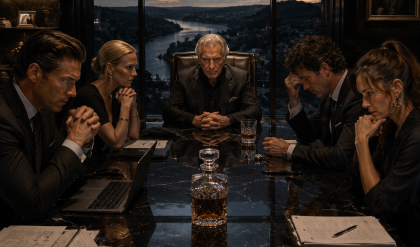
The event took place in a glass-walled studio near Hudson Yards, three weeks before launch. Critics, producers, bookstore buyers, magazine editors, and influencers gathered beneath lights hot enough to wilt herbs. Six recipes from At Blake’s Table would be cooked by Blake himself, live, for cameras and press. It was designed to bury the last of the scandal beneath glamour.
Nora arrived in a black coat, no makeup, kitchen clogs hidden under plain trousers. At the door, she gave a false publication name Vincent’s people had secured through entirely legal boredom. No one recognized her. The world had spent nine years photographing Pierce in dining rooms and Blake under lights. It had almost no photographs of the woman who fed them.
Before service began, six sealed envelopes were delivered to three journalists and the culinary historian. Each envelope carried a course number and a single instruction: Open only after tasting.
Inside each envelope was not a story, not an accusation, not a plea to believe an injured woman. Inside were predictions.
Course one: The spoonbread will taste metallic because the baking soda is written at double strength. Correct measure: half.
Course two: The short rib will carry raw bourbon and bitter coffee because the reduction time is cut from forty minutes to twelve. Correct method: reduce until the alcohol heat disappears and the coffee rounds the meat instead of shouting over it.
Course three: The crab cake will fall apart because the binder is listed after the chill step. Correct method: mix before chilling.
Course four: The carrot dish will be flat and sharp because the vinegar is added before roasting. Correct method: finish with vinegar.
Course five: The custard will curdle because the oven temperature is fifty degrees too high. Correct method: water bath, lower heat, patience.
Course six: The chocolate cake will sink because the rest time is omitted. Correct method: twenty minutes, covered, before slicing.
Predictions. Technical, falsifiable, written before Blake cooked. Nora knew paper could defeat memory in court. But in a kitchen, the future could testify.
Blake came onstage to applause. He looked magnificent. His sleeves were rolled exactly, his hair imperfect in a way that had cost money, his voice warm with practiced humility.
“These dishes,” he told the room, “represent almost a decade of my thinking about American food.”
Course by course, the room shifted. The spoonbread looked golden but tasted faintly of tin. The historian took one bite, opened the first envelope, and did not blink for several seconds. The short rib arrived glossy and handsome. Under the gloss, bourbon burned. The Herald critic tasted, stopped, opened the second envelope, and looked across the table at the historian. By the crab cakes, people were whispering. By the custard, which trembled into scrambled ruin inside its glass cup, the whispering had become a silence larger than the room.
“Chef Harlan,” he said mildly, “these notes predicted each technical failure before you cooked the dish. Not generally. Precisely. Can you explain how another person knew your recipes would fail in this exact order?”
“There may have been transcription issues,” he said. “Studio equipment varies. Live cooking is—”
“Then perhaps a second cook should try,” Nora said.
She removed her black coat. Under it, she wore a plain white chef’s jacket. No embroidery. No borrowed name.
“My name is Nora Quinn,” she said to the room. Her voice did not shake. “For nine years, I wrote the menu that made Whitman House famous. The recipes in Mr. Harlan’s book come from a notebook taken from my office after I was fired. That notebook was written to punish thieves. Every serious recipe contains a deliberate error. I know the corrections because I wrote both the traps and the food.”
The producers should have stopped it. Lawyers should have intervened. But cameras are animals with hunger, and every person in that room could smell the story of the year. Someone rolled a prep cart forward. Someone found clean pans. Someone handed Nora an apron.
She did not perform. That was what made it impossible to look away. Blake had filled the room with gestures. Nora filled it with work. She measured by feel where the book lied. She explained each trap without drama: why too much baking soda left metal on the tongue, why bourbon had to be reduced past arrogance, why carrots needed acid at the end so sweetness could speak first, why custard punished impatience, why cake needed rest the way people did.
She cooked all six dishes from memory, narrating the corrections as calmly as if teaching a class. The room smelled better with every minute. The short rib, when it landed, changed the air. The Herald critic tasted it and closed his eyes.
“There it is,” he said, not loudly but clearly enough for every microphone. “That’s Whitman House before it forgot itself.”
By morning, the publisher had paused the book. By Friday, the streaming deal was “under review.” By the following week, lawyers had obtained the original provenance documents Pierce signed, and Pierce, broken by the discovery that even his betrayal had been used by someone smoother, admitted the notebook had never belonged to him. Blake’s former assistants began telling stories. A prep cook from his television days produced emails. The elegant empire cracked along every borrowed seam.
The city tried to make a heroine of her overnight, which was almost as dangerous as making her invisible. Cameras arrived. Producers called. Magazines requested the story of her “incredible transformation,” as if she had become valuable only when they noticed. Nora accepted one interview, sitting at the smallest table in her own restaurant, wearing her own coat, with no makeup except flour on her wrist.
“Do you forgive them?” the interviewer asked, because people love forgiveness when they are not the ones who paid for it.
Nora looked through the window at Whitman House, dark for the third straight week.
“I don’t confuse forgiveness with access,” she said. “What they did changed my life. What I do next is mine.”
Whitman House closed quietly in January. There was no grand announcement. One morning, the brass sign was gone, the reservation page read temporarily unavailable, and a printed notice on the door thanked New York for its support. Pierce sold what remained of his stake to cover debts. Blake disappeared to Los Angeles, where people with new scandals eventually try to become wellness consultants.
He told Nora on a Thursday after dinner, sliding a folder across the corner table. The folder contained the deed.
“It is yours,” he said. “No debt. No investors. The big kitchen, the famous room, the address that should have had your name on it years ago. Tear down the old sign. Call it Quinn’s House. Call it anything you want.”
“I need you to understand why,” Nora continued. “That building is where I taught myself to disappear and called it devotion. If I go back, even with my name on the door, I’m still living in Pierce’s story. A revised edition is not freedom.”
She touched the scarred table between them, the one Manny had sanded and June had stained too dark.
“This is my restaurant. Twenty-six seats. Secondhand chairs. A stove that hates me every Tuesday. A front window where people watched me survive. Every inch of this place tells the truth. I don’t want the room that stole my name. I want the room where I learned to say it.”
Vincent looked at her for a long time. Then he opened the folder, removed the deed copy, and tore it cleanly in half.
He leaned back. “A culinary school. Scholarships. No tuition for working cooks. A legal clinic for restaurant employees on the second floor. Your choice of name.”
“My grandmother’s name was Ruth,” she said. “She cleaned offices at night and made biscuits good enough to make atheists look upward. Call it the Ruth Quinn School for Working Cooks.”
She laughed, and his face changed when he saw it, as if he had been waiting months for that particular sound without admitting it.
Vincent rested his hand on the table, palm up. Not reaching. Not claiming. Offering.
“I stopped coming for the short rib months ago,” he said.
“I noticed.”
“Of course you did.”
“You still order it.”
“I needed an excuse.” He looked toward the kitchen. “For seven years, your food gave me one hour a week with my mother. Then I met the woman who had been guarding that hour for a stranger without ever asking his name. I have known loyalty bought, sold, demanded, punished, and inherited. I had not seen it given so quietly that no one knew to thank it.”
“I am not an easy man to stand beside,” Vincent said. “You know what people say about me. Some of it is true. Some of it is old. Some of it is worse than true because it leaves out why. I will not decorate myself for you. But I can be honest at your table. Those are my cards.”
The old Nora might have searched for the safe answer. The invisible Nora might have denied wanting anything. The woman sitting in Quinn’s Table under her own name had learned better.
“Thursday dinner remains sacred. No business at the table. No favors that touch my restaurant unless I ask. You do not frighten my suppliers, charm my inspectors, or buy my problems before I have a chance to solve them. You respect my kitchen. You try new dishes. And you stop treating grief like a locked room when it can be a porch light.”
Vincent closed his fingers around hers.
“You are funding scholarships for cooks who look like the people restaurants hide in basements.”
The kiss, when it came, was not a rescue and not a reward. It was an agreement made with breath instead of ink, at the corner table of a restaurant that had survived because its owner refused to trade one shadow for another. Manny and June would argue for years about who leaned in first. Eli would insist the stove sighed. Nora would say nothing because some happiness deserves to keep one secret.
Spring returned slowly to New York. The Ruth Quinn School for Working Cooks opened in the old Whitman House building that September. The chandeliers stayed, but the walls came down. The old private dining room became a classroom where dishwashers learned sauce theory after lunch shifts. The office where Nora’s notebook had once been locked became a legal aid room. The famous pass became a teaching counter scarred by students who were not afraid to make mistakes because Nora told them mistakes were only theft if you pretended they belonged to someone else.
Quinn’s Table remained twenty-six seats. It did not expand. It did not become a brand. Nora wrote a cookbook eventually, but only after every recipe had been tested by cooks whose names appeared beside hers. The book opened with a warning: Trust no recipe you have not tasted. It sold well enough to pay bonuses and fund twelve more scholarships.
Every Thursday at eight, Vincent Calderone sat at the corner table. Sometimes he ordered the short rib. Sometimes he ordered catfish, roast chicken, tomato pie, or whatever new thing Nora brought out with the expression of someone daring him to be haunted differently. Some nights they talked until the chairs were stacked. Some nights they sat quietly while snow, rain, or summer heat pressed against the glass.
A woman built something real with her hands. Men who valued packaging over substance tried to steal it, sell it, and erase the body that made it. She survived not because a powerful man claimed her, and not because the world finally clapped at the correct moment, but because she had prepared for theft long before thieves believed she was worth robbing. She had hidden the final proof where no one vain enough to steal from her would ever look: in the discipline of doing the work correctly.
Years later, a student at the Ruth Quinn School asked Nora how to keep going when no one saw you.
Nora thought about Pierce, Blake, the missing notebook, the studio lights, the day she signed the lease, the first time Vincent called her chef. She thought about the body men had mocked, the hands they had underestimated, and the kitchen where those hands had become a life.
“Make sure you see yourself,” she said. “That has to come first. Then write nothing down that a thief can cook.”
The students laughed, but Nora did not smile until she had added the part that mattered.
“And when the door closes,” she said, “do not spend your life begging it to reopen. Cross the street. Build another door. Paint it yourself if you have to. Put your name on it. Feed people there until the whole city learns which light was real.”
That night, after class, she returned to Quinn’s Table, where the little dining room glowed against the dark like a coal held carefully in two hands. Vincent was already at the corner table. There was no short rib in front of him. Only two cups of coffee, one for her, one for him, steam rising between them like a small, faithful ghost.
He smiled, and outside, people walked past the front window without knowing they were passing the place where an empire had failed to kill a kitchen. Inside, under her own sign, Nora Quinn lifted her cup. Across from her sat a man the city feared and a son still grateful for one more door into his mother’s Sunday kitchen. Behind her waited a stove, a staff, a room, a name, a life.
The woman they had fired for not looking like a legend had become something better than one. She had become a place people could come to remember what truth tasted like.
And every Thursday, at eight, the door opened.