He checked the voltage, made a note on his clipboard, and listened.
The ballroom was quiet for now. Tables stood half dressed in white linen. The stage crew had not yet arrived. Coils of cable lay near the platform like sleeping snakes. Along the south wall, a row of black curtains concealed a narrow service corridor that led to the loading dock. Above the northwest corner, one security camera pointed a few degrees lower than it should have.
Ethan noticed it immediately.
He also noticed a man in a catering jacket standing near the third pillar from the stage.
The man was too early.
Catering was not scheduled until 9:30.
Ethan looked down at his meter, wrote another number, and looked again without moving his head. The man held a clipboard, but he had not turned a page. His shoes were polished black, acceptable for catering, but his stance was wrong. Service workers carried fatigue in their knees and purpose in their hands. This man carried stillness. His eyes kept returning to the stage.
Ethan filed the detail away.
He had spent three years trying not to be the man who filed details like that away. He had failed every day.
At 6:48, his phone buzzed.
A photo from Sophie’s after-school program appeared on the screen. She had drawn another picture during breakfast club. This one showed a huge building with flames coming out of a window and a tiny stick-figure Ethan holding a wrench.
Under it, her teacher had typed: Sophie says you can fix hotels AND volcanoes.
Ethan let himself smile.
Then a second message arrived, this one from the school nurse: Just a reminder, Sophie’s inhaler is in the front office. She was coughing a little this morning, but she says she feels fine.
Ethan’s smile faded. He typed back: Thank you. Please call me if it gets worse.
He placed the phone face down and returned to the panel.
At 8:10, the ballroom began to wake. Stagehands rolled in equipment. Floral designers arrived with tall glass vases and white orchids. A sound engineer tested microphones with the bored intimacy of a man whispering to machines. Event coordinators hurried through the room with headsets and tablets, carrying expressions of professional panic.
Ethan stayed near the panel, invisible in the way maintenance workers become invisible in expensive places. People stepped around his toolbox without seeing him. They complained near him, laughed near him, revealed secrets near him, and never seemed to understand he had ears.
At 8:37, Rick Alvarez, the Alden House head of security, entered through the side door. Rick was a broad man in his late fifties with a former cop’s eyes and a hotel manager’s patience. He had hired Ethan three years earlier after a strange interview in which Ethan had answered every technical question correctly but nothing about his past directly.
Rick stopped beside him. “How bad?”
“Grid is stable now,” Ethan said. “The flicker came from a tired relay. I’ll replace it after the event. Backup will hold if the main system drops.”
Rick grunted. “Good. Whitmore’s people are already breathing down my neck.”
Ethan glanced toward the third pillar. The catering-jacket man had vanished.
“Your catering team checked in?” Ethan asked.
“Not until nine-thirty.”
Ethan kept his tone level. “Someone in a catering jacket was here at six-forty.”
Rick looked at him.
“Third pillar,” Ethan said. “Clipboard. No cart, no badge visible. He watched the stage more than the floor.”
Rick’s expression tightened. “You sure?”
“I’m sure he was here.”
Rick spoke into his radio, walked toward the service corridor, and returned five minutes later with a look Ethan knew too well.
“No one there now,” Rick said. “Loading dock says no catering staff entered yet. Could’ve been event crew wearing the wrong jacket.”
“Could’ve been,” Ethan said.
Rick studied him. “You want me to lock it down?”
Ethan looked at the stage, the service corridor, the camera angle, the places where people would stand because a schedule told them to. “Not yet. But recheck the camera in the northwest corner. It’s been turned down.”
Rick followed his gaze and cursed softly. “I’ll send someone.”
By 10:55, Claire Whitmore’s convoy arrived.
Three black SUVs stopped along Wabash Avenue in a formation that made traffic hesitate. Two men exited the lead vehicle. A driver opened the rear door of the middle SUV. Mason Drake stepped out first.
Everyone noticed Mason.
He was six foot three, broad shouldered, and calm in the heavy way of men who had learned to move through danger without wasting motion. Former Marine, Ethan guessed. Private sector now. Expensive suit tailored to hide the equipment without hiding the posture. His eyes swept the entrance, the windows, the lobby staff, the mezzanine, and finally Ethan, who stood near the ballroom doors with a tool bag in one hand.
Mason’s gaze paused for less than two seconds.
Maintenance. No threat.
His eyes moved on.
Ethan did not resent it. Dismissing the obvious was part of the job. Dismissing the ordinary was how people got killed.
Then Claire Whitmore entered.
She was forty-six, though the magazines liked to call her ageless, and she carried herself with the unhurried authority of someone who had never needed to ask permission twice. Her dark hair was cut just above her shoulders. Her navy suit looked severe enough to be architectural. Pearls rested at her throat. Her eyes were sharp, impatient, and beautiful in a cold way, like city lights reflected on ice.
Her assistant, Tessa Vale, moved one step behind her, tablet already open. Mason took his place at Claire’s left side. Two junior executives followed. Cameras flashed outside as the doors closed behind them.
The lobby staff greeted her.
Claire did not ignore them cruelly. That would have required attention. She simply did not register them at all.
Her world was divided into assets, obstacles, and weather. Hotel workers belonged to weather.
She crossed the lobby, speaking without looking back. “Tessa, where are we on the revised deck?”
“Slide fourteen is updated. Legal approved the language ten minutes ago.”
“And press?”
“Seated at one-thirty. CNBC gets first question if you want market reach. The Journal gets first question if you want credibility.”
“Credibility,” Claire said. “Reach follows.”
They entered the ballroom at 11:03.
The room changed around her. People straightened. Voices dropped. Even the flowers seemed to stand taller.
Ethan was back at the west panel, replacing a cover plate, when Claire began her walkthrough. She moved from stage to seating chart to camera platform, asking short questions that made adults with graduate degrees sweat. Mason followed, reading exits, shoulders, hands. Tessa typed constantly. A younger event assistant nearly tripped over Ethan’s tool bag and scattered a handful of wrenches across the marble floor.
The sound cracked through the room.
Heads turned.
The assistant’s face went pale. “I’m so sorry.”
“It’s all right,” Ethan said.
He crouched and collected the tools one by one.
Claire turned at the noise. Her gaze landed on him with faint annoyance, as if a stain had appeared on a document she had already signed.
“What is that?” she asked Tessa.
“Alden House maintenance,” Tessa said quietly.
“In the ballroom?”
“There was an electrical issue this morning.”
Claire watched Ethan close the tool bag and stand. “There seems to be an issue with presentation as well.”
Ethan heard her. He gave no sign.
By noon, the room was nearly ready. The acquisition announcement was scheduled for 2:00 p.m. Claire wanted one final security walkthrough before lunch. Mason pointed out the VIP route from the green room to the stage. Rick Alvarez stood nearby, explaining hotel procedures with the careful dignity of a man accustomed to wealthy guests believing they had invented caution.
Ethan remained by the west wall, monitoring the backup circuit during the lighting cycle.
Claire’s attention returned to him.
She stopped. “Why is he still there?”
Rick followed her gaze. “Mr. Cole is monitoring the backup power line. We had a relay issue earlier.”
Claire looked at Ethan. “You. What exactly are you doing beside my VIP entrance?”
Ethan turned. “Making sure your lights stay on.”
A small silence followed.
Mason’s mouth twitched.
Claire took one step closer. “I’m sorry. I must have missed the part where hotel maintenance became executive security.”
Ethan held her gaze. “It didn’t.”
“Then perhaps you can understand my confusion.” Her voice carried easily. People nearby pretended not to listen, which meant they listened harder. “I have a room full of investors, press, and senior partners arriving in two hours. I have paid an extraordinary amount of money to make sure every detail of this event reflects competence. Yet I find a man with a wrench standing at the edge of the secured route.”
Rick said, “Ms. Whitmore, he’s exactly where I asked him to be.”
Claire did not look at Rick. She looked only at Ethan.
“There are professions,” she said slowly, “that require a person to understand a room. To know when his presence changes the risk instead of reducing it. To recognize when he is out of his depth.”
Ethan said nothing.
Claire’s eyes moved over his uniform, his calloused hands, the worn tool bag at his feet. “That does not appear to be your profession.”
The room went still.
Mason shifted slightly, not quite smiling, but close enough that the cruelty became shared. A camera technician looked away. Tessa stared at her tablet. Rick’s jaw tightened.
Ethan felt the words land.
He had been shot at twice, stabbed once, and blamed for surviving something his wife had not. He had sat in a hospital hallway with his daughter asleep against his chest while doctors used phrases like “massive trauma” and “we did everything we could.” He had learned that humiliation was rarely fatal. But it could still cut, especially when delivered casually by someone who believed herself too important to be unkind on purpose.
He bent, picked up his tool bag, and set it farther from the VIP path.
“The backup circuit will hold,” he said. “You’ll have no delay from me.”
Claire waited, perhaps expecting anger or apology. Ethan gave her neither.
He turned back to the panel.
The dismissal should have ended there.
It did not.
At 12:26, Ethan saw the catering-jacket man again.
This time the badge was visible. It read: Daniel Morris, Windy City Premier Catering.
The real catering crew had arrived twenty minutes earlier, pushing carts, arguing softly about plate counts, smelling of coffee and garlic and industrial dish soap. This man blended well enough at first glance. He carried a tray. He wore black slacks. He moved when others moved.
But he never entered the kitchen service line.
He never spoke to the catering captain.
Every ninety seconds, his eyes found the stage.
Ethan lifted his radio. “Rick.”
“Go.”
“The man I mentioned is back. Catering jacket, badge says Daniel Morris. East side now, near the coffee station. Run the name against the staffing list.”
A pause. “Stand by.”
Ethan watched the man set down the tray and rub his right thumb across the inside of his left wrist. Not nervous. Rehearsal.
Rick came back on. “We have a Daniel Morris on the list.”
“Does the real Daniel Morris match six feet, narrow face, scar under the chin?”
Another pause, longer this time.
“List only has name and badge number,” Rick said. “Catering captain says they’re short two people and using last-minute replacements. I’ll check.”
“Do it quietly.”
“Ethan, Whitmore’s team is already angry about disruptions.”
“Then do it angry.”
Rick exhaled. “Stay in your lane until I get there.”
Ethan lowered the radio.
Stay in your lane.
He had heard variations of that phrase his entire adult life. Stay with the principal. Stay on the exit. Stay behind the barricade. Stay with your daughter in the waiting room. Stay away from the memories. Stay where other people could understand you.
The man in the catering jacket moved toward the west wall.
Toward the junction box.
Toward the camera blind spot.
Claire stood on the stage now, running through microphone levels. Mason was at the stairs, speaking to Tessa. The ballroom buzzed with pre-event motion. Two hundred guests would arrive within the hour. A security plan existed on paper. Human beings existed in the gaps between paper and reality.
Ethan set down his tool bag.
He walked across the ballroom.
He did not run. Running changed a room before you knew what shape the change would take.
The man in the catering jacket opened the junction box with a key he should not have had.
Ethan stopped three feet behind him. “Daniel.”
The man froze.
Not turned. Froze.
Ethan’s voice remained low. “I need to see your badge.”
The man turned slowly. His eyes moved over Ethan’s face. The calculation inside them lasted less than a second.
Then his right hand went behind his back.
Ethan moved before the hand returned.
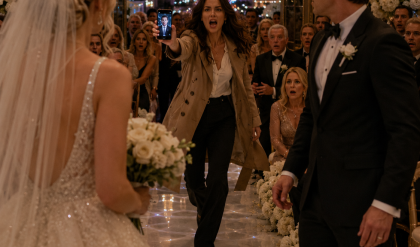
The blade came out thin and pale, not steel but ceramic, narrow enough to hide, sharp enough to open a throat. A woman near the coffee station gasped. Mason saw the blade and launched himself from the stage stairs with explosive speed.
But Mason saw the wrong picture.
He saw a maintenance man close to a knife. He saw Claire on stage. He saw movement. He saw danger.
He hit Ethan from the left like a linebacker.
The impact drove the air from Ethan’s ribs, but Ethan did not fight the force. He turned with it, letting Mason’s momentum carry past the place where resistance would have broken something. His left hand found Mason’s wrist. His right forearm rose under Mason’s elbow. One step, one pivot, one controlled rotation.
Mason stopped.
Not slowed. Stopped.
His knees bent under the sudden argument of his own joints. His arm locked in a position where the next inch would cost him the wrist. His eyes widened, not with fear, but with a professional’s shock at encountering a language he spoke fluently and still could not answer.
Ethan released him before injury became necessary.
Mason fell sideways, rolled, and came up on one knee.
By then Ethan had already closed the distance to the man with the ceramic knife.
The attacker slashed once. Ethan was no longer where the blade expected him to be. He caught the wrist, turned it down and inward, and struck the man’s forearm with the heel of his hand. The knife clattered onto the marble.
The man tried to drive forward with his shoulder.
Ethan stepped inside, placed two fingers beneath the man’s collarbone, and applied pressure with brutal precision.
The man’s legs folded.
He dropped to both knees, conscious but unable to command his own body. His mouth opened around a sound that never became a word.
Three seconds had passed.
The ballroom fell into a silence so complete that the faint hum of the lighting rig seemed enormous.
Claire stood behind the podium, one hand gripping the edge. Her face had gone pale beneath its careful makeup. Tessa’s tablet lay facedown on the floor. A microphone shrieked once with feedback and died.
Mason stared at Ethan from one knee.
Ethan looked down at the blade but did not touch it.
“Rick,” he said into his radio, “lock the ballroom. Police and EMS. Suspect restrained. Weapon on the floor west of stage.”
Rick’s voice cracked through the speaker. “Say again?”
Ethan looked at Claire. She stared back as if seeing, for the first time, not a man in gray fabric, but the outline of a life she had not earned the right to judge.
“Suspect restrained,” Ethan repeated. “No injuries.”
The police arrived in seven minutes.
By then, Mason had stood, though he kept flexing his right hand as if trying to persuade it that the last three seconds had really happened. The attacker lay cuffed near the wall, breathing hard. His badge had already been proven false. The real Daniel Morris had called in sick that morning from Joliet and had never entered Chicago.
The ballroom was sealed. Guests were redirected. The acquisition announcement was delayed. Whitmore Global’s communications team moved into crisis mode with terrifying efficiency, issuing bland statements about a “security incident” and “no ongoing threat.”
Ethan gave his statement to a detective named Paula Grant.
He described the man’s early presence in the ballroom, the camera angle, the false work pattern, the repeated focus on the stage, the hand movement to the lower back, and the unauthorized access to the junction box. He did not embellish. He did not mention Claire’s insult. He did not mention Mason’s mistake except as sequence.
Detective Grant listened carefully. “You noticed him at six-forty this morning?”
“Yes.”
“And you reported it?”
“To hotel security at eight-thirty-seven and again at twelve-twenty-six.”
Rick Alvarez, standing nearby, closed his eyes.
Detective Grant wrote that down.
Claire heard it from across the room.
At 3:15, the police took the attacker away. His real name was Nolan Pierce. He was thirty-nine years old, a former engineer and founder of a small medical device company called Brightline Prosthetics. Sixteen months earlier, Whitmore Global had acquired its patents after a lawsuit Nolan could no longer afford to fight. The company collapsed. Its employees scattered. Nolan’s wife left with their son to live with her sister in Ohio. Nolan began sleeping in his truck near Midway Airport.
That was what the first search revealed.
The second revealed something worse.
Nolan had not acted alone.
Detective Grant found a temporary access code on his phone. It matched a code generated by Whitmore Global’s own event system. Someone had given him the route, the blind spot, the schedule, and the knowledge that Claire would be standing at the podium at exactly 1:52 for a final sound check.
Claire’s face hardened when she heard it.
“Who had access?” Detective Grant asked.
Tessa Vale answered before Claire could. “Senior internal staff. Executive office. Security liaison. Communications. Strategy.”
“And who managed the acquisition Nolan Pierce lost?”
Tessa’s fingers hovered over her tablet.
Claire already knew.
“Martin Kessler,” she said.
Her chief strategy officer. Her fixer. Her oldest professional ally.
The man who had built half her empire in silence.
The man who had stood behind every difficult deal and said, with calm certainty, There is no clean way to win, Claire. There is only winning and pretending otherwise.
By evening, Martin Kessler was missing.
The twist landed not like lightning but like rot exposed beneath polished wood. Nolan Pierce had been desperate, angry, and unstable, but he had also been fed. Someone had sent him documents showing Claire’s schedule. Someone had told him where security would be weak. Someone had convinced him that if Claire Whitmore bled onstage, the world would finally listen to what had been stolen from him.
Martin had used a ruined man as a weapon.
Why?
The answer arrived just before midnight.
Whitmore Global’s pending $480 million acquisition was not merely a purchase. It was a rescue. Claire had planned to announce that her firm was taking over a failing medical technology company and preserving its Chicago manufacturing plant. Martin had opposed it for months. The margins were too low. The labor contracts were too expensive. The patents were valuable, but the people were not.
Claire had overruled him.
If the event collapsed, if Claire appeared reckless or compromised, Martin intended to call an emergency board meeting. He had already prepared a recommendation to remove her from direct control of the deal. Then he would break the company apart, keep the patents, close the plant, and sell the remaining assets for a profit that would make investors applaud.
He had not wanted Claire dead, according to the messages later recovered. He had wanted her frightened, injured if necessary, discredited in public, and dependent on him.
It was the kind of evil that wore a suit and called itself strategy.
At 11:40 that night, Claire sat alone in a private conference room on the hotel’s third floor. The city glowed beyond the windows. Her phone had not stopped vibrating for hours. Board members. Attorneys. Reporters. Police. Investors. Every person wanted a version of the truth that served a purpose.
For the first time in many years, Claire did not know which version served hers.
Tessa entered quietly. “They found Kessler at O’Hare. He had a ticket to Zurich.”
Claire closed her eyes.
“Good,” she said.
Tessa did not leave.
Claire looked up. “What?”
“The hotel worker,” Tessa said. “Ethan Cole.”
Claire’s jaw tightened almost imperceptibly. “What about him?”
“Mason asked around. Rick knew some of it.”
Claire waited.
Tessa set a folder on the table. “He wasn’t always maintenance.”
Claire opened the folder.
There was not much. People like Ethan Cole did not leave much behind if they had ever been good at disappearing. But there were fragments: a federal commendation sealed under a security exemption, a private protection firm tied to witnesses in organized crime cases, a training program known among professionals but almost invisible to civilians. A photo from nine years earlier showed a younger Ethan in a dark suit, standing behind a U.S. attorney during a press conference after a major corruption trial.
Another clipping showed a funeral notice for Laura Cole, age thirty-four, beloved wife of Ethan and mother of Sophie.
Claire read slowly.
Tessa spoke softly. “His wife was killed three years ago outside a courthouse in Milwaukee. Ethan was protecting a federal witness inside. A shooter went after the witness’s family in the public entrance. Ethan stopped him before he reached the witness, but his wife had come to surprise him after the hearing. She was in the wrong place.”
Claire’s eyes remained on the page.
“He left the field after that,” Tessa said. “Moved to Chicago. Took the maintenance job here. Rick said he wanted work that ended when the shift ended. Something that let him pick up his daughter from school.”
Claire thought of the man she had mocked in front of a ballroom.
There are professions that require a person to understand a room.
She had said that to him.
To him.
The shame rose slowly, not hot but heavy. Claire Whitmore had endured public criticism, hostile interviews, lawsuits, betrayals, and rooms full of men waiting for her to prove she deserved her chair. Shame was different. Shame did not attack from outside. It asked what kind of person she had become when no one powerful was watching.
Mason knocked once and entered without waiting.
He looked tired. His right wrist was wrapped.
Claire gestured toward it. “You should have that examined.”
“I did.”
“And?”
“Sprain. Pride fracture.”
Despite herself, Claire almost smiled.
Mason did not. “I misread him.”
“We all did.”
“No,” Mason said. “I’m paid not to.”
Claire closed the folder. “Did you know who he was?”
“Not until tonight. But I should have known he was something. His feet were too quiet.”
Claire looked at him.
Mason’s expression did not change. “You learn to notice that.”
“And what did you learn today?”
“That some men don’t become harmless just because they choose peace.”
The words stayed in the room after he left.
The next morning, Ethan was in the basement mechanical corridor at 7:05, checking the boiler pressure. He had slept four hours. Sophie had woken twice coughing, then insisted on going to school because Friday was library day and she needed to return a book about wolves. He had braided her hair badly, packed her lunch, and kissed her forehead while she complained that he used too many carrots.
Life, he had learned, continued after terror with insulting ordinary detail.
He was tightening a valve when he heard footsteps on the stairs.
Mason Drake appeared at the bottom landing.
Ethan turned back to the gauge. “You’re favoring the wrist.”
“I’m aware.”
“You came down here for medical advice?”
Mason stepped closer. “I came down to apologize.”
Ethan looked at him then.
Mason held his gaze. “I saw a threat picture and put you in the wrong box. That was my mistake.”
“You moved to protect your principal.”
“I moved without seeing the room.”
Ethan wiped his hands on a rag. “That happens.”
“Not to me.”
“It happened yesterday.”
Mason absorbed that with a small nod. Then he extended his uninjured hand.
Ethan took it.
The handshake was brief, firm, and clean.
“You could’ve broken my wrist,” Mason said.
“Yes.”
“You didn’t.”
“You were doing your job.”
“I did it badly.”
“You did it fast,” Ethan said. “Fast can be corrected. Arrogant is harder.”
Mason’s eyes shifted slightly, acknowledging the target beneath the words.
“She’s upstairs,” he said.
“I figured.”
“She wants to see you.”
“I’m working.”
Mason nodded once, as if he respected that more than any answer Ethan could have given. “She’ll come down.”
“She shouldn’t.”
“She will.”
Ten minutes later, Claire Whitmore walked into the boiler corridor wearing a charcoal coat over a black suit that probably cost more than Ethan’s car. Tessa was not with her. Mason remained at the foot of the stairs, far enough away to make the conversation private and close enough to do his job.
Claire looked out of place among pipes, gauges, concrete, and the low industrial breath of the building. For once, she seemed to know it.
“Mr. Cole,” she said.
“Ms. Whitmore.”
“I owe you an apology.”
“You gave one yesterday.”
“No,” she said. “Yesterday I expressed regret because you saved me and I was embarrassed. That is not the same thing.”
Ethan said nothing.
Claire took a breath. It was not a dramatic breath. It was the breath of someone forcing herself to stand still.
“I humiliated you because I believed your uniform told me your value. I did it publicly because part of me wanted the room to understand that my standards were higher than what I saw in front of me. That was not professionalism. It was vanity.”
The boiler clicked softly.
“And then,” Claire continued, “you saw what my people did not. You acted when no one listened. You stopped a man who had been pointed at me by someone I trusted. You spared Mason when you did not have to. You prevented a tragedy, and afterward you did not try to make me smaller, even though I had tried to make you smaller first.”
Ethan looked at her for a long moment.
“My daughter says when you break something, sorry matters,” he said. “But fixing matters more.”
Claire nodded. “She’s right.”
“She usually is.”
“What would fixing look like?”
The question surprised him. Most powerful people arrived with solutions already gift-wrapped in their own importance. Claire asked as if she understood, at least for the moment, that she did not know.
Ethan turned the rag in his hands.
“Nolan Pierce belongs in custody,” he said. “He brought a knife into a room full of people. But he was also used. Don’t bury that because it embarrasses your company.”
“I won’t.”
“Martin Kessler didn’t create himself. Someone rewarded him for thinking people were numbers. Maybe that someone was you.”
Claire did not flinch, though he saw the words strike.
“Yes,” she said.
“And the people at that plant you were announcing today?”
“What about them?”
“If you were saving them because it made a good headline, they’ll know. If you were saving them because they’re people, prove it when the cameras leave.”
Claire swallowed. “And you?”
“What about me?”
“What can I do for you?”
Ethan almost laughed. Not because it was funny, but because money always came looking for a door. He could have used money. Sophie’s inhalers cost money. Rent cost money. Childhood cost money in a hundred quiet ways. But he also knew the danger of becoming a wealthy person’s redemption project. Gratitude could become another form of ownership if accepted carelessly.
“You can stop calling me a hero to reporters,” he said.
“I haven’t given them your name.”
“Keep it that way.”
“I will.”
“And tell your people to stop stepping over maintenance workers like they’re extension cords.”
Claire’s face changed, just a fraction. It might have been pain. It might have been respect.
“That I can do,” she said.
He turned back to the boiler gauge. “Then we’re done.”
But they were not done.
The postponed summit took place that afternoon under a different name. The press expected scandal. Investors expected a defensive performance. What they got was Claire Whitmore walking onto the stage without music, without a video intro, without the shimmering language her communications team had prepared.
She stood at the podium and looked across the ballroom.
“Yesterday,” she began, “a man with a weapon entered this room using access provided by a senior executive of my own company. That executive is in custody. The man he manipulated is also in custody. No one was injured because a member of this hotel’s staff saw what my organization failed to see.”
The room went electric.
Claire did not name Ethan.
“I have spent twenty years building a career on fast judgment,” she said. “Markets reward it. Boards reward it. The press often celebrates it. But fast judgment becomes dangerous when it teaches you to mistake category for character. Yesterday I made that mistake before this event even began.”
Tessa stood in the wings, motionless.
Mason watched the room, but his posture had changed. His attention included the edges now. The hotel staff. The service doors. The people everyone else ignored.
Claire continued. “Whitmore Global will proceed with the acquisition announced today, but not under the terms originally drafted. We will preserve the Chicago plant, honor existing labor agreements, and establish an independent review of prior acquisitions under Martin Kessler’s authority, beginning with Brightline Prosthetics.”
A murmur moved through the crowd.
“Our legal team will cooperate fully with investigators. Our board will receive the same report the public receives. No executive bonus, including mine, will be paid this year until that review is complete.”
This time the murmur became something larger.
Money understood sacrifice only when sacrifice touched money.
Claire glanced down once, then back up.
“This is not charity. It is correction. There is a difference.”
In the back of the ballroom, Rick Alvarez stood beside Nora from laundry and two bellmen who had found excuses to listen. Ethan was not there. He was on the fifth floor replacing a broken thermostat in room 512 while Sophie’s school nurse texted that the cough had settled and library day had been a success.
But later, someone showed him a clip.
He watched twenty seconds and closed the phone.
Rick studied him. “That’s it?”
“That’s it.”
“You know, most guys would enjoy seeing a billionaire eat humble pie.”
“I’m not most guys.”
“No,” Rick said. “You are aggressively inconvenient.”
Ethan smiled faintly.
The investigation lasted months.
Martin Kessler pleaded not guilty until the evidence became too heavy for even expensive lawyers to lift. Emails, encrypted messages, access logs, and bank transfers revealed a pattern that reached back years. He had pressured vulnerable founders, manipulated valuations, buried safety complaints, and treated ruined lives as acceptable friction. Nolan Pierce had been one of many. His rage had made him useful.
Claire testified before a federal grand jury in March.
She did not perform innocence. She did not pretend ignorance was virtue. She said, under oath, that she had trusted Martin because his methods worked and because she had benefited from not asking enough questions about why. The testimony cost her. Whitmore Global’s stock dipped. Two board members resigned. Commentators argued for weeks about whether Claire’s accountability was genuine or strategic.
Ethan did not follow the coverage.
He followed Sophie’s spelling tests, the boiler schedule, rent, grocery prices, and the slow improvement of his daughter’s breathing after the doctor changed her medication. He followed the ordinary map of a life he had chosen because ordinary was not the same as small.
One Thursday in April, he found a white envelope in his staff mailbox.
Inside was a handwritten note from Claire.
Mr. Cole,
You told me fixing matters more than sorry. I am trying to learn the difference.
The Brightline review is complete. Nolan Pierce’s patents were taken through a settlement our own investigators now believe was engineered under false pressure. We are returning ownership of two designs to a trust benefiting former Brightline employees and their families. Nolan will still face charges for what he chose to do. That is right. But his son will receive the medical support Brightline’s collapse interrupted. That is also right.
The Chicago plant remains open. Its workers voted yesterday to accept a five-year preservation agreement.
I have also instituted a rule that every executive at Whitmore Global, myself included, will spend one paid workday each quarter shadowing the employees whose labor we usually only see as cost lines. Not for publicity. Phones prohibited.
I do not expect this to balance anything. I only wanted you to know that your words did not disappear into the boiler room.
Claire Whitmore
Ethan read the note twice.
Then he folded it carefully and put it in his locker behind Sophie’s drawing.
That evening, he picked Sophie up from after-school care. She came running with her backpack bouncing and a library book clutched to her chest.
“Dad! Did you know wolves can hear other wolves from six miles away?”
“I did not.”
“That is because you read boring books.”
“Mostly manuals.”
“Exactly.”
They walked toward the train under a sky the color of wet concrete. Sophie took his hand at the crosswalk, then looked up at him with sudden seriousness.
“Liam at school said you beat up a bodyguard.”
Ethan closed his eyes briefly. “Liam hears too much from adults.”
“Did you?”
“No.”
“But kind of?”
“I stopped a man from making a mistake. Then I stopped another man from making a different mistake.”
“With karate?”
“With leverage.”
“What’s leverage?”
“It means using what’s already moving instead of trying to be stronger than it.”
Sophie considered this. “Can I use leverage to clean my room?”
“No.”
“That seems unfair.”
“It often is.”
She leaned against his arm as they waited for the light to change. “Were you scared?”
Ethan watched traffic slide past, headlights bright in the early dark.
“Yes,” he said.
Sophie’s hand tightened around his. “But you did it anyway?”
“Yes.”
She nodded, accepting this as children accept truths adults spend lifetimes complicating. “Mom would say that counts.”
Ethan’s throat closed for a moment.
“Yes,” he said softly. “She would.”
Summer came slowly to Chicago. Snow turned to rain, rain to wind, wind to bright mornings along the lake. The Alden House replaced the tired relay in the Grand Lake Ballroom. The northwest camera received a protective housing. Rick Alvarez retired in June and recommended Ethan for a security management position.
Ethan declined.
Then he changed his mind halfway.
He did not want the old life back. He did not want tinted SUVs, earpieces, threat briefings, or the terrible intimacy of standing between violence and strangers until his own family became a shadow at the edge of the job. But he also understood something he had been avoiding: leaving a gift unused was not the same as healing from the wound that gift had failed to prevent.
So he accepted a new role the hotel created for him: safety systems trainer, three days a week, with maintenance shifts on the other two. Better pay. Predictable hours. School pickup protected in writing. He trained guards, desk clerks, housekeepers, banquet servers, and engineers to read rooms without dismissing people. Mason Drake attended the first session.
He arrived early, sat in the front row, and took notes.
When Ethan demonstrated the wrist lock, Mason raised his hand.
“Are you going to teach the part where you made me look like a folding chair?”
The room laughed.
Ethan shook his head. “Advanced class.”
Claire came to the Alden House once more in September.
No cameras. No entourage beyond Mason. She wore a simple gray coat and waited in the lobby until Ethan finished helping a bellman reset a jammed luggage cart wheel. The staff noticed her, of course, but she greeted each person who greeted her. Not warmly, exactly. Claire Whitmore would never become soft in the decorative sense. But she looked at people now. That was not everything. It was not nothing.
Ethan crossed the lobby. “Ms. Whitmore.”
“Mr. Cole.” She looked toward the ballroom doors. “I wanted to tell you in person. The preservation agreement held. The plant hired back forty-three workers last month.”
“That’s good.”
“Nolan Pierce accepted a plea deal. He’ll serve time. His wife wrote a statement asking the court to recognize Kessler’s role without excusing Nolan’s choices.”
“Both can be true,” Ethan said.
“I am learning that.”
Mason stood near the revolving doors, speaking quietly with Rick’s replacement, a young security manager Ethan had trained. The sight pleased Ethan more than he expected.
Claire reached into her coat pocket and removed a small envelope. “This is not a check.”
“Good.”
“It’s an invitation. Whitmore Global is funding a scholarship for children of hotel and service workers in Chicago. The board insisted on naming it after the company. I refused. It will be called the Laura Cole Scholarship, if you permit it.”
Ethan went very still.
Claire continued quickly, not with her usual command but with something almost like fear. “I read about your wife. I know I have no right to use her name without asking. The scholarship is not about me, and it will not mention the incident. It will support children whose parents work jobs that keep other people’s lives functioning. That is all.”
Ethan looked through the lobby windows at the city beyond. For a moment, he saw Laura as she had been on the morning of their last anniversary, dancing barefoot in the kitchen while Sophie, then five, clapped from a chair. He saw the hospital hallway. He saw the years after, the way grief had narrowed his world until only duty could pass through.
“My wife was a nurse,” he said. “She hated when people acted like invisible work was simple work.”
Claire’s eyes shone, though she did not let tears fall.
“Then may I use her name?”
Ethan took the envelope.
“Yes,” he said. “But Sophie gets to approve the logo.”
For the first time since he had known her, Claire Whitmore laughed without calculation.
“That seems only fair.”
The scholarship launched quietly the following spring. Sophie did approve the logo, though her first version included a wolf, a wrench, and what she insisted was a “dignified unicorn.” A designer translated it into something elegant, but kept a small star hidden near the corner because Sophie demanded magic somewhere.
Years later, people would still tell the story incorrectly.
They would say a billionaire CEO mocked a janitor and watched him destroy her bodyguard in three seconds. They would say he was secretly a martial arts master, an ex-agent, a ghost, a legend. They would make the story smaller by making it louder. They would focus on the takedown because violence is easy to understand when compared to humility, grief, accountability, and repair.
The truth was more complicated.
A single father went to work in a hotel because his daughter needed breakfast, clean socks, and someone waiting at the school gate. A powerful woman entered a room believing she could measure human worth at a glance. A bodyguard made a mistake and had the courage to admit it. A desperate man chose a knife and was stopped before his worst moment became the only thing left of him. A trusted executive revealed the rot beneath profitable silence. A dead woman’s name became a door for children whose parents fixed what others never noticed.
And in the Alden House Hotel, the lights stayed on.
One evening, long after the headlines faded, Ethan stood in the Grand Lake Ballroom after a charity dinner for the first class of Laura Cole scholars. The tables were empty now. The staff moved through the room collecting glasses and folding linens. Sophie, older by then and taller than he was ready for, slept in a chair near the stage with her coat over her knees.
Claire stood beside him, looking across the polished floor.
“I used to think power meant never being corrected,” she said.
Ethan watched a housekeeper laugh softly with a banquet server near the far wall.
“What do you think now?”
Claire took her time.
“I think power is being corrected and having enough courage left to change.”
Ethan nodded.
From the stage, Sophie stirred and opened one eye. “Dad?”
“I’m here.”
“Are we going home?”
“In a minute.”
She sat up, hair messy, face soft with sleep. “Did the lights break?”
“No,” Ethan said. “Just checking.”
Sophie yawned. “You always check.”
Claire looked at him then, not as weather, not as labor, not as a category, but as a man whose quiet vigilance had once saved her life and then asked her to become worthy of it.
Ethan picked up his daughter’s coat and helped her stand.
Outside, Chicago shone with rain. The streets reflected red taillights, gold windows, green signals, all of it trembling and alive. Ethan walked Sophie through the lobby, past the brass railings and marble floors, past the staff who nodded goodnight, past the revolving doors turning patiently toward home.
Behind him, the hotel continued breathing.
Above him, the lights held steady.
And for once, Ethan did not feel the need to disappear.
He had not returned to the man he used to be. He had not outrun the grief that made him leave. He had simply found a way to carry both the wound and the gift, the sorrow and the skill, the father and the protector, without letting any single part of him become the whole story.
Sophie slipped her hand into his.
“Dad?”
“Yeah?”
“When I grow up, I want to fix things too.”
Ethan looked down at her, at Laura’s eyes in her face, at the future walking beside him in sneakers with untied laces.
He smiled.
“Then we’ll start with your room.”
Sophie groaned so loudly that the doorman laughed.
The revolving door carried them out into the night, where the city was cold, bright, imperfect, and still worth saving.