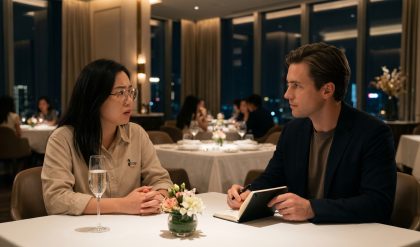
Luca did not move at all.
The man who had built an empire from silence, suspicion, and control looked suddenly powerless before one sentence from a woman buried under a false name.
Then the message glowed again on the tablet.
Ask Emily what her mother never told her.
Emily looked up slowly.
“My mother?” she whispered.
Luca turned toward her. “Where is she?”
The question was gentle, but Emily heard the urgency underneath.
“Dead,” Emily said. “Six years ago.”
George lowered his head.
“She was named Kathleen,” Emily continued. “Kathleen Callahan. She married my father after they met at a church fundraiser. She worked at a public library, hated cilantro, loved mystery novels, and cried every time old people danced at weddings.”
Her voice trembled.
“She was my mother. That’s all.”
Luca’s gaze softened. “Nobody said she wasn’t.”
Emily looked at the tablet again.
But something had already begun to unravel inside her.
A daughter.
Ask Emily what her mother never told her.
“No,” Emily said, more to herself than to anyone else. “No, my mother would have told me if there was something like this.”
George did not answer.
Emily turned toward him.
The silence in the room shifted.
“Grandpa?”
George’s hands were folded on his lap, his fingers knotted together so tightly the skin had gone white.
“Grandpa,” Emily said again. “What do you know?”
The old man closed his eyes.
And Emily understood, with a pain that rose slowly rather than struck quickly, that the mystery had not arrived from nowhere.
It had been sitting at her kitchen table for years, drinking tea from a chipped mug, calling her sweetheart, and hiding behind love.
George opened his eyes.
“I promised your mother,” he said.
The room seemed to tilt.
“My mother knew?”
George looked at Luca, then at Emily. “She knew enough to be afraid.”
Emily stepped back from him. “Afraid of what?”
“Of losing you.”
Those words were worse than an answer.
Luca’s voice came low. “George.”
The old man looked older than his years now, as if the truth had placed a hand on his shoulder and pressed.
“After Matthew died,” George said, “Kathleen found a letter hidden in his toolbox. Your father had written it years earlier, when you were little. He told her that if anything ever happened to him, she was to take you and leave Chicago.”
Emily shook her head. “Why?”
George looked at the tablet.
“Because Matthew had started remembering things.”
Luca’s expression changed.
Emily barely heard herself ask, “What things?”
George swallowed.
“He remembered a woman singing in Italian. He remembered being carried through rain. He remembered a blue sweater. He remembered another child crying somewhere in the house before Nora took him away.”
Luca gripped the edge of the desk.
“Another child,” he said.
George nodded.
“Maria’s daughter?” Emily whispered.
“We thought so.”
Emily’s breath caught. “Thought?”
George looked down. “We never found proof.”
The office door opened before anyone could speak again.
Dana Weiss stepped in without knocking, phone in one hand, coat half-buttoned as if she had dressed while running.
“You all need to stop touching that tablet,” she said.
Luca’s eyes narrowed. “Hello to you too.”
Dana ignored him and looked at the screen. “The message came through an encrypted relay. Whoever sent it knew exactly when you’d watch the video.”
Marco, standing near the door, folded his arms. “That mean they’re watching us?”
Dana looked around the office. “Maybe not with cameras. But they’re watching the story.”
Emily’s skin prickled.
Dana turned to her. “Are you Emily?”
“Yes.”
“I’m sorry to ask this bluntly, but did your mother ever give you anything unusual? A necklace, a book, a recipe card, a photograph, something she told you not to lose?”
Emily almost said no.
Then she stopped.
A memory surfaced.
Her mother in the hospital bed six years ago, her body made small by illness, her hands still warm around Emily’s.
There’s a place in my sewing basket, Em.
Don’t open it until you need to know who you are.
At the time, Emily thought it was medicine talking.
Grief talking.
Fear talking.
She had gone home after the funeral and put the sewing basket in the closet because the smell of her mother’s lavender sachets hurt too much.
She had never opened it.
Emily looked at George.
His face told her he remembered too.
“The sewing basket,” she whispered.
George covered his mouth with one hand.
Luca was already reaching for his coat.
Emily shook her head. “No. Not you.”
He stopped.
“This is my mother,” she said. “My apartment. My truth. You don’t get to storm through it like one of your old files.”
Luca’s jaw tightened, but he nodded.
“All right.”
Emily looked at him, surprised by how quickly he accepted the boundary.
Then he added, “But you’re not going alone.”
Before Emily could argue, George rose carefully from his chair.
“She won’t,” he said. “I’m going with her.”
Dana lifted her phone. “So am I.”
Emily stared at her.
Dana shrugged. “I’m a reporter. Also, I have a terrible habit of becoming invested in stories I should keep professional.”
For the first time that night, Emily almost smiled.
Luca looked at Marco. “Drive them.”
Emily shot him a look.
“Not command,” Luca said quietly. “Offer.”
That stopped her.
Because the old Luca would not have known the difference.
The streets of Chicago glittered wet under the restaurant lights as Marco’s car moved through the city. Emily sat in the back with George beside her and Dana in the front, her phone open, recording notes quietly.
No one spoke much.
The city outside looked familiar and strange at once. The corner store with the flickering sign. The laundromat where Emily had once cried into a dryer because her rent check had bounced. The church steps where her father used to buy Christmas trees from volunteers and always picked one too wide for the living room.
All those ordinary places had existed beside a hidden history she had never seen.
When they reached her apartment, Mrs. Doyle across the hall opened her door three inches.
Emily sighed. “Mrs. Doyle, not tonight.”
The old woman’s eyes moved from Emily to George to Marco.
“Is he dangerous?” she asked.
Marco blinked. “Ma’am?”
Mrs. Doyle studied him. “You look dangerous.”
“He’s parking,” Emily said.
“He’s standing.”
“He’ll park emotionally.”
Mrs. Doyle looked satisfied by nothing, as usual, and shut her door.
Inside, the apartment was exactly as Emily had left it. The cat, offended by everyone’s existence, watched from the bookshelf.
The sewing basket sat in the bedroom closet beneath folded winter blankets.
Emily carried it to the kitchen table.
Her hands shook as she opened it.
Inside were spools of thread, buttons sorted in baby-food jars, fabric scraps, a thimble shaped like a tiny house, and old paper packets of needles.
Nothing dramatic.
Nothing glowing with answers.
Then George reached forward and lifted the faded floral lining.
Beneath it was a flat envelope sealed with yellowed tape.
Emily stared at it.
Her name was written across the front.
For Emily, when love is no longer enough protection.
Her mother’s handwriting.
Emily sat down before her legs could fail.
Luca arrived at the door just as she opened the envelope. He did not enter until she looked up and nodded.
Inside was a photograph.
Two young women stood in front of a hospital garden in springtime.
One was Kathleen Callahan, Emily’s mother, younger and fuller-cheeked, smiling nervously.
The other was Maria Romano.
Alive.
Tired.
Beautiful.
Holding a newborn baby wrapped in a white blanket.
Emily turned the photograph over.
On the back, Kathleen had written:
Maria and Isabella. St. Agnes. April 1999.
Emily’s fingers went cold.
“Isabella,” Luca whispered.
The name passed through him like a memory he had never been allowed to have.
There was also a letter.
Emily unfolded it.
My dearest Emily,
If you are reading this, then I either failed to explain myself while I was alive, or I was too afraid to try. Maybe both are true.
You deserved honesty from the beginning. I told myself that silence was kindness, but silence has a way of turning into a locked room.
Your father was Matthew Callahan by name, Matteo Romano by blood. He knew there were pieces of his early life missing, and he spent years trying to understand them quietly. He was never interested in money or power. He wanted truth, but more than that, he wanted peace.
Before you were born, he discovered that Maria Romano had not only hidden him. She had hidden a daughter too.
Emily stopped reading.
Her heartbeat filled her ears.
Luca stood across from her, every muscle in his face held still.
She continued.
Maria gave birth to Isabella while hiding under another name. She believed Dominic knew about Matthew, but not the baby girl. Kathleen and I helped place Isabella with a family far from Chicago. We thought distance would save her.
It did, for a while.
But when your father began asking questions years later, someone else began asking too.
Emily, this is the part that will hurt.
After Matthew died, I received a letter from Isabella’s adoptive mother. She said Isabella had grown up safe, loved, and unaware of the Romano name. She begged me never to contact her unless danger came.
I agreed.
Then, six months before I died, Isabella contacted me herself.
She knew.
She had found her adoption papers. She wanted to meet you.
I said no.
Emily pressed the letter to the table, unable to continue.
George closed his eyes.
Luca’s voice was low. “Why would Kathleen say no?”
Emily forced herself to keep reading.
I told her no because your father was dead, because I was sick, because fear had become a habit, and because I could not bear the thought of losing the last person Matthew left me.
That was selfish.
I know that now.
Isabella wrote once more. She said she understood. She said she would not disturb your life. She sent one photograph and one address, in case you ever wanted to know her.
I hid them.
Forgive me, Emily.
Not because I deserve it.
Because carrying my fear will not protect you.
Your father believed family was not made by blood alone, but he also believed truth should never be buried forever. Find her, if your heart tells you to. Or don’t, if peace asks that of you.
Either way, know this: every choice I made badly, I made while loving you desperately.
Mom
The apartment was silent.
Emily sat very still.
For most of her life, her mother had been warmth. Library cards. Soup on rainy days. Hummed songs. A woman who left notes in lunch boxes and circled job ads in red pen.
Now she was also fear.
A locked door.
A mother who had kept a sister away.
Emily did not know how to hold both truths at once.
Dana spoke gently. “Was there an address?”
Emily looked inside the envelope.
There was a smaller folded paper.
And a photograph.
The girl in it was perhaps twenty-three or twenty-four. She stood in front of a little bakery with blue shutters, wearing a flour-dusted apron, dark hair piled messily on top of her head.
She had Maria’s eyes.
Luca made a sound so soft Emily barely heard it.
On the back was a name.
Isabella Bell.
Galena, Illinois.
Emily stared at the bakery behind her.
Bell.
The same false surname Maria had been buried under.
George whispered, “She kept the name.”
Luca turned away, one hand covering his mouth.
Emily looked at him then, really looked.
He had lost his mother twice. His brother once without knowing him. Now a sister had stepped out of a photograph, alive in a small river town, flour on her apron and Maria in her eyes.
And Emily, who had begun this story as the waitress he humiliated, now held the key to whether he would meet the only sibling left.
It should have felt powerful.
Instead, it felt tender.
Dangerously tender.
“We should call first,” Dana said.
Emily looked at the address.
“No,” she said.
Everyone turned to her.
“If I call, I’ll lose my nerve.”
George reached for her hand. “Em.”
“She wanted to meet me,” Emily said. “My mother said no. I never got to decide.”
She looked at Luca.
“Neither did you.”
By sunrise, they were driving west.
Luca did not bring a convoy. He did not bring armed men into Emily’s line of sight. He brought Marco, because Marco drove like a man who expected the road to apologize, and because by now Emily trusted him not to speak unless necessary.
Dana followed in her own car, insisting that good reporters never rode in vehicles where organized crime figures controlled the door locks.
George stayed home after Emily made him promise to rest. He protested for twenty minutes, then fell asleep in his chair before they even left.
The road to Galena carried them out of the city and into rolling quiet. Morning light spilled across fields still damp with mist. Barns appeared and disappeared beyond low hills. The sky widened.
Emily sat in the back seat with Maria’s photograph in her lap.
Luca sat in front, silent.
After nearly an hour, he said, “I don’t know how to do this.”
Emily looked up.
His eyes were on the road ahead.
“I know how to interrogate people,” he said. “How to negotiate. How to read threats. How to make a room afraid.”
Marco glanced at him but said nothing.
Luca continued, “I don’t know how to knock on a bakery door and say, ‘Hello, I might be your brother, and our family history is a disaster.’”
Emily folded the photograph carefully.
“Maybe don’t open with disaster.”
“What should I open with?”
She thought about it.
“Your name.”
Luca nodded faintly. “That sounds harder.”
“It probably is.”
The corner of his mouth moved.
Not quite a smile.
Galena appeared like something from a postcard. Brick storefronts. Flower boxes. Old streetlamps. A river curving through town. It looked too pretty to belong to their story.
The bakery was on a side street, smaller than Emily expected.
Blue shutters.
A hand-painted sign.
BELL & BRIGHT BAKERY.
The windows were fogged from ovens. Inside, someone had arranged loaves of bread in baskets and pastries beneath glass domes. The smell reached the sidewalk before the door opened: butter, yeast, cinnamon, sugar.
Emily stopped outside.
Luca stopped beside her.
For a moment, neither moved.
Dana waited across the street, giving them space while pretending not to watch every breath.
Marco stood near the car, hands folded.
Emily looked at Luca. “Ready?”
“No.”
“Good.”
She opened the door.
A little bell rang overhead.
Behind the counter, a woman looked up from tying a ribbon around a white pastry box.
The photograph had not lied.
She was older now, early thirties perhaps, with flour on one cheek and dark hair pinned back in a blue scarf. Her face was softer than Luca’s, but the resemblance was there in the bones. The eyes were Maria’s completely.
She smiled automatically.
“Good morning. What can I get for—”
The sentence faded.
Her gaze moved from Emily to Luca.
The ribbon slipped from her fingers.
For a long second, the bakery held its breath.
Then she whispered, “You’re from Chicago.”
Emily felt her heart kick.
“Yes,” she said.
The woman gripped the edge of the counter.
“Are you Emily?”
Emily’s eyes filled instantly.
“Yes.”
The woman pressed one hand to her mouth.
“Oh,” she whispered. “Oh my goodness.”
Luca took one step forward, then stopped himself.
“I’m Luca,” he said.
The woman’s eyes went to him.
Something inside her seemed to recognize him before her mind could catch up.
“Luca Romano?”
He nodded.
Her expression trembled between fear and wonder.
“I was told you might come one day.”
“By who?” Luca asked.
The woman reached beneath the counter and drew out a small wooden box.
“My mother,” she said. “My adoptive mother. She said if two people ever walked in looking like they’d seen a ghost and one of them had Maria’s eyes, I should open this.”
She placed the box on the counter.
Emily’s breath caught when she saw what was carved into the lid.
A calendula flower.
Isabella opened it.
Inside was a folded recipe card, a gold baby bracelet, and a cassette tape labeled in careful handwriting.
For my children, when fear finally loses.
Luca stared at the tape.
Emily whispered, “Maria.”
Isabella nodded slowly, tears slipping down her cheeks now.
“I never heard her voice,” she said. “I was afraid to play it alone.”
The bakery kitchen had an old radio with a cassette player because Isabella liked vintage things, she explained through tears and nervous laughter. Customers came in, sensed something intimate happening, and quietly left with coffee and muffins from a young employee who took over the counter without asking questions.
In the warm back room, among sacks of flour and cooling racks, Maria Romano spoke to her children.
Her voice was younger on the tape than in the video.
Tired, but not broken.
“My sweet ones,” she began. “Luca. Matteo. Isabella. If you are hearing this, then some miracle has happened that fear could not prevent.”
Luca closed his eyes.
Emily reached for Isabella’s hand without thinking.
Isabella held on.
“I do not know who raised you,” Maria continued. “I do not know whether you grew up rich or poor, loud or quiet, angry or gentle. I only know this: I loved you before I knew your faces clearly. I loved you enough to make choices that may feel unforgivable.”
A soft sound followed on the tape.
Maria crying.
Then she gathered herself.
“I hid Matteo with Nora and George because Nora had kindness in her bones. I hid Isabella with a nurse named Ruth Bell because she had once lost a child and knew love was not smaller because it arrived unexpectedly. I tried to return for Luca. I failed.”
Luca bowed his head.
“I need you to know what matters. Not the name. Not the money. Not the restaurants or the men who speak loudly because they are empty inside. What matters is what you feed in yourself. Cruelty grows if you feed it. So does tenderness. So does courage.”
A pause.
Then, unexpectedly, Maria laughed softly.
“And if you are fighting, which I suspect you may be, cook first. Angry people listen better after butter.”
Emily laughed through tears.
Even Luca made a broken sound that might have become laughter if it had known how.
Maria’s voice softened.
“The recipe is not magic. It is memory. Calendula is bitter if you use too much, golden if you use just enough. That is life too. Even grief can flavor love, but only if you do not let it become the whole meal.”
The tape crackled.
“My last wish is this. Do not spend your lives punishing the dead. Live in a way that proves they did not win.”
The tape clicked off.
No one moved.
Then Isabella covered her face and sobbed.
Emily wrapped her arms around her without hesitation.
At first, Isabella stiffened, surprised by the sudden embrace. Then she folded into it like someone who had been waiting years to be held by a person who understood the shape of her missing pieces.
Luca stood apart.
Emily saw him watching them.
Not jealous.
Not excluded.
Afraid.
She reached one hand toward him.
He stared at it.
Then he stepped forward.
The three of them stood in the bakery kitchen, surrounded by flour and butter and the ghost of a mother who had hidden them to save them, then left them a recipe so they could find each other again.
It was not a perfect reunion.
Perfect things rarely survive real life.
It was better.
It was true.
Over the next few weeks, the Romano Files did not explode all at once. They unfolded.
Dana Weiss published carefully, piece by piece, working with investigators, protecting sources, verifying documents. Luca gave statements through attorneys. Sal Vitale, faced with evidence and old fear finally losing its teeth, agreed to cooperate.
Former officials were questioned. Cold cases were reopened. Families who had spent years with unanswered grief received phone calls that began with, “We found something.”
It did not fix everything.
Truth never does.
But it opened windows in rooms that had been sealed too long.
Luca began the slow, public process of separating his restaurants and businesses from anything rotten beneath them. Accountants arrived. Lawyers arrived. Inspectors arrived. People whispered that he was finished.
Maybe he was.
Maybe that was the point.
One evening, Emily found him alone in Trattoria Romano after closing, sitting in the same corner booth where he had insulted her.
Only now the booth looked smaller.
Or he did.
There were renovation plans spread across the table.
She approached with two cups of coffee.
“You look like a man trying to remodel a haunted house,” she said.
He accepted the cup. “That obvious?”
“You’re staring at wallpaper like it confessed.”
He looked around the dining room. “I’m changing the name.”
Emily sat across from him.
“To what?”
He slid a paper toward her.
The new sign design was simple.
MARIA’S TABLE.
Emily’s throat tightened.
“She would like that,” she said.
“I don’t know what she would like.”
“She liked butter, courage, and telling children not to become cruel. I think she’d approve.”
Luca looked down.
“I sold two properties,” he said. “The money is going into a fund.”
“What kind?”
“For staff education. Legal aid. Families affected by my father’s crimes. Maybe that sounds like a rich man trying to buy peace.”
Emily studied him.
“Is it?”
He looked at her honestly. “Some days.”
“And other days?”
“Other days it feels like cleaning a kitchen after a fire. You can’t unburn the walls, but you can stop pretending the smoke is decoration.”
Emily smiled faintly. “That was almost poetic.”
“Don’t tell Marco.”
“I’m telling everyone.”
He leaned back, and for the first time since she had known him, his smile reached his eyes.
A comfortable silence settled between them.
Then he said, “I owe you more than an apology.”
“You do.”
“I don’t know how to give it.”
“Start by never insulting waitresses in Italian again.”
“That seems manageable.”
“And promote Paulie away from scheduling uniforms.”
“Already done.”
“And stop acting like guilt makes you special. Everyone has something to regret. What matters is whether you learn how to be useful afterward.”
He looked at her for a long time.
“You sound like Maria.”
Emily’s smile faded into something gentler.
“No,” she said. “I sound like my father.”
Two months later, they gathered at the cemetery outside Joliet.
The sky was pale blue, the kind of clear autumn day that made every leaf look lit from within. George stood with one hand on Emily’s arm. Isabella came with her adoptive mother, Ruth Bell, a small woman with silver hair and kind eyes who cried the moment she saw Maria’s headstone.
For years, the grave had read:
MARY BELL
Beloved Friend
Now a new marker stood in its place.
MARIA ROMANO
Mother
Protector
Beloved
Below it, carved in smaller letters, was a line from her tape.
Live in a way that proves they did not win.
Luca stood silently before the stone.
He had brought no grand speech, no expensive display, no performance of grief. Only a small bunch of calendula flowers tied with blue ribbon.
He knelt and placed them at the grave.
“I found them,” he whispered.
Emily looked away to give him privacy, but his next words carried softly on the wind.
“I’m sorry it took me so long to become someone you could recognize.”
George wiped his eyes.
Isabella stepped forward and placed the baby bracelet from the wooden box at the base of the stone.
Ruth touched her shoulder.
“She would have loved you,” Ruth said.
Isabella nodded, crying quietly. “I know. Somehow, I know.”
Afterward, they drove back to Chicago not to the old Trattoria Romano, but to Maria’s Table.
The new sign had gone up that morning.
Inside, the restaurant looked transformed. The dark corners had been warmed with light. The old photographs of powerful men had been replaced by pictures of kitchens, families, staff celebrations, and one black-and-white photograph of Maria standing beside a stove, smiling as if she knew something beautiful was coming.
The staff gathered before opening.
Paulie, now properly terrified of Emily’s competence, had accepted a different role in inventory. Linda from the kitchen became floor manager. Uniforms fit. Breaks were scheduled. The menu had changed too.
At the very top was one dish without a price.
Maria’s Slow Butter Pasta.
Underneath, in small print:
Served free to anyone who needs a meal and cannot pay today.
Emily read it twice before looking at Luca.
“You did this?”
He shook his head. “Isabella.”
Isabella emerged from the kitchen holding a saucepan.
“Don’t look at me like that,” she said. “I run a bakery. I know hunger when it walks in pretending to check prices.”
George chuckled.
Dana Weiss, invited as a guest rather than a reporter for once, lifted her glass. “To Maria’s Table.”
“To Maria’s Table,” everyone echoed.
Luca looked at Emily.
“There’s one more thing,” he said.
She narrowed her eyes. “That phrase has ruined my life twice.”
“This one may be better.”
He handed her an envelope.
Emily opened it cautiously.
Inside were ownership documents.
She stared at them.
“No.”
“Yes.”
“Luca.”
“Not the whole restaurant,” he said quickly. “Before you yell.”
“I’m already yelling internally.”
“Ten percent. Held in trust until you decide what to do with it.”
Emily looked up, stunned. “Why?”
“Because my mother’s recipe brought you here. Because your father should have inherited something clean. Because you worked in this place while men like me sat in booths and thought ownership meant dignity.”
His voice softened.
“And because family should mean giving someone a seat at the table, not making them serve from the shadows.”
Emily looked at George.
He was crying openly now.
“Grandpa,” she whispered.
“Take it,” he said. “Your father would want you to.”
Emily looked at the papers again.
For years, she had measured life in rent due dates, aching feet, grocery totals, and how much dignity she could keep while people mistook kindness for weakness.
Now she held a piece of the place where her story had broken open.
Not as charity.
As inheritance.
As correction.
As beginning.
She looked at Luca. “I have conditions.”
He smiled. “Of course you do.”
“No staff member gets mocked for their body, their accent, their background, or their bank account.”
“Agreed.”
“Free meals stay.”
“Agreed.”
“George gets a permanent table by the window.”
George perked up. “With soup?”
“With soup,” Luca said.
“And Isabella’s bakery supplies dessert.”
Isabella raised a hand. “At a fair price.”
Luca nodded. “Done.”
Emily looked at the dining room, at the warm lights, the staff waiting, the photograph of Maria, the faces of people who had become connected by secrets and choice.
Then she signed.
That night, Maria’s Table opened to a line down the block.
Some came because of the headlines. Some came for gossip. Some came because the food smelled like heaven. A few came quietly, older now, carrying grief from years when the Romano name had meant locked doors and unanswered questions.
Emily moved through the restaurant with a confidence she had not known she possessed.
Not because she was thinner.
Not because she had become someone else.
Because she had stopped apologizing for taking up space.
A woman at table seven cried after tasting the slow butter pasta.
“My mother made something like this,” she whispered.
Emily smiled. “Then she had good hands.”
Near the end of the night, after the last plates were cleared and the kitchen quieted, Luca found Emily standing in front of Maria’s photograph.
“She looks happy,” Emily said.
“She was,” Luca replied. “In that moment, anyway.”
“That counts.”
He nodded.
For a while they stood shoulder to shoulder.
Then Emily said, “Do you ever wonder what would have happened if she lived?”
“Every day.”
“What do you imagine?”
Luca thought about it.
“I imagine she would have been disappointed in me for a long time.”
Emily looked at him. “And then?”
“And then she would have made me eat.”
Emily laughed softly.
“Yes,” she said. “That sounds right.”
The door opened behind them.
George entered from the dining room, holding the violet tin box.
“I found something,” he said.
Emily turned. “What now?”
“Don’t sound so frightened. This one is good.”
He set the tin box on the nearest table and removed the fabric square from Maria’s blue sweater. Then he turned it over.
Emily frowned.
There was stitching on the inside, so tiny none of them had noticed before.
Three initials.
L. M. I.
Luca. Matteo. Isabella.
And beneath them, one more word sewn in gold thread.
Sempre.
Always.
Luca touched the stitching with one finger.
His face crumpled—not dramatically, not completely, but enough for Emily to see the boy his mother had loved beneath the man his father had shaped.
“She carried us with her,” Isabella whispered from the doorway.
None of them had heard her come in.
George nodded. “Every day.”
Emily looked at the fabric, then at her grandfather, then at Luca and Isabella.
All this time, she had thought the recipe was the secret.
But the recipe had only been the invitation.
The true secret was this: Maria Romano had not left behind a weapon, or a fortune, or a revenge plan.
She had left behind a way home.
A dish to remember.
A name to follow.
A flower stitched into memory.
A table large enough for the lost to find seats.
Outside, Chicago moved in its endless noise and light. But inside Maria’s Table, the night settled warm and golden.
Luca folded the blue fabric carefully and placed it beside Maria’s photograph.
Emily slipped her arm through George’s.
Isabella leaned her head briefly against Luca’s shoulder, and after a surprised second, he let himself lean back.
No one said the family was healed.
Healing was not a door you walked through once.
It was a table you returned to.
Again and again.
With trembling hands.
With honest words.
With food still warm between you.
Emily looked around the restaurant that had once humiliated her, frightened her, and changed her life. Now it glowed with laughter from the kitchen, clean light on polished wood, and the quiet promise that old pain did not get the final word.
Luca glanced at her. “You’re smiling.”
Emily touched the violet tin box.
“I was thinking,” she said, “your mother was right.”
“About what?”
She looked toward the kitchen, where butter, cream, and calendula still scented the air.
“A pinch of bitterness can change everything,” she said. “But so can a little gold.”
THE END