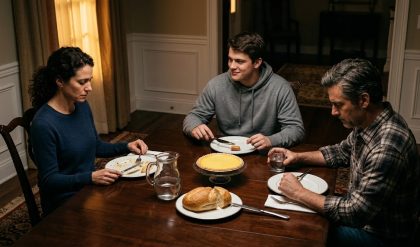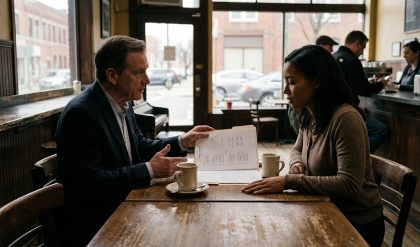
“After my graduation, I quietly moved my grandparents’ estate into a trust—just in case. Last week, my parents and my sister showed up grinning. “We had the house signed into Ashley’s name. You’re out by Friday.” I just smiled. “You really think I’d let that happen?” Two days later, they came back with movers… and froze when they saw who was standing on the porch, holding the folder.
My name is Emily Carter. I’m twenty-eight, and for most of my life, I was the person in my family who made things easier by learning how to take up less space.
In our coastal Oregon town, my family looked polished from the sidewalk. A two-story house with flower baskets on the porch. My father’s respected hardware store. My mother’s quiet job at the city library. Salt wind in the curtains, gulls crying over the roofs, wet cedar after rain. People smiled at us in the grocery store and said, “You’re so lucky.”
They never saw how luck was rationed.
Ashley did.
Ashley was my younger sister by three years, the long-awaited child, the one my parents handled like glass. Dance lessons meant a private instructor. Europe meant tickets appearing like magic. “Finding herself” meant they funded the search without blinking.
Me? I got lectures. Money was tight. Independence made you stronger. You could not lean on your parents forever.
So at sixteen, I worked evening shifts at a roadside café where my hair smelled like fryer oil and burnt coffee by midnight. I saved for tuition while Ashley saved inspiration boards. I learned that asking for nothing was the safest way to avoid being told I was too much.
For years, I tried to make it sound fair. Ashley needed comfort. I needed discipline. She needed protecting. I was simply strong enough to do without.
Then I grew up.
Not all favoritism is loud. Some of it is written quietly in receipts, missed ceremonies, empty chairs, and who gets rescued before they even ask.
My undergraduate graduation still sits in me like a bruise. My parents arrived almost an hour late because Ashley had a costume emergency before a performance. They took a few rushed photos, said they were proud, and left before the ceremony ended. When I told them I had been accepted into the MBA program at the University of Washington, my father barely looked up.
“Good,” he said. “But don’t expect us to help.”
So I didn’t.
I worked through that MBA like someone running from the life she was born into. Scholarships. Part-time jobs. Marketing consulting for local businesses. Full-time coursework stacked on top of forty-hour weeks. At 1:12 a.m. on most nights, I was still answering client emails under a desk lamp while Seattle rain clicked against the window.
Graduation day came bright and loud, full of applause, camera flashes, and families crying happy tears. I walked across the stage and heard my friends cheering.
The seats reserved for my family were empty.
What hurt was not the shock. What hurt was that there was none.
After the ceremony, while other graduates posed beneath the big UW building, my phone rang. Oregon number. Samuel Pierce, my maternal grandparents’ attorney.
“Emily,” he said, calm as a notarized page, “your grandparents left their entire estate to you. We need to meet.”
I stopped walking.
Not because of the money. I had not even asked how much. I stopped because Harold and Margaret Lewis were the only people in my family who had ever loved me without conditions.
Their seaside home had warm brick walls, a wide porch facing the ocean, and a rose garden that exploded every summer like it had something to prove. As a teenager, I escaped there almost every weekend. I repaired fences with Grandpa. I baked pies with Grandma. I sat at their kitchen table while they listened without trying to reshape me into someone easier to love.
At their house, I never had to earn gentleness.
I just had it.
Samuel and I met three days later at Pierce & Vale Legal Services. He laid out the will, the deed history, the estate inventory, and my grandparents’ handwritten letter in a neat row across his conference table. The documents smelled faintly of toner and old paper. Every page had my name on it.
The Lewis Seaside Residence. The investment account. The savings bonds. The rose garden parcel. All of it.
Then Samuel looked at me over his glasses and said, “Emily, I need to ask this carefully. Are your parents aware?”
I laughed once, but nothing about it was funny.
By 4:30 p.m. that same Friday, we had started the trust paperwork. By the following Wednesday, Samuel had filed the transfer documents, recorded the trust certificate, and locked the estate under the Carter-Lewis Family Trust with me as sole trustee. I kept copies of the trust agreement, the recorded deed, the probate closing letter, and my grandparents’ original signed instructions in a fireproof box.
I did not do it to punish anyone.
I did it because I finally knew my family.
Greed rarely walks in wearing a mask. Most of the time, it arrives smiling, calling itself concern, fairness, or what your grandparents would have wanted.
Last week, my parents and Ashley proved it.
They came to the seaside house on a gray afternoon while rain tapped against the porch roof and the ocean air made the brass doorknob cold under my hand. Ashley wore cream cashmere and that soft little smile she used whenever she had already been given what she wanted. My mother held a folder against her chest. My father stood behind them like he was there to enforce a decision, not discuss one.
“We need to talk,” he said.
My stomach went still.
They sat in my grandparents’ living room like they owned the grief in it. Ashley crossed her legs under Grandma’s blue quilt. My mother would not look at the framed photo of Harold and Margaret on the mantel.
Then my father said it.
“We had the house signed into Ashley’s name. You’re out by Friday.”
The room went strangely quiet. The grandfather clock ticked. Rainwater slid down the window glass. Ashley’s smile widened just enough for me to see the cruelty under it.
“You don’t even live here full-time,” she said. “And honestly, Em, you’ve always been independent. This house makes more sense for me.”
My fingers curled around the arm of Grandpa’s chair. For one ugly second, I imagined standing up and throwing every one of them out with my bare hands. Instead, I let the rage go cold.
“Signed by whom?” I asked.
My mother opened the folder and showed me a paper with Ashley’s name printed in bold near the top. A quitclaim deed. A notary stamp. My father’s signature. My mother’s signature.
Not mine.
I looked at the paper, then at Ashley. “You really think I’d let that happen?”
My father’s face hardened. “Don’t make this dramatic.”
“I’m not.” I smiled. “You are.”
Nobody spoke for a moment. My mother’s thumb kept rubbing the edge of the folder. Ashley glanced at my father, then back at me, as if waiting for me to cry, beg, or fold the way I had been trained to.
But training breaks when the student finally sees the lesson.
Two days later, they came back with movers.
A white truck groaned to a stop in the gravel drive at 9:07 a.m. The side door rattled open. Men in work gloves stepped down, carrying pads, straps, and blank inventory stickers. Ashley climbed out behind them holding a travel mug, smiling like she had arrived for a home makeover.
My father pointed toward the porch. My mother stayed by the truck, pale but silent.
Then Ashley saw me standing at the top step.
And behind me, Samuel Pierce stepped out of the front door in a charcoal suit, holding the blue legal folder against his chest.
→
Samuel’s voice carried across the porch like a judge reading a verdict. “Good morning. I’m Samuel Pierce, counsel for the Carter-Lewis Family Trust. This property, along with all assets of the late Harold and Margaret Lewis, was placed into an irrevocable trust six months ago with Emily Carter as the sole trustee and beneficiary.”
He opened the folder and held up the recorded deed, the trust certificate, and my grandparents’ handwritten letter — the one that explicitly stated: “Everything we have built is for Emily. She alone decides its future.”
Ashley’s travel mug slipped from her fingers and shattered on the gravel. My mother’s face went ghostly white. My father’s mouth opened, but no sound came out.
“You forged documents,” Samuel continued calmly, “attempted an illegal title transfer, and brought movers onto private property without permission. These actions constitute fraud, trespass, and conversion. The sheriff’s department has already been notified.”
Two cruisers rolled up the driveway, lights flashing but sirens silent. Deputies stepped out, hands resting near their belts, eyes scanning the movers who suddenly looked very interested in the ground.
My father finally found his voice. “This is family business—”
“No,” I said, stepping forward. My voice was quiet, but it cut through the salt air. “This is my house. The one Grandpa taught me to repair. The one Grandma baked pies with me in. The one you never visited unless you needed something. You didn’t just try to steal from me. You tried to erase the only place I was ever truly loved.”
Ashley started crying — the pretty kind of tears she used when she wanted rescue. “Em, please… we’re sisters…”
I looked at her for a long moment. “Sisters don’t evict each other from their only safe home.”
The deputies served the cease-and-desist and trespass warnings. The movers were sent away empty-handed. My family stood on the gravel like strangers who had wandered onto the wrong property.
As they were escorted off the land, my mother turned back once, eyes desperate. “Emily… we’re still your parents.”
I stood on the porch beside Samuel, the ocean wind tugging at my coat.
“You were,” I said. “But family isn’t a title you keep when you treat blood like a burden.”
The house stayed mine. I turned the upstairs bedrooms into a scholarship residency for young women who had been told they were “too much” or “not enough.” The rose garden bloomed brighter that summer than it had in years.
My parents sent letters. Ashley left voicemails. I never answered.
Some tables were never meant for you. So you build your own — with room for everyone who was once told they didn’t belong.
And you make sure the door stays open… for everyone except those who tried to lock you out.”