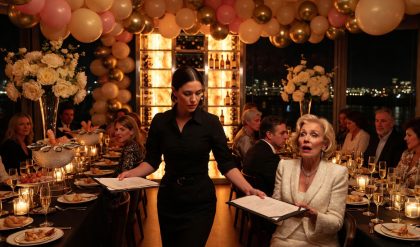
“The jury is still out.”
They talked for three hours. About business. About old movies. About the ramen shop in Hell’s Kitchen they both loved. About the fact that Zara grew up in a small Ohio town where people measured success by how far you could get without forgetting who packed your first suitcase.
Kieran told her Luminary had been born in a garage after he watched his mother struggle with medical software so confusing it made her cry.
“I wanted to build technology that helped people instead of humiliating them,” he said.
For the first time, Zara saw the man behind the magazine covers.
When dessert arrived, Kieran leaned in.
“Show me why I should care about you, Zara Nightingale.”
The question was too personal.
The air changed.
“That sounds dangerously close to flirting, Mr. Frost.”
“It is.”
“I start working for you on Monday.”
“I know.”
“That makes this complicated.”
“Yes,” he said. “But some complications are worth approaching carefully.”
She should have walked away then. Maybe a safer woman would have.
But Zara had spent her life choosing sensible doors, and this one felt like it opened onto lightning.
At work, they were careful. Painfully careful.
Zara built her reputation without leaning on his name. She arrived early, stayed late, challenged executives twice her age, and turned Luminary’s confusing AI launch into the company’s biggest consumer success.
In a boardroom packed with skeptical men, she stood before a screen and said, “The problem isn’t the product. It’s that you’re explaining genius like a tax form.”
Rowan Archer, Luminary’s CFO and Kieran’s oldest friend, laughed first.
Then Kieran said, “Give her the campaign.”
The campaign doubled projections.
Industry magazines praised Luminary for making artificial intelligence feel human. Kieran credited Zara publicly, carefully, without a hint of favoritism.
But privately, their weekly strategy sessions became something else.
They would sit in his office after everyone had gone home, takeout containers scattered across polished tables, city lights blinking beyond the glass. They talked about markets and meaning. Growth and fear. Failure and family.
One Wednesday night, Zara stood at the whiteboard arguing about Luminary’s European expansion.
“You’re treating Europe like a single audience,” she said. “Berlin and Barcelona do not dream in the same language.”
Kieran rose and came to stand beside her. “So we localize by country?”
“By culture,” she corrected, turning.
He was too close.
She could smell cedar and cold rain on his shirt. His eyes dropped to her mouth, then returned to hers.
“The ROI would…” he prompted softly.
She forgot what ROI stood for.
“Kieran.”
“I’m falling in love with you,” he said. “And I don’t know what to do about it.”
There were a thousand reasons not to kiss him.
Zara knew every one.
She kissed him anyway.
Part 2
At first, secrecy felt like protection.
By day, Zara and Kieran were CEO and strategist. He gave her hard questions. She gave him better answers. In meetings, they kept their distance so cleanly that no one could accuse her of anything except brilliance.
By night, they became themselves.
He cooked badly in his penthouse kitchen and pretended it was intentional. She made him listen to old soul records while they ate on the floor. He took her to his lake house in the Adirondacks, where the air smelled like pine and the world felt far enough away to forgive them.
Under a sky crowded with stars, Zara asked the question she had avoided for months.
“Do you ever think we should stop hiding?”
Kieran’s fingers moved through her hair. “Every time I want to take your hand in public.”
“Then why don’t we?”
“Because people respect you right now for your work. I won’t let them turn your talent into gossip.”
“How long does that last?”
“Not forever,” he promised. “Just until your name is untouchable.”
She wanted to believe him.
Maybe that was the first mistake. Not loving him, but trusting the word “until” when it came from a man who had built his life around delay, control, and strategy.
The first crack appeared at Luminary’s annual investor gala at the Metropolitan Museum of Art.
Zara arrived alone in an emerald gown that made Talia clap when she saw it.
“You look like a woman who could either win an award or ruin a man’s life,” Talia said.
“Tonight I’m aiming for networking.”
“Sure. And I’m aiming for emotional maturity.”
The gala was breathtaking. Champagne shimmered beneath ancient stone. Investors gathered like royalty around the Temple of Dendur. Screens displayed Luminary products Zara had helped shape, while string music floated above conversations worth millions.
Kieran stood across the room, tuxedo sharp, smile practiced, surrounded by people who needed something from him.
Zara watched him with the ache of loving someone everyone else thought they owned a piece of.
Rowan appeared beside her with two glasses of champagne.
“All this money in one room,” he said, “and everyone pretending they’re here for the technology.”
“Isn’t the technology what makes the money?”
“In theory.”
His gaze moved toward a silver-haired man near the north wall.
“Maxwell Sinclair,” Rowan said. “Luminary’s largest individual investor. Brilliant. Ruthless. Thinks loyalty is something you buy and invoice quarterly.”
Zara followed his stare. Maxwell Sinclair commanded attention without raising his voice. Beside him stood a tall blonde woman in a white satin dress, elegant enough to make the room adjust around her.
“And that,” Rowan said, “is Vivien Sinclair.”
Zara felt something cold move under her ribs.
“His daughter?”
“Harvard MBA. Venture capital. Old money with a better haircut. Maxwell has been floating the idea of her and Kieran as a power match for months.”
Zara forced her face still. “Kieran isn’t a stock to be merged.”
“No,” Rowan said quietly. “But Maxwell thinks everyone is.”
For the rest of the night, Maxwell arranged the room like a chessboard.
Kieran beside Vivien for photos.
Kieran beside Vivien at dinner.
Kieran beside Vivien when the Singapore investors arrived.
Vivien laughed at the right moments. Touched his arm with casual possession. Looked like she belonged in every room Zara had ever felt she had to earn her way into.
Near midnight, Zara slipped into a quiet gallery to breathe.
Kieran found her there.
“I’ve been trying to get a moment alone with you all night,” he said.
“You looked occupied.”
“Maxwell is pushing something I don’t want.”
“Vivien?”
His face softened. “Zara.”
“She fits your world.”
“She doesn’t fit me.”
“Would she be better for Luminary?”
The pause was less than a second.
It still cut her.
“On paper, maybe,” he admitted. “But I don’t make personal decisions on paper.”
She wanted to believe him again.
Then Vivien appeared in the gallery entrance.
“There you are, Kieran. Daddy needs you.”
Daddy.
The word landed like a claim.
Kieran’s expression sealed shut. “Of course.”
He turned to Zara, voice formal. “Excellent work tonight, Miss Nightingale.”
“Thank you, Mr. Frost.”
Vivien walked away with her hand on Kieran’s arm.
Zara watched them go, understanding for the first time that secrecy did not just protect love.
It also made love easy to deny.
Three weeks later, Zara sat in their favorite café waiting for him.
Kieran was thirty minutes late, which meant something was wrong. He was never late. Not for board meetings. Not for flights. Not for dinner with her.
She opened the news on her phone because silence was becoming unbearable.
The headline stopped her heart.
Tech Titan Kieran Frost Engaged to Vivien Sinclair in Billion-Dollar Alliance
There was a photo.
Vivien’s hand on Kieran’s chest. Diamond catching the camera flash. Kieran’s smile polished and unreadable.
The caption said the engagement had been announced the night before at a private dinner at the Sinclair estate.
Zara stared until the letters blurred.
Then Kieran texted.
Emergency board meeting. Need to reschedule. I’m sorry.
Not I can explain.
Not you saw the news.
Not I love you.
Just I’m sorry.
The apartment was dark when she got home. Talia found her sitting on the bedroom floor in her coat.
“Oh, honey,” Talia whispered, seeing the phone in Zara’s hand.
“I was stupid.”
“No.”
“I thought I was different.”
“You were.”
“Not different enough.”
The next morning, Zara went to work.
She put on concealer over eyes that had not slept. She wore a navy sheath dress. She carried a tablet. She nodded at colleagues whispering congratulations about “the wedding of the decade.”
Rowan stopped her near the elevator.
“You heard.”
“Yes.”
“He was ambushed,” Rowan said. “Maxwell announced it in front of everyone. Kieran didn’t—”
“Don’t.” Her voice was calm enough to terrify them both. “He is a grown man. Billionaire CEOs do not accidentally become engaged.”
At 6:17 p.m., Kieran called her to his office.
He looked exhausted. Beautiful. Cruel in the way only beloved people can be cruel when they are trying to survive their own choices.
“This isn’t how I wanted you to find out,” he said.
“But it is how I found out.”
“Maxwell forced the announcement.”
“And the ring forced itself onto her finger?”
His jaw tightened. “The company needs this alliance.”
“The company,” Zara repeated.
“There can’t be an us anymore.”
The sentence emptied the room.
Zara looked at him and saw, with horrible clarity, not the man who had loved her under stars, but the CEO who could convert heartbreak into strategy before breakfast.
“Did you ever love me?”
His eyes flickered.
“It doesn’t matter now.”
That was when something inside her became quiet.
Not healed.
Not fine.
Quiet.
“No,” she said. “I suppose it doesn’t.”
She turned to leave.
“Zara.”
She stopped.
“I need you to stay professional. There will be press around the wedding. Marketing will need to coordinate messaging.”
Slowly, she looked back.
“You want me to market your wedding?”
“I expect you to do your job.”
She nodded once.
“I will, Mr. Frost.”
For six months, Zara did exactly that.
She worked.
She built campaigns. Led meetings. Closed partnerships. Made Luminary look humane while feeling less human every day.
The world fell in love with Kieran and Vivien. Magazines called them the future of American innovation. Society pages praised her elegance and his intensity. Investors toasted the marriage before it happened.
Zara saved every scream for the shower.
One night, long after midnight, she opened a resignation letter on her computer.
Then she closed it.
Not yet.
Leaving then would feel like running. She would not let heartbreak evict her from a career she had earned.
So she waited.
She took calls from recruiters. Negotiated quietly. Built a plan.
By the time wedding week arrived, Zara had accepted an offer from a rival firm, secured enough savings to breathe, and packed the framed campaign awards from her office into a cardboard box.
On Friday morning, forty-two hours before Kieran Frost was scheduled to marry Vivien Sinclair in front of four hundred guests at a private estate in the Hamptons, Zara printed her resignation.
Then she walked into his office.
And told him the truth.
Part 3
Kieran stared at Zara like her seven words had split him open.
“I’m still in love with you,” she had said.
Now neither of them seemed able to breathe.
“I’m sorry,” Zara said quickly. “That was inappropriate. Please disregard it.”
“Say it again.”
Her throat tightened. “What?”
“Say it again.”
He came around the desk slowly, as if moving too fast might scare the truth back into hiding.
She should have left. Her pride begged her to leave. Instead, she stood her ground.
“I’m still in love with you,” she said. “I have tried not to be. I have tried everything. But I can’t stay here and pretend I’m fine while you marry her.”
Kieran stopped inches away.
“Why now?” His voice was almost broken. “Why today?”
“Because leaving without saying it felt like one last lie. And I’m tired of letting your choices make me smaller.”
The words hit him. She saw it.
For once, Kieran Frost had no strategy.
“I’ve been living a lie since the day I let you go,” he said.
Zara’s pulse faltered.
“No.”
“Yes.”
“You don’t get to say that now.”
“I know.”
“You are getting married in two days.”
“I know.”
“You chose her.”
“I chose fear,” he said. “I dressed it up as duty. I called it leadership. I told myself Luminary needed the Sinclair alliance, that I could become the man everyone expected me to be. But every morning I woke up beside the consequences of losing you, and every morning I hated myself a little more.”
Zara stepped back.
“Words are easy, Kieran. You were always good with words when no one else could hear them.”
His face changed. Pain, yes. But also acceptance.
“You’re right.”
That surprised her more than a denial would have.
He picked up her resignation letter at last.
“I won’t accept this.”
“That is not your decision.”
“No,” he said. “It isn’t. But I won’t let you disappear because I failed you.”
“I’m not disappearing. I’m choosing myself.”
“Then let me choose you too.”
The office door opened.
No knock.
Vivien Sinclair stood in the doorway in a cream suit, blonde hair smooth as a threat. Behind her, Kieran’s assistant hovered in horror.
Vivien’s eyes took in the letter, the closeness, the wreckage on both their faces.
“Well,” she said. “At least now the rumors are emotionally accurate.”
Zara closed her eyes. “I should go.”
“No,” Kieran said.
Vivien lifted one perfect eyebrow. “Brave timing, Kieran. Forty-two hours before the ceremony.”
“I was going to call you.”
“I’m sure. Right after you finished destroying your marketing director’s life for a second time?”
Zara looked up sharply.
Vivien’s gaze moved to her. It was cool, but not unkind.
“Oh, don’t look so surprised. I have eyes. I also have a father who believes private investigators are a form of parenting.”
Kieran went still. “Maxwell knows?”
“Maxwell suspects. Which, for him, is the same as knowing with worse manners.”
“I never wanted to humiliate you,” Kieran said.
Vivien laughed once. “Please. You think I wanted this wedding?”
The silence shifted.
Kieran blinked. “You don’t?”
“Kieran, we have spent more time with attorneys than with each other. Our wedding planner knows my coffee order. You do not.”
Despite herself, Zara almost laughed.
Vivien crossed her arms. “This marriage was my father’s idea. A clean alliance. Sinclair capital. Luminary innovation. Two attractive people in expensive clothes waving from the balcony of capitalism.”
“Then why agree?” Zara asked.
Vivien looked at her, and for the first time Zara saw exhaustion beneath the elegance.
“Because daughters of men like Maxwell Sinclair are trained early to mistake obedience for intelligence.”
The sentence landed harder than any insult.
Vivien turned back to Kieran. “You want out. I want out. The problem is my father.”
“If we cancel, he pulls funding,” Kieran said.
“Maybe. Or maybe he blusters, threatens, calls three newspapers, and then realizes Luminary is still the best investment in his portfolio.”
“He’ll come after you.”
“He has been coming after me since I was twelve and said I didn’t want to play tennis at the club.”
Kieran exhaled slowly. “Vivien, I’m sorry.”
“I believe you,” she said. “And I accept your apology only because I was never in love with you either.”
Then she looked at Zara.
“As for you, Miss Nightingale, make sure he earns the second chance before you hand it over.”
“I haven’t handed over anything.”
“Good.”
Vivien stepped farther into the room and shut the door.
For the next hour, they did not discuss love.
They discussed war.
Statements. Investors. Legal exposure. Board optics. Media strategy. Maxwell Sinclair’s predictable fury and how to contain it.
Zara, despite herself, began solving problems.
“No vague language,” she said. “People smell blood when statements sound sanitized. Use mutual respect. Acknowledge the business partnership. Make it clear the marriage cancellation does not affect Luminary’s operational structure.”
Vivien studied her. “You’re annoyingly good.”
“I know.”
Kieran looked at Zara with something like wonder and regret braided together.
She ignored it.
By noon, Vivien had called her attorney. By two, Rowan was in the office swearing under his breath while drafting investor talking points. By four, the board had been informed.
By six, Maxwell Sinclair exploded.
He arrived at Luminary like a storm in a tailored coat.
“You selfish little fools,” he said, voice cold enough to frost glass. “Do you understand what you are throwing away?”
“My wedding,” Vivien said. “So yes.”
Maxwell’s eyes flashed toward Zara. “And you. The employee.”
Kieran stepped forward. “Careful.”
Zara raised a hand. “No. Let him.”
Maxwell smiled without warmth. “You think this is a fairy tale? You think love beats capital?”
“No,” Zara said. “But I think a company that needs a forced marriage to survive deserves to fail.”
Rowan muttered, “Damn.”
Maxwell’s face hardened.
Zara continued, “Luminary’s value was never your dinner-table arrangement. It’s the product. The people. The trust customers have in what we build. If your investment depends on controlling your daughter’s life and Kieran’s marriage, then it isn’t partnership. It’s ransom.”
No one moved.
Not even Kieran.
Vivien looked at Zara as if she had just decided she liked her.
Maxwell turned to Kieran. “If you let this woman speak for you, you are weaker than I thought.”
Kieran’s voice was steady.
“She isn’t speaking for me. She’s telling the truth.”
Maxwell left with threats.
The next morning, the cancellation broke across business media.
The official statement was elegant, brief, and impossible to twist:
Kieran Frost and Vivien Sinclair have mutually decided not to proceed with their wedding. Their respect for each other remains strong, and Luminary Innovations and Sinclair Holdings will continue to evaluate business opportunities on merit, independent of personal arrangements.
The internet devoured it anyway.
Some called it a scandal. Some called it a strategy failure. Some blamed Vivien. Others blamed Kieran. A few anonymous accounts, inevitably, found Zara’s name and tried to build a story around it.
But Vivien did something no one expected.
She gave one interview.
One.
Sitting across from a respected financial journalist, she smiled politely and said, “I will not marry to stabilize a portfolio. Neither should any woman. Neither should any man.”
By sunset, she was a feminist icon, Maxwell Sinclair was furious, and Luminary’s stock dipped for exactly six hours before climbing again after customers began praising the company’s independence.
Zara watched it all from her apartment, where she had taken two weeks of leave and refused every call except Talia’s.
On the third day, someone knocked.
She opened the door to find Kieran in jeans, a blue shirt, and no armor at all.
“I know you asked for space,” he said. “I’ll leave if you want me to. But there’s something I need to say without an office between us.”
Zara leaned against the doorframe. “Say it.”
“I was a coward.”
She said nothing.
“I told myself I was protecting the company. Protecting your reputation. Protecting the future. But the truth is, loving you made me vulnerable in a way I didn’t know how to survive. Maxwell offered me a life that made sense on paper, so I chose paper over the only thing that ever made me feel alive.”
Her eyes burned. She hated that they burned.
“I don’t expect forgiveness,” he continued. “Not now. Maybe not ever. But I am going to become the kind of man who would have chosen you the first time. Whether you take me back or not.”
The old Zara would have collapsed into him.
The new Zara stepped aside slowly.
“I was making tea,” she said. “You can have one cup.”
His relief was painful to witness.
They talked for four hours at her kitchen table.
Not like lovers. Not yet.
Like two people standing in the ruins, deciding what could be rebuilt and what should remain rubble.
Zara told him she was leaving Luminary.
His face tightened, but he nodded.
“You should,” he said. “Not because I want you gone. Because you deserve a room where no one wonders if you earned the chair.”
“I accepted an offer from Brightline.”
“You’ll be brilliant there.”
“I know.”
He smiled faintly. “Good.”
Six months later, Zara did not work at Brightline anymore.
She had left after realizing she was tired of building other people’s visions.
So she built her own.
Nightingale Strategies launched from a rented loft in SoHo with four employees, mismatched desks, and a coffee machine that sounded like it was fighting for its life. Her first clients were mid-sized companies with products that mattered and messaging that didn’t.
She helped a healthcare startup speak to patients instead of investors. A climate-tech firm explain hope without sounding naive. A children’s education app become less addictive and more useful.
Her company grew because Zara had learned the difference between attention and trust.
Kieran did not invest.
He offered once. She declined before he finished the sentence.
“I need this to be mine,” she said.
“I know,” he replied. “That’s why I asked only once.”
He became a client instead.
Not immediately.
First, he spent months proving he could respect boundaries. No surprise visits. No pressure. No grand gestures designed to make forgiveness look romantic from the outside.
He showed up when invited. Left when asked. Apologized without defending himself. Listened without trying to win.
One evening, almost a year after the canceled wedding, Zara found him at the launch party for Nightingale Strategies, standing near the back with Rowan, watching her give a toast under rooftop string lights.
“To authentic connections,” Zara said, raising her glass. “In business, in life, and in every story brave enough to tell the truth.”
Kieran lifted his glass.
After the applause, he found her by the railing.
“You were magnificent,” he said.
“I know.”
He laughed softly. “I deserved that.”
“You did.”
Below them, New York glowed with a million windows, each one hiding a story no headline would ever fully understand.
“Luminary’s board approved the partnership,” he said. “If you still want it.”
Zara studied him. “You’re comfortable with my company telling yours when it’s wrong?”
“I’m counting on it.”
“And you understand I report to myself?”
“That,” he said, “is one of my favorite things about you.”
She looked away before her smile betrayed her.
“Kieran.”
“Yes?”
“I’m still scared.”
“So am I.”
That honesty mattered more than confidence ever had.
She took his hand in public for the first time.
No hiding. No coded messages. No footnotes.
Just a choice.
They married two years later in a small ceremony at his lake house, not because investors approved, not because society pages demanded a photo, but because one morning Zara looked at him making terrible pancakes in her kitchen and realized peace could be more powerful than fireworks.
Vivien came to the wedding alone, wearing red and looking spectacular.
“I hope he’s worth all this trouble,” she told Zara.
“He’s learning to be.”
“Good. Men should be assigned homework.”
Maxwell Sinclair did not attend.
No one missed him.
Years later, on an autumn evening, Zara sat at a long farmhouse table in the Adirondacks while her children argued over who got the last piece of cornbread.
Emma and Lily, twins with copper hair and Kieran’s blue eyes, were building a pillow fort empire in the living room. Ethan was explaining, with great seriousness, why dragons needed Wi-Fi. Baby Alexander sat in his high chair, wearing more pasta than he had eaten.
Kieran watched the chaos with reverence.
Every night at dinner, they played a game Zara had started when the twins were little.
Rose and thorn.
Your best part of the day. Your hardest part.
“My rose,” Emma announced, “is that Daddy let us use the fancy blankets for the fort.”
“My thorn,” Lily said, “is that Ethan said my dragon rules were unrealistic.”
“They were,” Ethan said.
“Dragons are not real.”
“Then how can their rules be unrealistic?”
Zara laughed so hard she had to cover her mouth.
“Mommy’s turn,” Emma said.
Zara looked around the table. At the children. At the man feeding pasta to a baby while mediating dragon law. At the life that had grown from the day she walked into an office intending to leave forever.
“My rose,” she said, “is this. Right now. All of us.”
“No thorn?” Lily asked.
“Not today.”
Later, after bedtime stories and whispered goodnights, Zara and Kieran sat on the porch swing under a blanket. The lake was black and silver beneath the moon.
“Do you ever think about it?” Kieran asked.
“The office?”
“The seven words.”
Zara leaned into him. “Sometimes.”
“If you hadn’t said them…”
“I would have built a good life anyway,” she said.
He nodded, accepting it. Loving her enough now not to pretend he was the only possible ending.
“But,” she added, “I’m grateful I said them.”
He kissed her hair.
“So am I.”
The stars hung bright above them, patient and clear.
Once, Zara had believed love meant being chosen loudly enough to erase every doubt.
Now she knew better.
Love was not one dramatic choice made in an office.
It was the choice after that.
And the one after that.
And every quiet morning when two people woke up and decided, again, to put truth before fear.
THE END